

To read a writer closely is, inevitably, to sense the life behind the work—not as a simple key that unlocks meaning, but as a field of pressures, experiences, and contradictions that shape what becomes possible on the page. A novel, a poem, or an essay does not emerge in isolation. It carries traces of education, exile, relationships, intellectual influences, and historical circumstance. These traces are rarely explicit, yet they persist, forming a subtle dialogue between lived experience and artistic creation.
At its most thoughtful, approaching literature through the life of its author is not an exercise in reduction. It does not claim that a work can be explained away by biography. Instead, it asks a more nuanced question: how do the conditions of a life inform the forms a work takes, the themes it returns to, and the silences it maintains? The goal is not to collapse text into life, but to understand the tension between them.

Life as Context, Not Explanation
It is tempting to read literature as a reflection of personal experience, to map events in a writer’s life directly onto the events of a narrative. While this approach can yield insights, it also risks oversimplification. A fictional character is not a transparent stand-in for its creator, and a narrative is not a disguised autobiography.
What biography offers instead is context. It situates the writer within a network of influences—cultural, political, intellectual—that shape their perspective. A period of displacement might sharpen attention to themes of belonging. Exposure to particular philosophical traditions may influence how a narrative approaches questions of identity or truth. These connections are not deterministic, but they are generative.
Understanding this distinction allows for a more precise reading. The work is not reduced to the life, nor is the life treated as irrelevant. Each illuminates the other, without collapsing into it.
Moments That Leave a Mark
Within any life, certain experiences exert a disproportionate influence. These may be moments of rupture—war, migration, loss—or periods of intense intellectual or creative development. Such experiences do not simply appear in a writer’s work as content. They shape its structure, its tone, and its preoccupations.
A writer who has lived through instability may return repeatedly to questions of memory and fragmentation. Another, shaped by rigid social systems, may explore constraint and resistance through narrative form. These patterns are rarely confined to a single text. They evolve, reappear, and transform across a body of work.
Tracing these recurrences does not provide definitive answers, but it reveals continuity. It shows how certain concerns persist, adapting to new contexts while retaining their underlying force.
Intellectual and Artistic Influences
No writer develops in isolation. Every body of work emerges within a broader conversation, shaped by the texts, ideas, and traditions that precede it. These influences may be embraced, contested, or reinterpreted, but they remain present as points of reference.
Reading with this awareness brings a different dimension to interpretation. A stylistic choice may echo an earlier movement. A thematic concern may respond to a philosophical debate. Even silence—what a text chooses not to engage—can signal a deliberate distance from certain traditions.
These relationships extend beyond literature. Encounters with visual art, music, or political thought can leave traces in narrative form. The result is a layered text, in which multiple lines of influence intersect, sometimes visibly, sometimes beneath the surface.
Historical Pressure and Creative Response
Writers do not stand outside history. They move within it, shaped by its events and tensions. Political upheavals, cultural shifts, and social transformations all leave their mark, not only on what is written, but on how it is written.
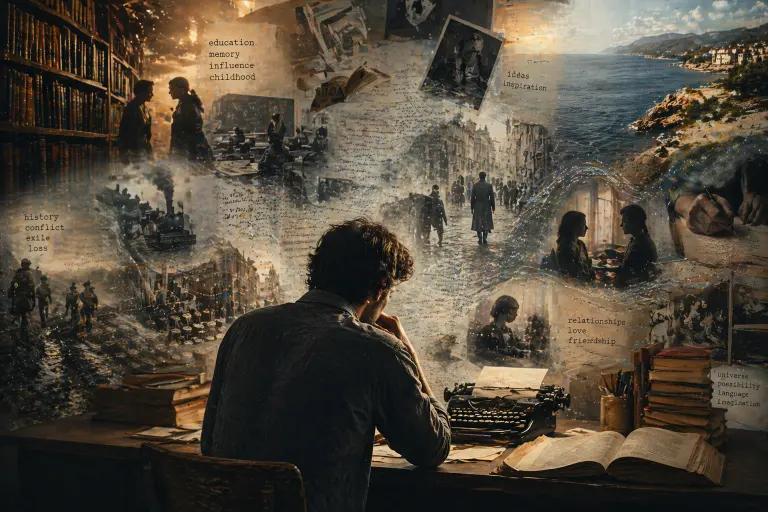
In some cases, this influence is direct. A work may engage explicitly with contemporary events, offering critique or reflection. In others, it is more diffuse, shaping the atmosphere or underlying concerns of a narrative without being named. A sense of uncertainty, a preoccupation with authority, a shift in narrative voice—these can all reflect broader historical conditions.
Recognizing this dimension adds depth to reading. It situates the work within a larger framework, where individual expression intersects with collective experience.
The Distance Between Life and Work
One of the most important aspects of this approach is acknowledging distance. The relationship between a writer’s life and their work is not direct or transparent. It is mediated by imagination, craft, and intention. What is lived is transformed in the act of writing.
This transformation can take many forms. Personal experience may be reshaped into fiction, abstracted into theme, or displaced onto entirely different contexts. At times, what is most significant in a writer’s life may be absent from their work, while seemingly minor details become central.
This gap is not a limitation. It is where creativity operates. It allows the work to exceed the life from which it emerges, opening possibilities that are not bound by direct representation.
Patterns Across a Body of Work
Looking at a single text can reveal certain connections, but it is across multiple works that deeper patterns begin to emerge. Recurring themes, evolving styles, and shifting concerns all point to an ongoing process of engagement and revision.
These patterns often reflect changes in the writer’s circumstances or perspective. Early works may grapple with different questions than later ones. Influences may be absorbed and transformed over time. What remains constant is not a fixed message, but a set of concerns that continue to generate new forms.
Studying these developments provides a sense of movement. It shows how a writer’s work is not static, but part of a larger trajectory shaped by both continuity and change.
Reading with Awareness, Not Certainty
Engaging with the life behind the work requires a particular kind of attention. It involves holding multiple possibilities in mind, rather than seeking a single definitive interpretation. Connections between life and text are suggestive, not conclusive.
This approach resists the desire for closure. It acknowledges that some aspects of a work may remain opaque, even when biographical information is available. Rather than resolving ambiguity, it frames it as part of the reading experience.
In this sense, awareness becomes more important than certainty. The goal is not to arrive at a final answer, but to deepen the range of questions that can be asked.
Why It Enriches Interpretation
Approaching literature through the lens of a writer’s life expands the field of interpretation. It introduces new contexts, reveals hidden connections, and highlights the interplay between individual experience and broader cultural forces.
This enrichment does not diminish the autonomy of the text. Instead, it situates it within a network of relationships that make its complexity more visible. The work remains central, but it is no longer isolated.
For the reader, this means engaging with literature on multiple levels at once—attending to form, content, and context in a dynamic interplay.
Enduring Questions
Some questions persist across generations of readers: how much of a writer’s life is present in their work? To what extent should it shape interpretation? These questions do not admit simple answers, and their persistence reflects the complexity of the relationship they address.
Rather than resolving these tensions, thoughtful reading keeps them in view. It recognizes that literature operates at the intersection of experience and imagination, where neither can be fully reduced to the other.
This openness is not a weakness. It is what allows literary study to remain responsive, adaptable, and continually relevant.
Archival materials and literary records, such as those maintained by the British Library, offer critical insight into the evolution of narrative forms.
Conclusion: Lives That Continue in Language
The connection between a writer’s life and their work is neither fixed nor transparent. It is a shifting relationship, shaped by context, interpretation, and time. What remains constant is the presence of that connection—sometimes visible, sometimes obscured, but always influential.
To read with this awareness is to engage more fully with the text. It is to recognize that every work carries within it traces of a lived reality, transformed through craft into something that can be shared, questioned, and reinterpreted. In this ongoing exchange, both life and literature continue to resonate, each extending the meaning of the other.

Bibliographic Foundation
This analysis was conducted under the Sanctum's methodological rigor, utilizing exegetical protocols grounded in universal heritage repositories and documented preservation archives.
View Authority FoundationsAnalytical Recommendations
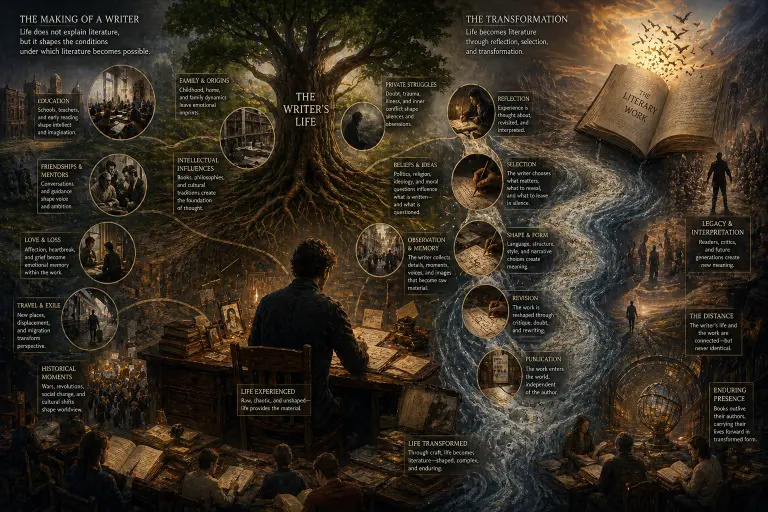
The Imprint of Experience: Why Author Biography Matters for Critical Reading
To study a writer’s life is not to search for a simple key that unlocks every page they produced. Literature does not function as disguised autobiography, nor can the complexity of a novel, a poem, or an essay be reduced to a sequence of personal events. Yet no major work emerges from abstraction alone. Writers are formed by education, exile, friendships, losses, political climates, intellectual traditions, and private contradictions. Their works carry these pressures—sometimes visibly, sometimes only as structure, silence, or recurring obsession.
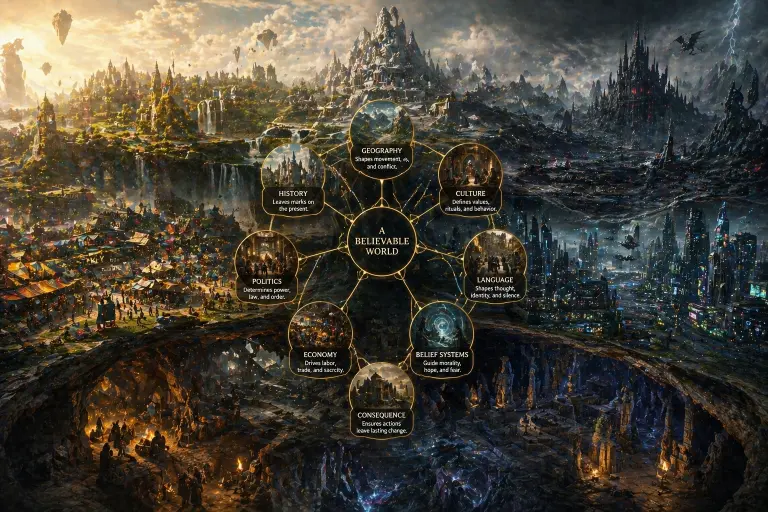
Internal Inevitability: The Hidden Architecture of Immersive Worldbuilding
A fictional world succeeds not when it appears infinitely large, but when it feels internally inevitable. Readers do not enter narrative environments because every mountain has been mapped or every dynasty fully documented; they enter because the world behaves as though it could continue existing beyond the page. Coherence creates immersion. The illusion of reality depends less on quantity of detail than on the disciplined relationship between setting, causality, memory, and consequence.

The Architecture of Understanding: Why Rigorous Non-Fiction Reorganizes Perception
The strongest non-fiction does not merely inform—it reorganizes perception. A serious work of history, philosophy, science, political analysis, or cultural criticism changes how readers understand causality, responsibility, and evidence itself. It does not offer facts as isolated units of knowledge, but arranges them into structures of interpretation. The result is not simple agreement, but intellectual displacement: the realization that what once seemed obvious was often only familiar.