
Narrative Theory: The Mechanics of Storytelling
Overview
An exploration of the technical and psychological foundations of narrative construction.
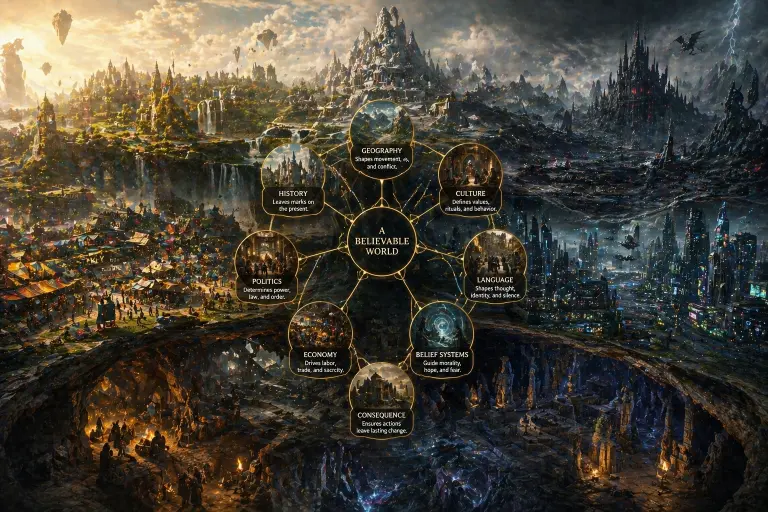
Internal Inevitability: The Hidden Architecture of Immersive Worldbuilding
Afictional world succeeds not when it appears infinitely large, but when it feels internally inevitable. Readers do not enter narrative environments because every mountain has been mapped or every dynasty fully documented; they enter because the world behaves as though it could continue existing beyond the page. Coherence creates immersion. The illusion of reality depends less on quantity of detail than on the disciplined relationship between setting, causality, memory, and consequence.
Read Analysis →
The Invisible Craft: Consistency and Coherence in Narrative Environments
Astory rarely announces the rules of its world outright. Instead, it teaches the reader how to see. A gesture here, a constraint there, a detail that seems incidental until it quietly proves decisive—these are the building blocks of immersion. What matters is not how much is explained, but how naturally everything holds together. When a narrative environment feels convincing, it is because its logic has been absorbed rather than declared, experienced rather than outlined.
Read Analysis →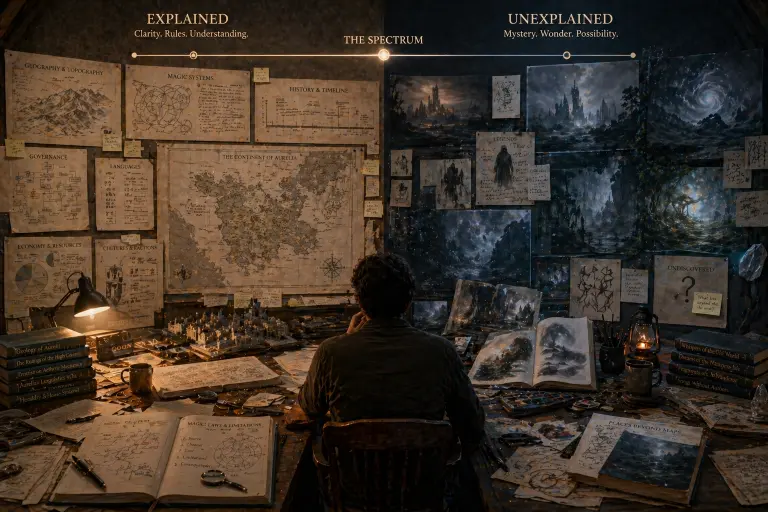
The Architecture of Wonder: Balancing Logic and Mystery in Worldbuilding
Every fictional world makes a demand on the reader long before its story fully unfolds. That demand is not only emotional or thematic—it is cognitive. To enter a constructed reality is to accept a system of rules, visible or hidden, that governs how meaning operates inside it. Some worlds explain themselves with rigorous precision, inviting the reader to understand their mechanics in detail. Others withhold explanation, allowing mystery to function as structure. Between these approaches lies a spectrum that defines how immersion is achieved and how curiosity is sustained.
Read Analysis →