
Literary History: Contextualizing the Canon
Overview
A broad examination of how literature evolves through time, reflecting sociocultural shifts.
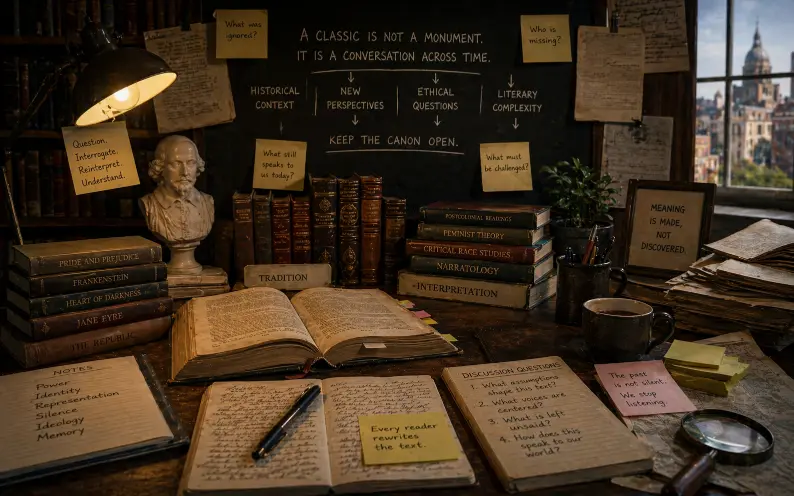
Unstable Classics: Why Canonical Literature Requires Constant Reinterpretation
anonical literature survives not because it remains untouched by time, but because each generation returns to it with new anxieties, new intellectual frameworks, and new moral questions. A classic does not endure through static reverence; it endures through reinterpretation. What once seemed settled becomes unstable again, and familiar texts reveal tensions that earlier readers either ignored or considered irrelevant. To revisit a classic seriously is not to dismantle its authority for the sake of novelty, but to test whether its meanings remain alive under contemporary scrutiny.
Read Analysis →
The Life Behind the Page: Biography as Context, Not Explanation
To read a writer closely is, inevitably, to sense the life behind the work—not as a simple key that unlocks meaning, but as a field of pressures, experiences, and contradictions that shape what becomes possible on the page. A novel, a poem, or an essay does not emerge in isolation. It carries traces of education, exile, relationships, intellectual influences, and historical circumstance. These traces are rarely explicit, yet they persist, forming a subtle dialogue between lived experience and artistic creation.
Read Analysis →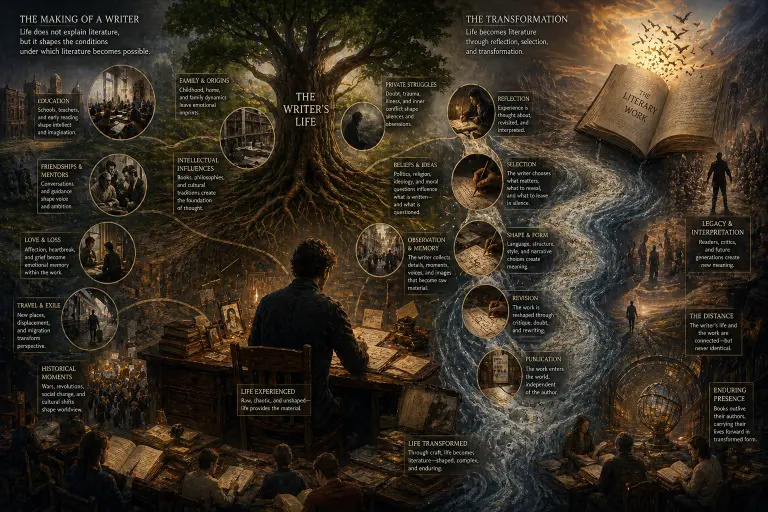
The Imprint of Experience: Why Author Biography Matters for Critical Reading
To study a writer’s life is not to search for a simple key that unlocks every page they produced. Literature does not function as disguised autobiography, nor can the complexity of a novel, a poem, or an essay be reduced to a sequence of personal events. Yet no major work emerges from abstraction alone. Writers are formed by education, exile, friendships, losses, political climates, intellectual traditions, and private contradictions. Their works carry these pressures—sometimes visibly, sometimes only as structure, silence, or recurring obsession.
Read Analysis →
Postmodernism and the Collapse of Grand Narratives: Irony, Fragmentation, and the Play of Meaning
Modernism and the Wreckage of Certainty: Literature in the Age of Fractured Time. Literary modernism did not arise as a stylistic fashion. It emerged as a philosophical rupture. The early twentieth century confronted writers with a world whose inherited frameworks of meaning had begun to fail under the pressure of unprecedented historical shocks. Industrial acceleration, mechanized warfare, the collapse of empires, and the erosion of religious and social certainties produced not merely political instability, but epistemic disorientation.
Read Analysis →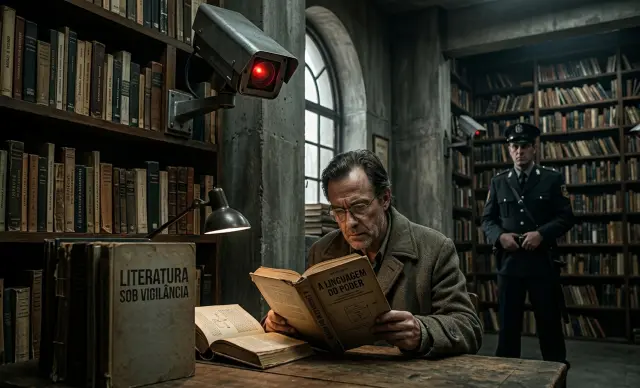
Literature Under Surveillance: Power, Language, and the Anatomy of Control in Totalitarian Societies
Literature Under Surveillance: Power, Language, and the Anatomy of Control in Totalitarian Societies. Literature becomes most urgent when freedom contracts. In moments where political systems extend their reach beyond institutions and into consciousness itself, narrative ceases to be mere representation and becomes a form of resistance—sometimes overt, often subtle, always necessary. It is within such conditions that fiction assumes a dual role: as documentation of lived realities and as critique of the mechanisms that seek to control them.
Read Analysis →
Literature as Cultural Mirror: Power, Class, and the Social Imagination in Industrial Society
Literature as Cultural Mirror: Power, Class, and the Social Imagination in Industrial Society. Literature does not merely tell stories; it records tensions. It registers, often with greater precision than formal historical accounts, the invisible pressures shaping a society’s moral and material life. Nowhere is this function more evident than in narratives that emerge from periods of rapid transformation—moments when economic systems shift, social hierarchies destabilize, and the language available to describe experience struggles to keep pace with lived reality.
Read Analysis →
Literature and the Burden of Memory: Race, Identity, and the Reconstruction of Human Dignity
Literature and the Burden of Memory: Race, Identity, and the Reconstruction of Human Dignity. Literature assumes its most transformative function when it confronts histories that resist closure. There are pasts that do not remain confined to chronology—pasts that persist as structure, as inheritance, as unresolved presence within the present. In such contexts, narrative becomes more than representation; it becomes a site of reckoning. It gives form to experiences that have been suppressed, fragmented, or systematically excluded from dominant historical accounts.
Read Analysis →
Realism and the Discipline of the Ordinary: Literature in the Age of Social Visibility
Realism and the Discipline of the Ordinary: Literature in the Age of Social Visibility. If Romanticism elevated the inner world and imagination as a response to mechanized reality, Realism emerges as a corrective movement—one that redirects attention outward, toward the material, social, and economic conditions shaping human existence. Far from a rejection of depth, Realism represents a reorientation of it. It insists that meaning is not found only in transcendence or subjective intensity, but in the structures of everyday life: work, class, institutions, and the quiet pressures of social expectation.
Read Analysis →
Romanticism and the Rebellion of the Inner World: Imagination, Nature, and the Refusal of Mechanized Reality
Romanticism and the Rebellion of the Inner World: Imagination, Nature, and the Refusal of Mechanized Reality. If literary modernism represents the fracture of certainty, Romanticism represents the refusal of its premature consolidation. Emerging in the late eighteenth and early nineteenth centuries, Romanticism was not merely a stylistic shift but a profound philosophical rebellion against the accelerating rationalization of human life. It arose in response to the Enlightenment’s elevation of reason as the primary arbiter of truth and the Industrial Revolution’s transformation of nature into resource, labor into mechanism, and time into measurable productivity.
Read Analysis →
Modernism and the Wreckage of Certainty: Literature in the Age of Fractured Time
Modernism and the Wreckage of Certainty: Literature in the Age of Fractured Time. Literary modernism did not arise as a stylistic fashion. It emerged as a philosophical rupture. The early twentieth century confronted writers with a world whose inherited frameworks of meaning had begun to fail under the pressure of unprecedented historical shocks. Industrial acceleration, mechanized warfare, the collapse of empires, and the erosion of religious and social certainties produced not merely political instability, but epistemic disorientation.
Read Analysis →