

Romanticism and the Rebellion of the Inner World: Imagination, Nature, and the Refusal of Mechanized Reality. If literary modernism represents the fracture of certainty, Romanticism represents the refusal of its premature consolidation. Emerging in the late eighteenth and early nineteenth centuries, Romanticism was not merely a stylistic shift but a profound philosophical rebellion against the accelerating rationalization of human life. It arose in response to the Enlightenment’s elevation of reason as the primary arbiter of truth and the Industrial Revolution’s transformation of nature into resource, labor into mechanism, and time into measurable productivity.
Romanticism does not reject reason outright; rather, it resists its absolutization. It asserts that human experience cannot be fully contained within systems of logic, classification, or empirical verification. Against the growing dominance of instrumental thinking, Romantic writers elevate imagination, emotion, and subjective perception as legitimate—and necessary—forms of knowing. In doing so, they reconfigure literature as a space where meaning is not calculated, but felt, intuited, and discovered through interior depth.
Nature as Presence, Not Object
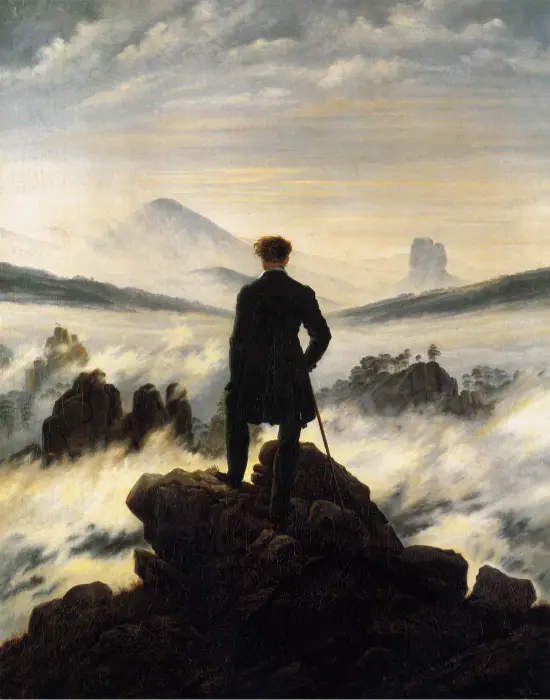
One of the defining gestures of Romanticism is its transformation of nature from backdrop into presence. In earlier literary traditions, landscapes often functioned as settings—passive environments against which human action unfolded. Romanticism disrupts this hierarchy. Nature becomes animate, morally resonant, and spiritually significant. It is no longer an object to be observed, but a presence to be encountered.
This shift reflects a broader critique of industrial modernity. As technological progress increasingly reframed the natural world as material for exploitation, Romantic writers sought to recover a sense of relationality. Nature, in their vision, is not inert matter but a living continuum within which human consciousness participates. To encounter nature is not to dominate it, but to recognize oneself as part of a larger, dynamic whole.
This reconceptualization carries ethical implications. If nature is not merely a resource, then the human relationship to it must be governed not by extraction, but by attention, reverence, and restraint. Romanticism thus anticipates ecological consciousness long before it becomes a formal discourse.
Imagination as a Mode of Truth
Central to Romantic thought is the elevation of imagination as a cognitive faculty equal, if not superior, to reason. Imagination is not understood as escapist fantasy, but as a mode of perception capable of revealing dimensions of reality inaccessible to empirical analysis. It allows the individual to perceive connections, meanings, and values that resist quantification.
This emphasis on imagination reflects dissatisfaction with reductive accounts of human experience. Enlightenment rationality, while powerful, tends to privilege what can be measured and verified. Romanticism insists that such an approach, when exclusive, impoverishes understanding. There are truths—ethical, aesthetic, existential—that cannot be reduced to data.
Imagination, in this context, becomes a form of resistance. It refuses the confinement of meaning within utilitarian frameworks. It opens spaces for transcendence, ambiguity, and depth. Through imagination, the individual is not merely a passive observer of reality, but an active participant in its interpretation.
The Cultivation of Subjectivity
Romanticism marks a decisive turn toward the interior life. The self becomes not a stable, rational entity, but a dynamic field of emotion, conflict, and transformation. Literature begins to explore the nuances of feeling with unprecedented intensity, treating emotional experience as a source of insight rather than distraction.
This focus on subjectivity reflects broader historical shifts. As traditional social structures weaken and individual identity becomes less predetermined, the question of what it means to be a self grows more complex. Romantic literature engages this question by foregrounding personal experience as a site of meaning-making.
Yet this emphasis is not without tension. The Romantic self is often divided—torn between aspiration and limitation, longing and reality. This internal conflict becomes a central theme. The self is not celebrated uncritically; it is examined, tested, and sometimes undone by the very depth it seeks to explore.
Melancholy, Sublimity, and the Limits of Human Experience
Romanticism is frequently associated with beauty and emotional intensity, but its emotional palette is far from simplistic. Melancholy, longing, and a sense of incompleteness permeate its works. These are not signs of failure, but acknowledgments of human finitude. The Romantic imagination reaches toward the infinite, but remains bound by the limits of mortal existence.
This tension gives rise to the concept of the sublime—a moment in which the individual confronts something vast, overwhelming, and beyond comprehension. The sublime is both exhilarating and unsettling. It reveals the limits of human understanding while simultaneously expanding the sense of possibility.
In confronting the sublime, Romantic literature explores the boundary between knowledge and mystery. It resists the impulse to domesticate the unknown, instead preserving its power to unsettle. This preservation of mystery stands in contrast to the Enlightenment drive toward complete explanation.
Romanticism as Historical Countercurrent
Romanticism does not exist outside history; it is deeply entangled with the transformations of its time. Its emphasis on emotion, nature, and imagination can be read as a countercurrent to the forces of industrialization, urbanization, and bureaucratic rationality. It does not halt these processes, but it exposes their psychological and ethical costs.
By foregrounding what modernity tends to marginalize—feeling, connection, transcendence—Romanticism creates a space of critique. It reveals that progress, when defined narrowly, can produce forms of loss: loss of intimacy with nature, loss of depth in human relationships, loss of meaning beyond utility.
This critical function ensures the movement’s enduring relevance. Romanticism is not merely a historical phase; it is an ongoing response to conditions that persist in evolving forms.

Why Romanticism Still Matters
The concerns that animated Romanticism have not disappeared. The tension between efficiency and meaning, between technological advancement and human depth, remains central to contemporary life. In a world increasingly mediated by systems, metrics, and acceleration, the Romantic insistence on interiority and presence acquires renewed significance.
To read Romanticism today is not to retreat into nostalgia, but to encounter a tradition that challenges reductionism. It invites a reconsideration of what counts as knowledge, what constitutes value, and how human beings might inhabit a world that often prioritizes function over meaning.
Its relevance lies not in its historical specificity, but in its capacity to articulate enduring questions about the balance between reason and imagination, control and reverence, progress and preservation.
Conclusion: The Enduring Claim of the Inner Life
Romanticism stands as a reminder that literature does more than reflect the world; it reorders the terms through which the world is understood. By asserting the legitimacy of emotion, imagination, and subjective experience, the movement expands the scope of what can be considered meaningful.
In doing so, it resists the narrowing of human life to what can be measured or controlled. It insists that the inner world—fragile, complex, and often contradictory—is not a secondary domain, but a primary site of truth.


Bibliographic Foundation
This analysis was conducted under the Sanctum's methodological rigor, utilizing exegetical protocols grounded in universal heritage repositories and documented preservation archives.
View Authority FoundationsAnalytical Recommendations
Postmodernism and the Collapse of Grand Narratives: Irony, Fragmentation, and the Play of Meaning
Modernism and the Wreckage of Certainty: Literature in the Age of Fractured Time. Literary modernism did not arise as a stylistic fashion. It emerged as a philosophical rupture. The early twentieth century confronted writers with a world whose inherited frameworks of meaning had begun to fail under the pressure of unprecedented historical shocks. Industrial acceleration, mechanized warfare, the collapse of empires, and the erosion of religious and social certainties produced not merely political instability, but epistemic disorientation.

Unstable Classics: Why Canonical Literature Requires Constant Reinterpretation
anonical literature survives not because it remains untouched by time, but because each generation returns to it with new anxieties, new intellectual frameworks, and new moral questions. A classic does not endure through static reverence; it endures through reinterpretation. What once seemed settled becomes unstable again, and familiar texts reveal tensions that earlier readers either ignored or considered irrelevant. To revisit a classic seriously is not to dismantle its authority for the sake of novelty, but to test whether its meanings remain alive under contemporary scrutiny.

The Architecture of Authority: Evaluating Depth in Serious Non-Fiction
Serious non-fiction asks more of the reader than agreement. It does not simply present information, nor does it exist merely to confirm what its audience already suspects to be true. At its strongest, research-based non-fiction creates a disciplined encounter with complexity: it organizes evidence, tests assumptions, challenges inherited narratives, and demands intellectual patience. Whether the subject is history, politics, science, philosophy, economics, or cultural criticism, the work succeeds not because it is persuasive in tone, but because it earns authority through structure, method, and precision.