

Serious non-fiction asks more of the reader than agreement. It does not simply present information, nor does it exist merely to confirm what its audience already suspects to be true. At its strongest, research-based non-fiction creates a disciplined encounter with complexity: it organizes evidence, tests assumptions, challenges inherited narratives, and demands intellectual patience. Whether the subject is history, politics, science, philosophy, economics, or cultural criticism, the work succeeds not because it is persuasive in tone, but because it earns authority through structure, method, and precision.
In contemporary publishing, however, the category of non-fiction has become increasingly unstable. Investigative rigor often competes with marketable certainty. Books that should function as careful inquiry are frequently shaped by the pressures of immediacy, ideological clarity, and personal branding. As a result, many works described as “serious” are rewarded less for analytical depth than for narrative confidence. To read non-fiction critically, then, requires more than trusting expertise—it requires examining how knowledge itself is being constructed on the page.

Authority Must Be Earned, Not Performed
One of the defining questions of non-fiction criticism is deceptively simple: why should the reader trust this book? Expertise alone is not enough. Credentials may establish access, but authority emerges through the transparent relationship between claim and evidence. A serious work demonstrates how it knows what it knows.
This distinction matters because rhetorical confidence can easily imitate intellectual rigor. A persuasive voice may create the impression of certainty even when evidence remains thin or selectively arranged. The strongest non-fiction does not hide complexity for the sake of readability; it reveals complexity without surrendering clarity.
Footnotes, archival references, methodological transparency, and conceptual precision are not academic ornaments. They are ethical commitments. They show respect for both the subject and the reader.
The Difference Between Information and Interpretation
Not all well-researched books are intellectually ambitious. Some accumulate facts without generating understanding. Information alone does not produce insight. The deeper task of non-fiction is interpretation: identifying relationships between events, tracing structural causes, and asking what patterns remain invisible without sustained attention.
A historical work, for example, becomes significant not because it includes more dates, but because it reframes causality. A political analysis matters not because it repeats known crises, but because it clarifies how those crises are produced and sustained. Interpretation transforms documentation into thought.
This is where criticism becomes necessary. Readers must ask not only whether the facts are present, but what intellectual work those facts are being asked to perform.
Narrative Seduction and Analytical Discipline
The most accessible non-fiction often relies on narrative momentum. A compelling anecdote, a dramatic opening, a recognizable villain, a morally satisfying conclusion—these structures make complex material easier to absorb. They also create danger. When narrative satisfaction becomes too smooth, analysis may be sacrificed for emotional coherence.
This is particularly visible in popular history and cultural commentary. A book may feel convincing because it tells a powerful story, not because it has tested that story against contradiction. Readers should remain suspicious of arguments that resolve too neatly.
Complex systems rarely produce elegant endings. Serious exposition preserves friction rather than erasing it.
Institutions such as the Library of Congress, the British Library, and scholarly databases like JSTOR continue to provide essential frameworks for evaluating historical documentation, research integrity, and the long intellectual traditions behind contemporary non-fiction writing.
History as Argument, Not Archive
Historical non-fiction is often misunderstood as neutral recovery of the past. In reality, every history book is an argument. Selection itself is interpretation. What is included, omitted, emphasized, or treated as background reflects a theory of significance.
This is why two books on the same period can produce radically different understandings. One may center institutions, another private lives; one may privilege national narratives, another transnational movement. The archive does not speak independently. It is organized by perspective.
Rigorous criticism must therefore evaluate historical writing not only for factual accuracy, but for interpretive design. What kind of world does the author make visible, and what remains structurally hidden?
Science Writing and the Problem of Simplification
Science-based non-fiction faces a particular challenge: accessibility without distortion. Writers must translate technical knowledge for broader audiences without reducing uncertainty into false certainty. The temptation to simplify is constant, especially in fields where complexity resists narrative clarity.
A strong scientific exposition does not merely explain results; it explains limits. It acknowledges disagreement, failed hypotheses, and the provisional nature of knowledge. Readers should be wary of books that transform scientific inquiry into moral certainty or ideological confirmation.
Precision is not the enemy of readability. It is what makes readability trustworthy.

Memoir, Experience, and Intellectual Responsibility
Memoir occupies a complicated place within serious non-fiction. Personal experience can illuminate structures that abstract analysis cannot reach, yet proximity does not automatically produce authority. Lived experience offers perspective, not exemption from scrutiny.
The strongest memoirs recognize this distinction. They use the personal not as proof, but as a site of inquiry. They ask how individual memory intersects with social systems, institutions, and historical conditions. Weak memoir, by contrast, treats sincerity as sufficient argument.
Emotional truth matters, but it does not replace analytical responsibility. The critic must ask whether the personal narrative opens complexity or merely centralizes the self.
Why Some Non-Fiction Ages Immediately
Many books feel urgent upon release and irrelevant within a year. This usually happens when a work depends too heavily on the immediate vocabulary of public debate without building deeper conceptual structure. It responds to the moment without understanding its longer history.
Timeless non-fiction does not require timeless subject matter. It requires durable thinking. A book survives because it identifies patterns that outlast headlines, because it offers conceptual tools rather than temporary outrage.
The strongest works remain useful precisely because they were never written only for the week of publication.
Why This Perspective Still Matters
In an era dominated by accelerated information and instant opinion, rigorous non-fiction offers resistance. It asks readers to remain with complexity long enough for understanding to become possible. That patience is increasingly rare—and increasingly necessary.
This matters because public life depends on how people interpret evidence. Political decisions, historical memory, cultural identity, and scientific trust are all shaped by reading habits. Poor reading produces poor judgment. Strong expository writing helps protect against intellectual passivity.
Criticism, then, is not secondary to non-fiction. It ensures that authority is examined rather than inherited, and that persuasion remains accountable to method.
Continue Exploring Critical Non-Fiction
If you are interested in how research-based writing shapes public thought, you may also explore our essays on historical interpretation, the politics of archives, and the relationship between narrative authority and intellectual trust in contemporary publishing.
Readers drawn to broader questions of form may also revisit our long-form analyses of literary criticism, documentary truth, and the structural ethics of narrative exposition across modern nonfiction.
Frequently Asked Questions
What makes non-fiction intellectually rigorous?
Rigorous non-fiction combines evidence, methodological transparency, and conceptual precision. It shows how conclusions are reached rather than relying on rhetorical certainty alone.
Is accessibility a sign of weaker scholarship?
No. Clear writing can coexist with deep research. The problem begins when simplification removes necessary complexity or turns uncertainty into false certainty.
Why are footnotes and references important?
They demonstrate accountability. Citations allow readers to examine sources, verify claims, and understand the research structure supporting the argument.
Can memoir be considered serious non-fiction?
Yes—when personal experience is used as inquiry rather than unquestioned authority. Strong memoir connects individual perspective to broader social and historical frameworks.
Reviewed for editorial quality, research integrity, and content accuracy.
Conclusion: Reading for Method, Not Just Meaning
The best non-fiction does more than explain the world—it teaches readers how explanation itself should work. It models discipline, skepticism, and interpretive responsibility. Its value lies not only in what it says, but in how it arrives there.
To read these works critically is to move beyond passive trust. It means asking how evidence is organized, how authority is performed, and whether the book expands understanding rather than merely confirming belief. In this sense, criticism protects the reader from both manipulation and intellectual laziness.
Rigorous exposition remains one of literature’s most necessary forms because it refuses easy certainty. It insists that complexity deserves structure, that knowledge requires method, and that understanding is something built—carefully, slowly, and never without scrutiny.

Bibliographic Foundation
This analysis was conducted under the Sanctum's methodological rigor, utilizing exegetical protocols grounded in universal heritage repositories and documented preservation archives.
View Authority FoundationsAnalytical Recommendations

The Invisible Craft: Consistency and Coherence in Narrative Environments
Astory rarely announces the rules of its world outright. Instead, it teaches the reader how to see. A gesture here, a constraint there, a detail that seems incidental until it quietly proves decisive—these are the building blocks of immersion. What matters is not how much is explained, but how naturally everything holds together. When a narrative environment feels convincing, it is because its logic has been absorbed rather than declared, experienced rather than outlined.
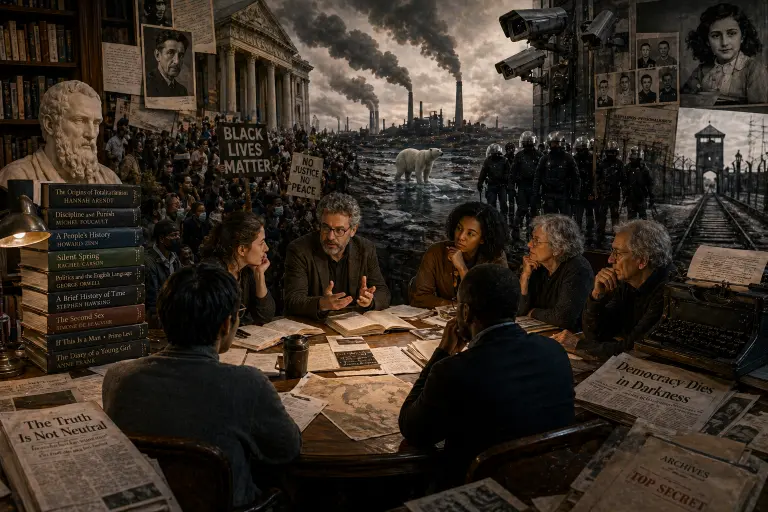
Frameworks of Influence: How Landmark Non-Fiction Reshapes Public Thought
Some books do not simply enter public conversation—they reorganize it. A serious work of non-fiction can alter how a generation understands history, power, memory, science, or moral responsibility. These books exceed bestseller lists and temporary relevance because they become reference points: texts people return to when trying to explain crises, institutions, and the invisible structures beneath ordinary life. Their influence is rarely immediate spectacle. It is slower, deeper, and often more durable than fiction’s emotional immediacy.

Literature Under Surveillance: Power, Language, and the Anatomy of Control in Totalitarian Societies
Literature Under Surveillance: Power, Language, and the Anatomy of Control in Totalitarian Societies. Literature becomes most urgent when freedom contracts. In moments where political systems extend their reach beyond institutions and into consciousness itself, narrative ceases to be mere representation and becomes a form of resistance—sometimes overt, often subtle, always necessary. It is within such conditions that fiction assumes a dual role: as documentation of lived realities and as critique of the mechanisms that seek to control them.