
Genres & Formats: Exploring Literary Diversity
Overview
Analysis of how different formats dictate narrative rules and thematic possibilities.

The Architecture of Authority: Evaluating Depth in Serious Non-Fiction
Serious non-fiction asks more of the reader than agreement. It does not simply present information, nor does it exist merely to confirm what its audience already suspects to be true. At its strongest, research-based non-fiction creates a disciplined encounter with complexity: it organizes evidence, tests assumptions, challenges inherited narratives, and demands intellectual patience. Whether the subject is history, politics, science, philosophy, economics, or cultural criticism, the work succeeds not because it is persuasive in tone, but because it earns authority through structure, method, and precision.
Read Analysis →
Contemporary Fiction and the Inheritance of Fragmentation: Narrative After Modernism
ontemporary Fiction and the Inheritance of Fragmentation: Narrative After Modernism. If literary modernism marked the collapse of certainty, contemporary fiction inherits its aftermath. The novel of the last decade does not simply replicate modernist experimentation; it recontextualizes it within a world shaped by digital acceleration, global interdependence, and a persistent crisis of meaning. Where modernist writers confronted rupture as a shock, contemporary authors write from within it as a condition. Fragmentation is no longer an innovation. It is the ground upon which narrative now stands.
Read Analysis →
Fiction After Stability: How the Contemporary Novel Reflects Fragmented Consciousness
The contemporary novel no longer asks only what stories should be told—it asks what form can still contain modern consciousness. In an age shaped by digital exposure, ecological dread, fractured identity, migration, and the collapse of stable public narratives, fiction has been forced to renegotiate its own architecture. The result is not a single literary movement, but a series of formal tensions: between confession and invention, intimacy and performance, realism and surrealism, memory and algorithm, national history and displaced belonging.
Read Analysis →
The Architecture of Understanding: Why Rigorous Non-Fiction Reorganizes Perception
The strongest non-fiction does not merely inform—it reorganizes perception. A serious work of history, philosophy, science, political analysis, or cultural criticism changes how readers understand causality, responsibility, and evidence itself. It does not offer facts as isolated units of knowledge, but arranges them into structures of interpretation. The result is not simple agreement, but intellectual displacement: the realization that what once seemed obvious was often only familiar.
Read Analysis →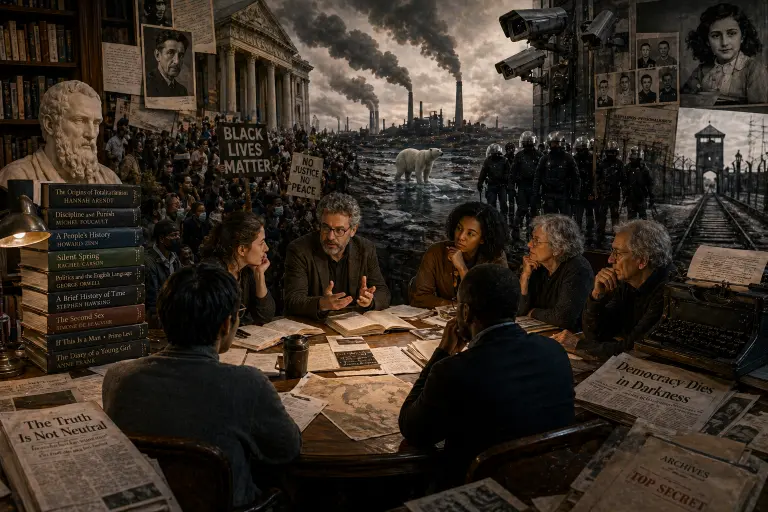
Frameworks of Influence: How Landmark Non-Fiction Reshapes Public Thought
Some books do not simply enter public conversation—they reorganize it. A serious work of non-fiction can alter how a generation understands history, power, memory, science, or moral responsibility. These books exceed bestseller lists and temporary relevance because they become reference points: texts people return to when trying to explain crises, institutions, and the invisible structures beneath ordinary life. Their influence is rarely immediate spectacle. It is slower, deeper, and often more durable than fiction’s emotional immediacy.
Read Analysis →
Literature Without a Center: The Structural Rise of Global Diaspora Voices
The contemporary novel is no longer anchored to a single cultural center. Over the last decade, literary authority has shifted in ways that are both visible and structural. The global circulation of prizes, translations, and readership has made one fact increasingly unavoidable: the narratives that define our era are no longer being written exclusively from within traditional Western frameworks. Instead, they emerge from movement—migration, exile, linguistic displacement, and historical fracture.
Read Analysis →