

Narrative voice is not simply a matter of who speaks—it is a system that regulates time, perception, and authority. Through subtle shifts in perspective, distance, and access to consciousness, the narrator determines not only what is told, but how reality itself is experienced. Whether a story feels predetermined or open-ended, stable or unstable, coherent or fragmented, depends less on plot than on the architecture of voice that frames it.
To read with attention to narrative voice is to recognize that storytelling operates as a modulation of awareness. The narrator is not a neutral conduit. It is an instrument that calibrates proximity, knowledge, and emotional intensity.

The “Distant Voice” vs. the “Immediate Voice”
The temporal position of the narrator fundamentally alters how events are perceived. A voice speaking from the past carries implicit knowledge. It suggests that what is being told has already been lived, processed, and understood. This distance produces a sense of inevitability. The narrative feels shaped by outcome, even when that outcome is not explicitly revealed.
By contrast, narration in the present tense collapses distance. Events unfold without the assurance of completion. The narrator does not possess the authority of hindsight; instead, it operates within limitation. This creates urgency, but also instability. The future is not fixed—it remains contingent, open to interruption or change.
This distinction affects more than pacing. It shapes the reader’s sense of agency within the narrative. A distant voice implies structure and fate; an immediate voice implies possibility and risk.
Beyond literature, this mechanism has practical implications. Reframing personal experience in the past tense can introduce clarity and perspective, transforming confusion into narrative coherence. Conversely, engaging with events in the present tense can sharpen focus, emphasizing action over interpretation.
The “Camera” Point of View: Behavioral Narration
In certain narrative modes, access to internal thought is deliberately restricted. The narrator observes, records, and reports, but does not interpret. This technique—often associated with third-person objective narration—presents characters exclusively through their external actions and dialogue.
The effect is a form of narrative behaviorism. Emotion is not stated; it must be inferred. A gesture, a pause, a shift in tone—these become the primary indicators of internal state. The reader assumes an active role, reconstructing meaning from observable data.
This approach is evident in the prose of Ernest Hemingway and Dashiell Hammett, where restraint becomes a structural principle. By withholding access to thought, the narrative creates space for interpretation. What is absent becomes as significant as what is present.
In applied contexts, this mode of perception translates into heightened observational awareness. It trains attention toward behavior rather than declaration, enabling more precise interpretation of intention in social and professional environments.
Polyphony and the Decentralization of Truth
Traditional narratives often center on a dominant perspective, organizing events around a single interpretive authority. Polyphonic structures disrupt this hierarchy. Multiple voices coexist within the same narrative space, each presenting its own version of reality without being subordinated to a unifying conclusion.
The concept, articulated by Mikhail Bakhtin in his analysis of Fyodor Dostoevsky’s work, describes a system in which characters are not merely functions of the plot, but independent centers of consciousness. Their voices are not resolved into a single truth; they remain in tension.
This multiplicity transforms the act of reading. The reader is no longer guided toward a definitive interpretation, but must navigate competing perspectives. Judgment becomes provisional, contingent on the interaction between voices.
Such structures appear in contemporary narrative forms as well, where shifting viewpoints reflect the complexity of modern experience. Authority is distributed rather than centralized.
Beyond literature, this model offers a framework for understanding complex systems. In organizational, social, or political contexts, no single perspective is sufficient. Meaning emerges through the interaction of multiple partial viewpoints.

Stream of Consciousness: Immersion in Mental Flow
Where objective narration restricts access to thought, stream of consciousness eliminates boundaries entirely. The narrative becomes an extension of the mind itself, unfolding in associative, non-linear patterns that resist conventional structure.
This technique, developed by writers such as James Joyce and Clarice Lispector, abandons syntactic clarity in favor of immediacy. Thoughts are not organized for external comprehension; they are presented as they occur—fragmented, recursive, and often contradictory.
The result is not simply a different style, but a different mode of experience. The reader is no longer observing a mind, but inhabiting it. Meaning emerges through immersion rather than analysis.
This approach reflects the reality of cognition. Human thought rarely follows linear progression. It shifts, loops, interrupts itself. By reproducing this movement, the narrative captures a dimension of experience that more structured forms cannot fully represent.
In practical terms, this recognition can alter how individuals relate to their own mental processes. The expectation of clarity and coherence gives way to an understanding of thought as inherently fluid. This shift can reduce the pressure to maintain constant internal order.
Voice as a System of Control
Across these modes—temporal distance, behavioral observation, polyphonic multiplicity, and cognitive immersion—narrative voice emerges as a system of control. It regulates access, shapes interpretation, and determines the relationship between reader and text.
Each choice carries implications. Distance introduces authority or fatalism. Restriction demands inference. Multiplicity generates ambiguity. Immersion dissolves structure.
The narrative is not defined solely by what it contains, but by how it allows that content to be perceived.
Why This Matters
The principles underlying narrative voice extend into broader forms of communication. Leadership, negotiation, and personal expression all involve choices about perspective, distance, and authority.
Understanding these dynamics enables more deliberate engagement with complex situations. It allows individuals to shift perspective when necessary—stepping back to gain clarity, or moving closer to engage with immediacy.
Resources from institutions such as the British Library, the Library of Congress, and scholarly archives like JSTOR offer extensive material for further exploration of narrative structures and their implications.
Continue Exploring Narrative Systems
If you are interested in how perspective shapes meaning, you may also explore our essays on narrative theory, stylistic analysis, and cognitive reading.
Readers seeking deeper engagement may revisit our long-form studies on voice, structure, and the mechanics of storytelling.
Frequently Asked Questions
What is the difference between distant and immediate narration?
Distant narration reflects on completed events, while immediate narration unfolds in real time.
Why use objective narration?
It encourages interpretation through observable behavior rather than internal explanation.
What is polyphony in literature?
It is the presence of multiple independent voices without a single dominant perspective.
What defines stream of consciousness?
It represents thought as it occurs, often in a non-linear and associative form.
Reviewed for editorial quality, analytical depth, and conceptual clarity.
Conclusion: The Mechanics of Perspective
Narrative voice is not a passive element of storytelling. It is an active mechanism that shapes time, perception, and meaning. Through its modulation, the same sequence of events can appear inevitable or uncertain, distant or immediate, singular or multiple.
To recognize this is to engage with narrative as a constructed system. It reveals that perspective is not given—it is designed.
In that recognition, reading becomes not only an act of interpretation, but an encounter with the architecture of perception itself.

Bibliographic Foundation
This analysis was conducted under the Sanctum's methodological rigor, utilizing exegetical protocols grounded in universal heritage repositories and documented preservation archives.
View Authority FoundationsAnalytical Recommendations
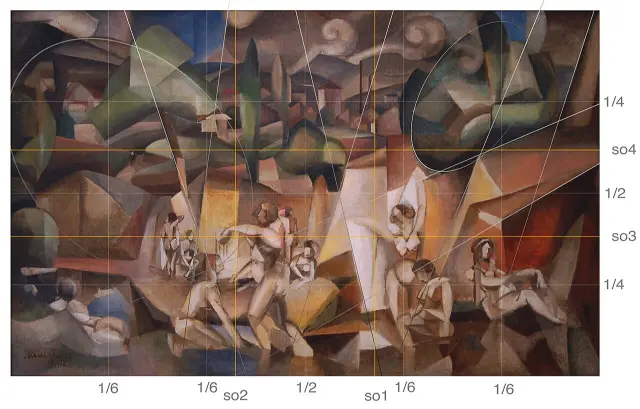
Modernism and the Wreckage of Certainty: Literature in the Age of Fractured Time
Modernism and the Wreckage of Certainty: Literature in the Age of Fractured Time. Literary modernism did not arise as a stylistic fashion. It emerged as a philosophical rupture. The early twentieth century confronted writers with a world whose inherited frameworks of meaning had begun to fail under the pressure of unprecedented historical shocks. Industrial acceleration, mechanized warfare, the collapse of empires, and the erosion of religious and social certainties produced not merely political instability, but epistemic disorientation.
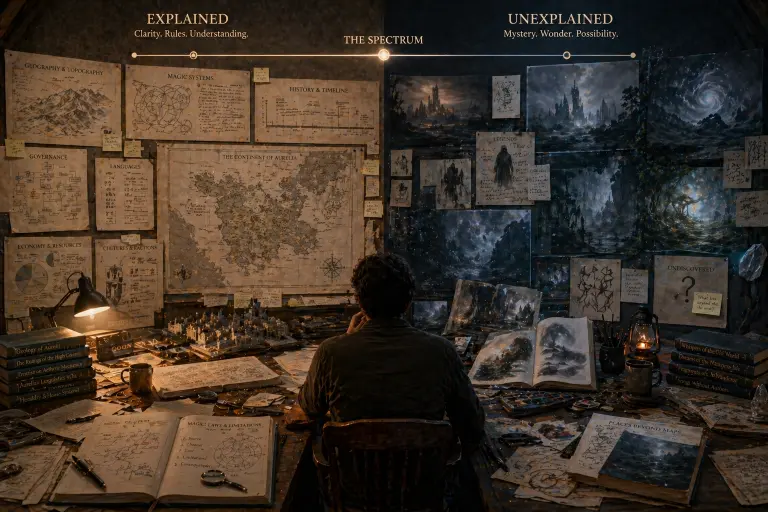
The Architecture of Wonder: Balancing Logic and Mystery in Worldbuilding
Every fictional world makes a demand on the reader long before its story fully unfolds. That demand is not only emotional or thematic—it is cognitive. To enter a constructed reality is to accept a system of rules, visible or hidden, that governs how meaning operates inside it. Some worlds explain themselves with rigorous precision, inviting the reader to understand their mechanics in detail. Others withhold explanation, allowing mystery to function as structure. Between these approaches lies a spectrum that defines how immersion is achieved and how curiosity is sustained.

Literature as Cultural Mirror: Power, Class, and the Social Imagination in Industrial Society
Literature as Cultural Mirror: Power, Class, and the Social Imagination in Industrial Society. Literature does not merely tell stories; it records tensions. It registers, often with greater precision than formal historical accounts, the invisible pressures shaping a society’s moral and material life. Nowhere is this function more evident than in narratives that emerge from periods of rapid transformation—moments when economic systems shift, social hierarchies destabilize, and the language available to describe experience struggles to keep pace with lived reality.