

Narrative structure does not merely determine the order of events. It determines the distance between the reader and certainty itself. Some stories accelerate meaning through clarity and direct progression, while others deliberately obscure truth through layers, interruptions, repetitions, and omission. The architecture of the narrative becomes a mechanism not only for storytelling, but for controlling trust, doubt, memory, and interpretation.
To understand structure, then, is to understand how fiction manipulates cognitive access. Every narrator, subplot, cyclical return, or omitted scene functions as a filter between reality and perception. The reader does not encounter truth directly. They encounter carefully engineered versions of it.

The “Onion” Structure: Narrative Layers and the Distance from Truth
Some narratives refuse direct access to events. Instead of presenting reality transparently, they interpose narrators, testimonies, manuscripts, recollections, or stories within stories. This layered architecture creates what may be called an “onion structure”: every narrative layer adds complexity while simultaneously reducing certainty.
In works such as Frankenstein or The Turn of the Screw, the reader rarely witnesses events firsthand. Information passes through multiple consciousnesses before reaching the audience. A sailor recounts Victor Frankenstein’s account, who himself recounts the Creature’s narrative. The result is not simple ambiguity, but structural instability.
Each narrator functions as a filter. Memory alters detail. Emotion reshapes interpretation. Self-interest contaminates testimony. The farther the reader moves from the original event, the more difficult it becomes to separate reality from narration.
This mechanism transforms uncertainty into a structural force. The mystery does not emerge solely from hidden facts, but from the impossibility of verifying any version completely. Truth becomes fragmented across competing perspectives.
Importantly, layered narration mirrors real-world information systems. In corporate environments, social circles, and digital media ecosystems, information frequently arrives through chains of interpretation rather than direct observation. A statement repeated through multiple intermediaries gradually loses precision while often gaining emotional intensity.
Understanding this “onion structure” cultivates informational skepticism. The question becomes not only “What happened?” but “How many narrative layers separate me from the original event?”
In practical terms, this awareness improves decision-making. Healthy skepticism does not require paranoia. It requires recognizing that every intermediary introduces distortion. The farther information travels, the more cautiously it should be interpreted.
The Intersection of A-Plot and B-Plot: Structural Tension Through Contrast
Complex narratives rarely advance through a single uninterrupted line of action. Instead, authors construct multiple narrative threads that intersect, delay, reflect, or destabilize one another. The relationship between main plot and subplot functions as one of storytelling’s most effective tension-management systems.
The primary narrative—the A-plot—usually contains the central conflict. Yet uninterrupted intensity eventually exhausts the reader. The subplot, or B-plot, provides modulation. It may slow the rhythm, deepen thematic resonance, or strategically postpone climactic resolution.
This delay is rarely accidental. Sophisticated writers understand that tension depends not only on acceleration, but on interruption.
A reflective subplot inserted during a moment of high suspense may initially appear distracting. Structurally, however, it increases emotional pressure by temporarily withholding resolution. The reader remains psychologically attached to the unresolved central conflict while being forced to navigate a secondary thread.
In many literary works, the subplot also acts as commentary. A romantic subplot may expose emotional dimensions ignored by the political conflict of the main story. A quieter domestic narrative may contrast with violent external events, amplifying both simultaneously through juxtaposition.
The power of this structure lies in controlled oscillation. Action alternates with reflection. Expansion alternates with compression. The narrative regulates cognitive fatigue while sustaining emotional investment.
Beyond literature, this structural principle has direct applications in productivity and strategic management. Human attention rarely sustains a single uninterrupted objective indefinitely. Secondary activities, when properly integrated, can reinforce rather than weaken primary goals.
Just as a subplot supports the thematic architecture of a novel, auxiliary projects in professional or personal life can function as psychological stabilization mechanisms. They create variation, preserve mental flexibility, and prevent burnout without abandoning the central objective.
The problem emerges when secondary narratives become structurally disconnected. A subplot that does not reinforce the central narrative weakens momentum. Likewise, tasks disconnected from long-term priorities generate fragmentation instead of support.

Circular Structure vs. Linear Structure: The Logic of Eternal Return
Most narratives appear linear on the surface. Events move from beginning to end, progressing toward transformation or resolution. Yet some of literature’s most philosophically unsettling works undermine this expectation by returning structurally to their point of origin.
In circular narratives, endings mirror beginnings. Images, situations, phrases, or symbolic conditions reappear, suggesting repetition rather than evolution. The reader recognizes that despite apparent movement, the structure has traced a closed loop.
Works such as One Hundred Years of Solitude or Finnegans Wake use circularity to communicate profound philosophical implications. Human beings appear trapped within recurring patterns. History repeats itself. Memory collapses into recurrence. Change becomes partial, temporary, or illusory.
The emotional effect of circular structure differs fundamentally from linear progression. Linear narratives suggest development, escape, or transformation. Circular narratives evoke inevitability.
This sense of inevitability emerges not primarily from plot, but from architecture itself. When the conclusion reflects the opening, the reader experiences the unsettling realization that the story may never have truly escaped its origin.
Importantly, circularity extends far beyond fiction. Organizations, relationships, and institutions frequently operate within structural loops. Certain problems recur because the underlying architecture reproduces the same conditions repeatedly.
Teams change personnel but preserve dysfunctional processes. Companies redesign strategies without altering incentive structures. Individuals pursue different outcomes while repeating identical behavioral patterns.
Recognizing circular structures allows for a deeper form of analysis. The question becomes not “Why did this happen again?” but “What underlying system guarantees recurrence?”
Linear progress requires structural transformation. Without altering the architecture itself, repetition becomes inevitable.
The Blank Space as Structure: The Power of Ellipsis
Some of the most powerful moments in literature are never written explicitly. They exist in absences, interruptions, skipped years, and silent transitions between chapters. The blank space itself becomes structural material.
Ellipsis functions through omission. Instead of describing every event continuously, the narrative leaves gaps the reader must actively reconstruct. Time jumps forward. Conversations end abruptly. Major emotional transformations occur outside the visible page.
This omission produces a paradoxical effect: what is absent often acquires greater emotional weight than what is directly shown.
The reader becomes structurally responsible for completing the narrative. Interpretation shifts from passive reception to active participation. The blank space demands inference.
Importantly, omission creates intellectual engagement precisely because it resists total explanation. Excessive exposition eliminates interpretive tension. By contrast, strategic absence preserves mystery, ambiguity, and psychological participation.
The white space between chapters therefore functions not as emptiness, but as narrative pressure. Silence acquires meaning because the reader attempts to fill it.
This principle extends powerfully into communication outside literature. In presentations, negotiation, leadership, and even personal branding, strategic omission often proves more persuasive than exhaustive explanation.
A résumé overloaded with unnecessary detail weakens focus. A presentation that explains everything leaves no room for audience interpretation. Excessive clarification can paradoxically reduce engagement because it removes cognitive participation.
The most sophisticated communicators understand that omission is not absence of control. It is controlled absence.
Leaving conceptual space for the audience to complete meaning transforms communication into collaboration rather than transmission.
Structure as Cognitive Engineering
Across layered narration, intersecting subplots, circular returns, and narrative ellipses, a common principle emerges: structure shapes cognition before interpretation becomes conscious.
The reader experiences uncertainty because narrative layers distort access to truth. They experience tension because subplots delay resolution. They experience inevitability because circularity undermines progression. They experience participation because omission requires reconstruction.
In each case, the architecture of the story manipulates psychological response through arrangement rather than direct instruction.
Structure therefore operates as invisible cognitive engineering.
Why These Structures Matter Beyond Literature
Studying narrative architecture develops analytical habits applicable far beyond fiction. The same structural mechanisms shaping novels also shape institutions, communication systems, organizations, and social behavior.
Layered narration teaches informational skepticism. Subplot dynamics illuminate multitasking and priority management. Circular narratives reveal recurring systemic failures. Elliptical structures demonstrate the persuasive power of strategic omission.
Literary analysis becomes valuable precisely because fiction isolates these mechanisms with unusual clarity. Stories compress psychological, organizational, and social dynamics into observable structures.
Institutions such as the British Library, the Library of Congress, and academic databases like JSTOR offer extensive research on narrative theory, structuralism, and literary architecture.
Continue Exploring Narrative Systems
If you are interested in how narrative structure manipulates perception, you may also explore our essays on pacing, unreliable narration, symbolic architecture, and psychological tension in fiction.
Readers seeking deeper analytical engagement may revisit our long-form studies on narrative compression, structural suspense, and literary cognition.
Frequently Asked Questions
What is a layered or “onion” narrative structure?
It is a structure where stories are filtered through multiple narrators or narrative levels, increasing ambiguity and distancing the reader from objective truth.
Why do subplots increase tension instead of reducing it?
Because delaying the resolution of the main plot prolongs psychological anticipation and emotional investment.
What is the difference between circular and linear narratives?
Linear narratives emphasize progression and transformation, while circular narratives emphasize repetition, inevitability, and recurring patterns.
Why is omission so powerful in storytelling?
Because strategic absence forces readers to actively participate in constructing meaning, increasing engagement and interpretive depth.
Reviewed for editorial quality, analytical depth, and structural precision.
Conclusion: The Structures That Shape Perception
Stories are not governed solely by characters or events. They are governed by systems of access, interruption, repetition, and omission. Every narrative layer increases uncertainty. Every subplot redistributes tension. Every circular return questions the possibility of change. Every blank space transforms silence into meaning.
To study narrative structure is therefore to study the hidden mechanics through which stories shape perception itself.
In that recognition, literature reveals one of its deepest functions: not simply reflecting reality, but demonstrating how reality becomes filtered, delayed, repeated, and reconstructed through the structures that organize human experience.

Bibliographic Foundation
This analysis was conducted under the Sanctum's methodological rigor, utilizing exegetical protocols grounded in universal heritage repositories and documented preservation archives.
View Authority FoundationsAnalytical Recommendations

The Little Prince: A Philosophy of Tenderness, Responsibility, and the Tragedy of Growing Up
Few works of modern literature occupy such a paradoxical space in cultural memory as The Little Prince. It is frequently categorized as a children’s tale, gifted to young readers with the assumption of simplicity, yet it is quietly revered by adults as a meditation on loss, love, and moral perception.

The Architecture of Wonder: Balancing Logic and Mystery in Worldbuilding
Every fictional world makes a demand on the reader long before its story fully unfolds. That demand is not only emotional or thematic—it is cognitive. To enter a constructed reality is to accept a system of rules, visible or hidden, that governs how meaning operates inside it. Some worlds explain themselves with rigorous precision, inviting the reader to understand their mechanics in detail. Others withhold explanation, allowing mystery to function as structure. Between these approaches lies a spectrum that defines how immersion is achieved and how curiosity is sustained.
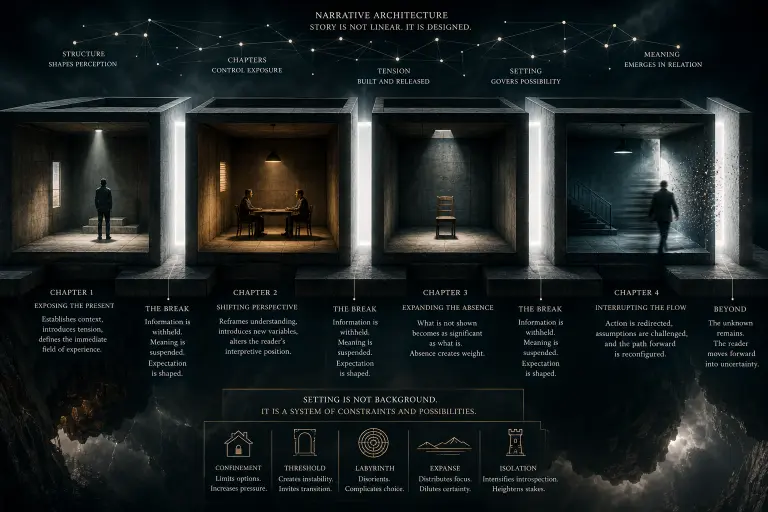
Controlled Exposures: The Active Mechanics of Chapter and Setting
Anovel is often discussed in terms of plot, character, or theme, yet two of its most decisive forces operate at a quieter structural level: the chapter and the setting. These are frequently mistaken for neutral containers—divisions of convenience or descriptive backdrops. In reality, they function as active mechanisms. They regulate the flow of information, shape perception, and determine how tension is built, released, and transformed. To read them closely is to see narrative not as a continuous stream, but as a sequence of controlled exposures.