

Literature as Cultural Mirror: Power, Class, and the Social Imagination in Industrial Society. Literature does not merely tell stories; it records tensions. It registers, often with greater precision than formal historical accounts, the invisible pressures shaping a society’s moral and material life. Nowhere is this function more evident than in narratives that emerge from periods of rapid transformation—moments when economic systems shift, social hierarchies destabilize, and the language available to describe experience struggles to keep pace with lived reality.
Among the works that most incisively capture this dynamic is Hard Times, by Charles Dickens. Set against the backdrop of industrial expansion in nineteenth-century England, the novel operates not simply as fiction, but as a cultural document. It reflects the emergence of a society increasingly organized around productivity, efficiency, and measurable output, while simultaneously critiquing the human cost of such organization.
Industrialization and the Reduction of Human Experience
The world depicted in Hard Times is governed by a logic that privileges facts over imagination, calculation over empathy, and production over reflection. Education, labor, and social relations are all structured according to this principle. Individuals are trained to become functional units within an economic system, their worth determined by their capacity to contribute to measurable outcomes.
This reduction of human experience reflects broader historical shifts. The Industrial Revolution reorganized not only economies, but perceptions of time, value, and identity. Work became increasingly specialized. Time was quantified. Efficiency emerged as a moral virtue. In such a context, qualities that resist measurement—emotion, creativity, moral intuition—were often marginalized.
Dickens’ narrative exposes the consequences of this transformation. Characters shaped by utilitarian logic exhibit a kind of spiritual impoverishment. Their lives are ordered, but empty; structured, but disconnected. The novel thus functions as a critique of a society that confuses precision with understanding.
Class, Inequality, and the Visibility of Suffering
One of the central contributions of literature to sociocultural analysis lies in its ability to render visible what systems obscure. In Hard Times, class is not an abstract category; it is lived experience. The divide between those who own and those who labor is inscribed in bodies, environments, and opportunities.
The working class is depicted not as a homogeneous mass, but as individuals navigating constrained circumstances. Their struggles are not dramatized for spectacle; they are presented as structural conditions. Poverty, exhaustion, and limited mobility are not the result of personal failure, but of systemic organization.
At the same time, the novel does not absolve the privileged of responsibility by attributing inequality solely to impersonal forces. It reveals how attitudes, assumptions, and indifference sustain these structures. The distance between classes is maintained not only by economics, but by imagination—by the inability or unwillingness to perceive others as fully human.
Education as Ideological Instrument
Education in Hard Times is portrayed as a mechanism of social reproduction. Rather than cultivating critical thought or moral awareness, it enforces conformity to a specific worldview. Students are taught to prioritize facts, dismiss imagination, and internalize the values of industrial rationality.
This portrayal highlights a crucial sociocultural insight: institutions do not merely transmit knowledge; they shape perception. What is taught—and what is excluded—determines how individuals interpret the world. An education system that suppresses imagination does not produce neutral subjects; it produces individuals aligned with a particular economic and ideological order.
The critique extends beyond the classroom. It raises broader questions about how societies define intelligence, success, and value. When knowledge is reduced to quantifiable data, what forms of understanding are lost?
Gender, Constraint, and Silent Suffering
While class structures the external world of Hard Times, gender shapes its internal dynamics. Female characters navigate expectations that limit their agency while demanding emotional endurance. Their experiences reveal another layer of sociocultural constraint—one less visible than economic inequality, but equally pervasive.
Women in the novel are often positioned as stabilizing forces within a destabilized society. They are expected to absorb tension, maintain order, and embody virtue, even when denied autonomy. Their suffering is frequently silent, expressed through resignation rather than resistance.
This representation reflects broader historical realities. In industrial society, gender roles were often reinforced as a means of maintaining social stability. The domestic sphere became a site of moral expectation, even as it remained constrained by limited power.
Imagination as Resistance
If industrial society privileges calculation, then imagination becomes a form of resistance. In Hard Times, imagination is not escapism; it is a mode of perceiving alternative possibilities. It disrupts the assumption that existing structures are inevitable.
Characters who retain imaginative capacity exhibit a different relationship to the world. They are capable of empathy, of recognizing complexity, of resisting reduction. Their presence in the narrative suggests that the human capacity for meaning cannot be entirely extinguished by systemic pressure.
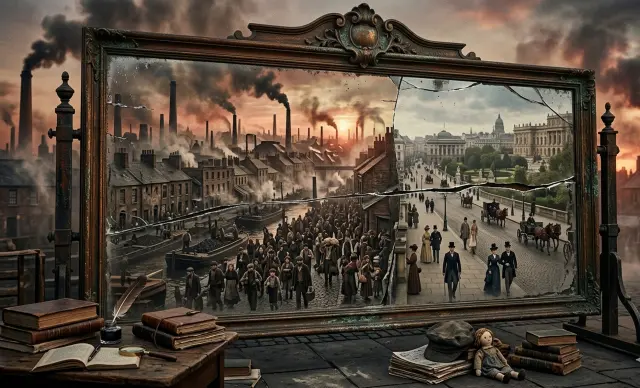
Why Literature’s Sociocultural Role Endures
The relevance of Hard Times extends beyond its historical context because the dynamics it examines persist in evolving forms. Contemporary societies continue to grapple with tensions between efficiency and humanity, productivity and well-being, data and meaning.
Literature remains a vital tool for engaging these tensions. It provides a space where abstract systems can be experienced concretely, where statistics become stories, and where structures reveal their human impact. Unlike purely analytical discourse, literature does not distance the reader from its subject; it implicates them.
Conclusion: Seeing Society Through Story
To read Hard Times is to encounter a society in the midst of transformation—and to recognize echoes of that transformation in the present. The novel demonstrates that literature’s value lies not only in its aesthetic achievements, but in its ability to illuminate the conditions under which people live, think, and relate to one another.
As a cultural mirror, literature does not offer a neutral reflection. It refracts reality, highlighting tensions, exposing contradictions, and inviting reconsideration. In doing so, it performs a function that remains indispensable: it teaches us how to see—not only the world as it is, but the structures that shape it, and the possibilities that lie beyond it.

Bibliographic Foundation
This analysis was conducted under the Sanctum's methodological rigor, utilizing exegetical protocols grounded in universal heritage repositories and documented preservation archives.
View Authority FoundationsAnalytical Recommendations
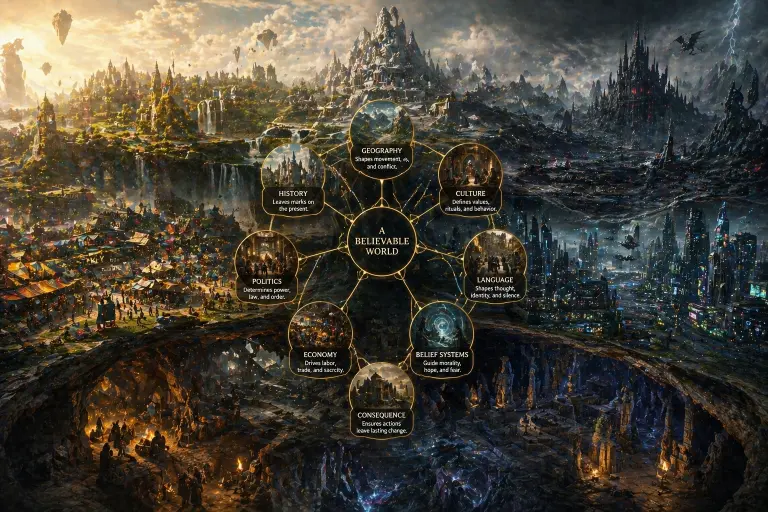
Internal Inevitability: The Hidden Architecture of Immersive Worldbuilding
A fictional world succeeds not when it appears infinitely large, but when it feels internally inevitable. Readers do not enter narrative environments because every mountain has been mapped or every dynasty fully documented; they enter because the world behaves as though it could continue existing beyond the page. Coherence creates immersion. The illusion of reality depends less on quantity of detail than on the disciplined relationship between setting, causality, memory, and consequence.
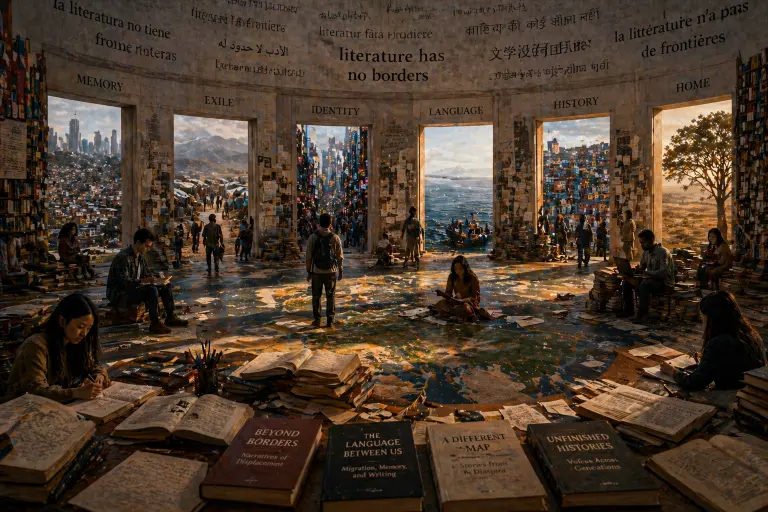
Literature Without a Center: The Structural Rise of Global Diaspora Voices
The contemporary novel is no longer anchored to a single cultural center. Over the last decade, literary authority has shifted in ways that are both visible and structural. The global circulation of prizes, translations, and readership has made one fact increasingly unavoidable: the narratives that define our era are no longer being written exclusively from within traditional Western frameworks. Instead, they emerge from movement—migration, exile, linguistic displacement, and historical fracture.
Realism and the Discipline of the Ordinary: Literature in the Age of Social Visibility
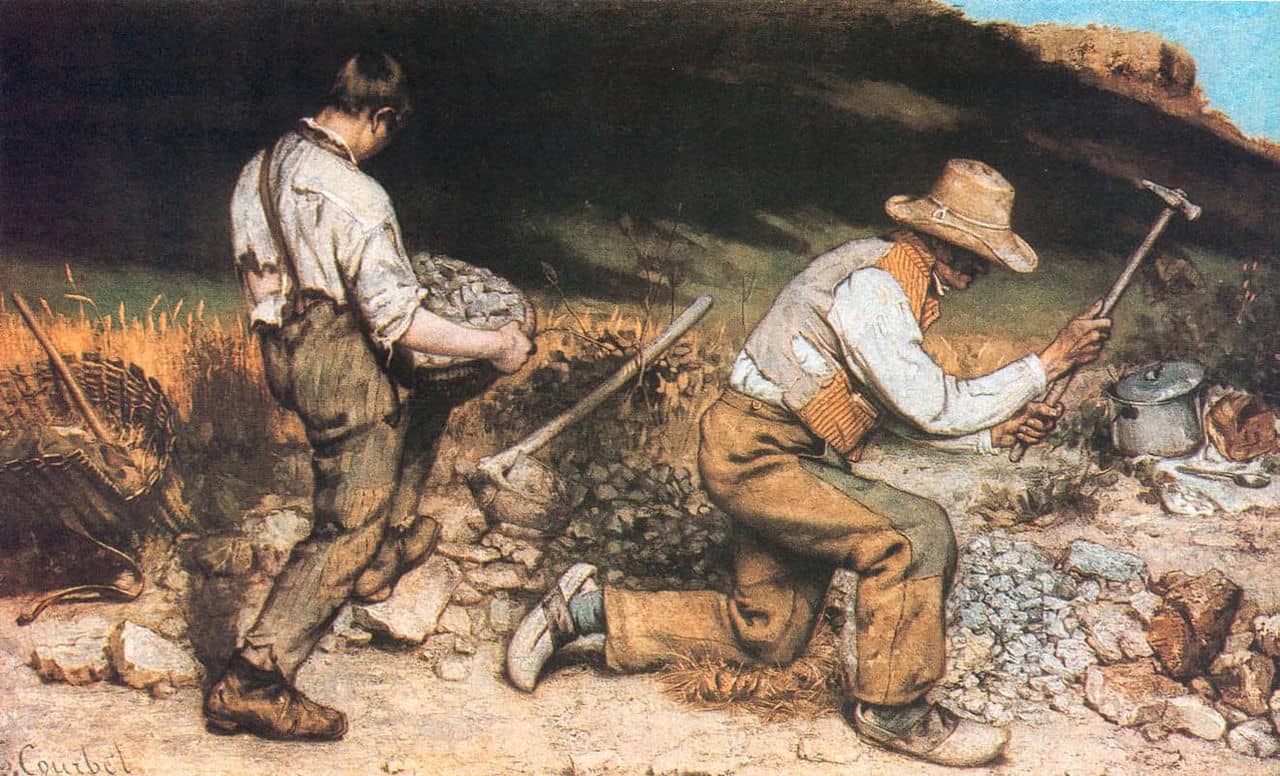
Realism and the Discipline of the Ordinary: Literature in the Age of Social Visibility. If Romanticism elevated the inner world and imagination as a response to mechanized reality, Realism emerges as a corrective movement—one that redirects attention outward, toward the material, social, and economic conditions shaping human existence. Far from a rejection of depth, Realism represents a reorientation of it. It insists that meaning is not found only in transcendence or subjective intensity, but in the structures of everyday life: work, class, institutions, and the quiet pressures of social expectation.