

The mythology of literary greatness often begins at the moment of recognition: publication, acclaim, institutional validation. What it tends to obscure are the long periods of invisibility that precede that moment—the years in which manuscripts are rejected, misunderstood, or ignored. To read literary history through biography is to confront a different narrative: one in which persistence, constraint, and collaboration shape the conditions under which art becomes possible.
When examined closely, the lives of major writers reveal not a linear progression toward success, but a complex negotiation with failure, financial pressure, psychological experience, and intellectual community. These elements do not exist outside the work. They inform its structure, its urgency, and its authority.

The Management of Failure: Rejection as Formation
The early trajectories of writers such as James Joyce and Gertrude Stein illustrate that rejection is not an interruption of creative development, but often its defining condition. Their works were initially dismissed as obscure, unconventional, or commercially unviable. Publication was delayed, fragmented, or resisted outright.
What emerges from these histories is not simply perseverance, but a particular form of conviction. The writer continues not because validation is imminent, but because the work itself demands completion. This distinction is crucial. Persistence is not sustained by external recognition, but by an internal alignment between intention and expression.
Such trajectories offer a reframing of failure. Rejection becomes not a verdict on value, but a reflection of misalignment between innovation and prevailing standards. The distance between these two can be substantial, and it is often within that distance that significant work develops.
For contemporary creators, this perspective provides a form of emotional calibration. It situates the experience of refusal within a broader pattern, reducing its capacity to define identity while preserving its capacity to inform growth.
The Economics of Creativity: Constraint as Catalyst
The relationship between financial pressure and literary production complicates the notion of the “pure” artist. Writers such as Fyodor Dostoevsky and Honoré de Balzac operated under conditions of sustained economic strain. Debt, contractual obligations, and the necessity of rapid output shaped not only their working habits, but the formal qualities of their texts.
The serialized format—publication in installments—required a particular narrative rhythm. Chapters had to sustain attention, create momentum, and encourage continuation. What might appear as stylistic intensity can often be traced to material necessity.
This does not diminish the artistic achievement. It reveals its conditions. Creativity does not emerge in isolation from constraint; it frequently adapts to it. Urgency becomes structure. Limitation becomes form.
Understanding this dynamic introduces a more grounded perspective on productivity. It suggests that creative output is not dependent on ideal conditions, but can be generated within—and sometimes because of—pressure.
Archival collections preserved by institutions such as the British Library, the Library of Congress, and research platforms like JSTOR provide detailed documentation of these material conditions, offering insight into how economic realities intersect with literary form.
Trauma as Medium: The Transformation of Experience
Biographical accounts often reveal experiences of profound difficulty—silence, poverty, displacement—that are later reconfigured within the work. In the case of Maya Angelou, periods of enforced silence following trauma became foundational to her engagement with language. For George Orwell, direct encounters with economic hardship informed a sustained critique of social and political systems.
These experiences are not simply represented; they are transformed. The narrative does not reproduce the event—it rearticulates it within a structure that allows for analysis, distance, and communication.
This process can be understood as a form of sublimation. Emotional intensity is redirected into form, producing work that carries both personal and collective significance. The authority of such writing does not derive from abstraction, but from proximity to lived experience.
For readers, this offers a model of engagement with their own histories. The act of articulation—whether through writing or other forms—can function as a means of reordering experience, converting what is internal and inarticulate into something structured and shareable.
Networks of Influence: The Ecology of Creation
Literary production is often framed as an individual act, yet biographical evidence consistently points to the importance of intellectual communities. Groups such as the Inklings, which included J.R.R. Tolkien and C.S. Lewis, or the Bloomsbury Group, associated with Virginia Woolf, demonstrate how sustained exchange shapes creative development.
These networks function as environments of critique and support. Drafts are discussed, assumptions challenged, and ideas refined through dialogue. The work that emerges is not the product of isolation, but of interaction.
This does not diminish individual authorship. It situates it within a broader ecology. Creativity is distributed across relationships, conversations, and shared frameworks of thought.

From Biography to Practice
When these elements are considered together—failure, constraint, experience, and community—a different model of literary creation emerges. It is not defined by uninterrupted progress or solitary genius, but by sustained engagement with conditions that are often resistant or unpredictable.
This model has practical implications. It reframes creative work as a process that includes interruption, negotiation, and adaptation. It suggests that development occurs not in the absence of difficulty, but through its integration.
Why These Histories Matter
The value of literary biography lies in its capacity to connect abstract achievement with concrete conditions. It reveals that the qualities often associated with great works—complexity, urgency, depth—are not purely aesthetic. They are responses to specific circumstances.
For readers and creators alike, this perspective introduces a form of realism. It replaces idealized narratives of inspiration with a more nuanced understanding of process. It acknowledges that uncertainty, limitation, and collaboration are not obstacles to be eliminated, but elements to be engaged.
Continue Exploring Literary Biography
If you are interested in how the lives of writers inform their work, you may also explore our essays on author biographies, narrative theory, and literary history.
Readers seeking further depth may revisit our long-form studies on creative process, intellectual networks, and the relationship between experience and form.
Frequently Asked Questions
Do all great writers face rejection?
While experiences vary, many significant authors encountered periods of dismissal or misunderstanding before recognition.
Can financial pressure influence creativity?
Yes, material conditions often shape both the pace and structure of literary production.
Is personal experience necessary for meaningful writing?
Not exclusively, but lived experience can provide a foundation for depth and authenticity.
Do writers need communities to succeed?
While not strictly necessary, intellectual exchange and support networks often contribute significantly to creative development.
Reviewed for editorial quality, analytical depth, and biographical accuracy.
Conclusion: The Conditions of Creation
The study of literary lives reveals that creation is not an isolated act of inspiration, but a sustained engagement with conditions that shape and challenge it. Rejection refines conviction, constraint generates form, experience informs perspective, and community enables development.
To understand these dynamics is to move beyond simplified narratives of success and toward a more comprehensive view of creative work. It is to recognize that what endures is not only the finished text, but the process through which it came into being.
In that recognition, biography becomes more than context. It becomes a method for understanding how literature is made—and how it continues to evolve.

Bibliographic Foundation
This analysis was conducted under the Sanctum's methodological rigor, utilizing exegetical protocols grounded in universal heritage repositories and documented preservation archives.
View Authority FoundationsAnalytical Recommendations

Architectures of Mind: Perspective as Psychological Embodiment
Narrative perspective is often treated as a technical choice—a question of who speaks and from what distance. Yet in its most sophisticated forms, perspective is not simply a matter of viewpoint. It is a psychological architecture. It determines not only what the reader sees, but how reality itself is filtered, distorted, or intensified. Two of the most powerful strategies in modern fiction—the unreliable narrator and deep internal focus—demonstrate how perspective can move beyond description into embodiment.
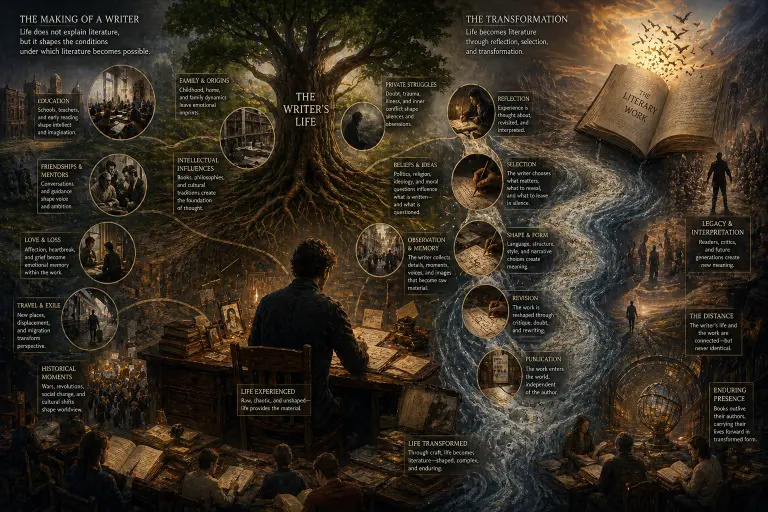
The Imprint of Experience: Why Author Biography Matters for Critical Reading
To study a writer’s life is not to search for a simple key that unlocks every page they produced. Literature does not function as disguised autobiography, nor can the complexity of a novel, a poem, or an essay be reduced to a sequence of personal events. Yet no major work emerges from abstraction alone. Writers are formed by education, exile, friendships, losses, political climates, intellectual traditions, and private contradictions. Their works carry these pressures—sometimes visibly, sometimes only as structure, silence, or recurring obsession.

Literature and the Burden of Memory: Race, Identity, and the Reconstruction of Human Dignity
Literature and the Burden of Memory: Race, Identity, and the Reconstruction of Human Dignity. Literature assumes its most transformative function when it confronts histories that resist closure. There are pasts that do not remain confined to chronology—pasts that persist as structure, as inheritance, as unresolved presence within the present. In such contexts, narrative becomes more than representation; it becomes a site of reckoning. It gives form to experiences that have been suppressed, fragmented, or systematically excluded from dominant historical accounts.