

Some books do not simply enter public conversation—they reorganize it. A serious work of non-fiction can alter how a generation understands history, power, memory, science, or moral responsibility. These books exceed bestseller lists and temporary relevance because they become reference points: texts people return to when trying to explain crises, institutions, and the invisible structures beneath ordinary life. Their influence is rarely immediate spectacle. It is slower, deeper, and often more durable than fiction’s emotional immediacy.
What distinguishes these works is not only research, but consequence. They change the language available for public thought. After certain books are published, arguments can no longer proceed in quite the same way. Readers inherit new frameworks—sometimes liberating, sometimes disturbing—that reshape how societies narrate themselves. To revisit such works is not an academic exercise in admiration; it is a way of understanding how intellectual history continues to shape the present.
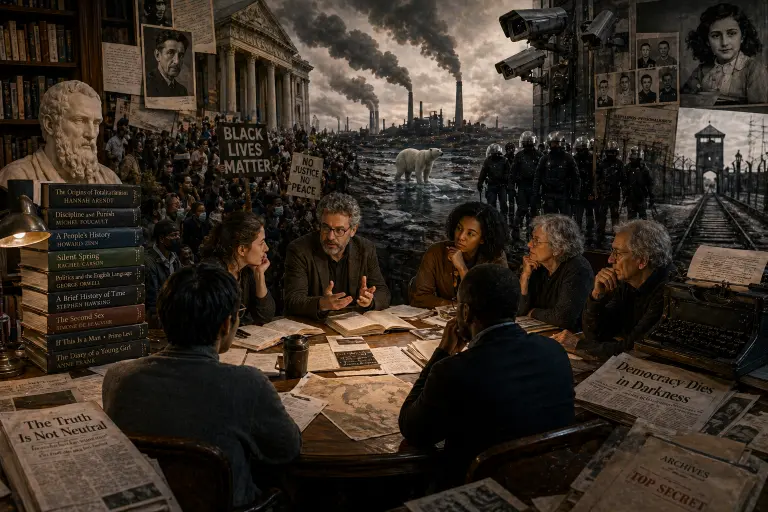
Books That Changed Political Vocabulary
Few works have altered political language as profoundly as Hannah Arendt’s The Origins of Totalitarianism. Published in the aftermath of catastrophe, it offered readers more than historical explanation. It gave conceptual form to experiences that seemed almost resistant to language—mass ideology, bureaucratic violence, and the terrifying normality of institutional cruelty.
Arendt’s importance lies in her refusal of simplification. Rather than reducing totalitarianism to individual evil, she examined the structures that made evil administratively efficient. Later, in Eichmann in Jerusalem, her phrase “the banality of evil” entered public discourse precisely because it challenged comforting assumptions about monstrosity. Evil was not always dramatic; it could be procedural.
That insight remains disturbingly relevant. Modern political criticism still depends on the vocabulary she helped create.
When History Was Rewritten from Below
Howard Zinn’s A People’s History of the United States became influential not because it discovered unknown facts, but because it changed narrative perspective. National history, often written through presidents, wars, and institutional triumph, was reoriented toward workers, indigenous communities, enslaved people, women, and those systematically excluded from official memory.
The controversy surrounding the book was itself proof of its impact. Historical argument is never only about the past; it is about legitimacy in the present. By changing who counted as the subject of history, Zinn forced readers to confront the politics of narrative selection.
Even readers who disagree with his conclusions cannot avoid the question he made unavoidable: whose story is being called national history?
Science Writing That Altered Public Responsibility
Rachel Carson’s Silent Spring did more than expose the ecological consequences of pesticides. It transformed environmental awareness from scattered concern into public ethical urgency. Carson demonstrated that scientific writing could reshape policy when evidence was joined to moral clarity without abandoning rigor.
Its importance was not merely scientific but civic. The book showed how invisible systems—chemical contamination, industrial decisions, regulatory silence—could determine ordinary life without public consent. Environmental criticism became inseparable from questions of institutional accountability.
Similarly, Stephen Hawking’s A Brief History of Time opened cosmological thinking to general readers, proving that intellectual ambition need not remain confined to specialists. Complexity could be shared without being trivialized.
Institutions such as the Library of Congress, the British Library, and research archives like JSTOR remain essential for preserving the documentary foundations behind these influential works, allowing readers to trace how research becomes public thought.
Memoir as Historical Witness
Some books matter because they preserve history at the scale of individual consciousness. Anne Frank’s The Diary of a Young Girl remains powerful precisely because it refuses abstraction. The Holocaust, often discussed through incomprehensible numbers, becomes visible through the ordinary rhythms of a young person trying to remain human under extraordinary terror.
Primo Levi’s If This Is a Man performs a similar function with different tonal discipline. Its restraint makes it devastating. Levi refuses spectacle and instead documents the systematic erosion of moral and physical existence inside the camp. The result is not simply testimony, but a philosophical confrontation with what survival means.
These books remind readers that history without individual voice risks becoming morally unreadable.
Language as Ethical Responsibility
George Orwell’s Politics and the English Language remains one of the most cited essays of the twentieth century because it transformed style into ethics. Orwell argued that vague, inflated language protects bad thinking and political dishonesty. Clarity was not aesthetic preference—it was moral resistance.
This insight became foundational far beyond literary criticism. Journalism, political commentary, and public discourse continue to return to Orwell because language remains one of power’s most efficient disguises. When words become abstract enough, violence can appear administrative rather than human.
Good prose, in this sense, becomes a civic responsibility.
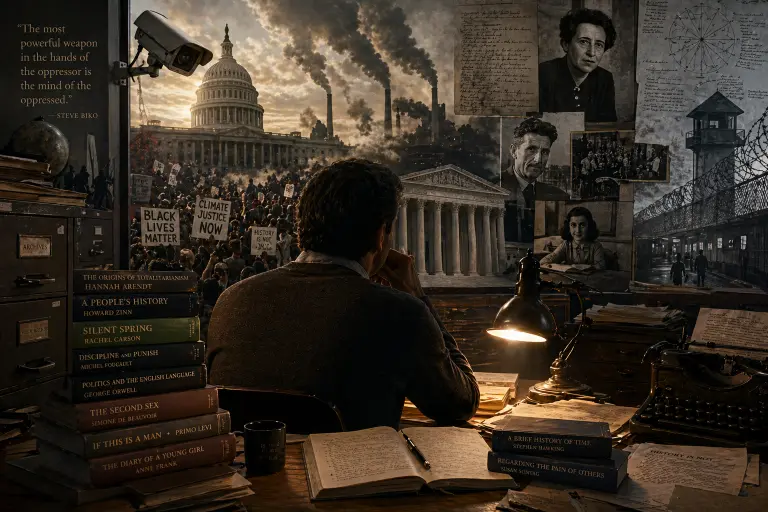
Books That Made Power Visible
Michel Foucault’s Discipline and Punish changed how readers think about institutions by shifting attention away from spectacular punishment toward ordinary surveillance. Schools, prisons, hospitals, and bureaucracies became readable as systems of normalization rather than neutral administration.
This was not merely academic theory. Once readers absorbed Foucault’s argument, modern life itself looked different. Architecture, schedules, examinations, documentation—everyday routines revealed hidden structures of discipline.
Similarly, Susan Sontag’s Regarding the Pain of Others forced readers to reconsider how images of suffering circulate in media. Witnessing was no longer innocent. Looking itself carried ethical consequence.
These books endure because they teach suspicion toward what feels normal.
Why Certain Works Refuse to Age
Some books survive because they answer permanent questions poorly enough to remain open. Others survive because they ask the right questions before society is ready to hear them. Great non-fiction often feels prophetic only in retrospect.
Simone de Beauvoir’s The Second Sex remains essential not because every conclusion stands unchanged, but because it altered the scale of feminist thought. It moved gender from private condition to philosophical structure. Personal life became intellectually legible as a political system.
Books endure when they create frameworks larger than their immediate historical moment. Their relevance expands rather than expires.
Why This Perspective Still Matters
In an age of accelerated opinion and algorithmic visibility, returning to these works restores proportion. They remind readers that intellectual influence is not measured by virality, but by durability. Public thought depends less on immediate reaction than on the frameworks inherited from serious writing.
This matters because contemporary crises—political extremism, environmental collapse, institutional distrust, historical amnesia—are not new enough to be understood without memory. Many of the conceptual tools needed to interpret them already exist inside earlier books.
Reading them is not nostalgia. It is preparation.
Continue Exploring Intellectual Traditions
If you are interested in how major works of non-fiction reshape public imagination, you may also explore our essays on literary criticism, documentary truth, and the relationship between historical narrative and political legitimacy across modern thought.
Readers drawn to broader structural questions may also revisit our long-form analyses of archives, philosophical prose, and the enduring ethics of explanation in research-based writing.
Frequently Asked Questions
Why do some non-fiction books remain influential for decades?
Because they create durable frameworks for understanding history, power, science, or ethics rather than responding only to temporary public debates.
Is historical non-fiction ever neutral?
No. Every historical work selects perspective, emphasis, and narrative structure. Interpretation begins with deciding what counts as important.
Why are memoirs like Anne Frank’s still central to historical reading?
Because individual testimony makes large-scale catastrophe morally legible. Personal voice prevents history from becoming emotionally abstract.
How can old essays like Orwell’s still matter today?
Because language remains central to power. Clarity, manipulation, and political rhetoric continue to shape how societies understand truth and responsibility.
Reviewed for editorial quality, research integrity, and historical relevance.
Conclusion: Books That Continue Thinking for Us
The most valuable non-fiction does not remain important because it was once famous. It remains important because its questions continue returning under new names. Political fear changes shape, environmental crisis acquires new language, institutions evolve—but the need to interpret them remains constant.
These books endure because they do not offer comfort through certainty. They sharpen perception. They make readers less satisfied with official explanations and more attentive to the hidden systems beneath ordinary life. Their real legacy is not information, but method.
To revisit them is to recognize that intellectual history is never finished. We are still living inside arguments they helped begin, and reading them closely means learning how to think inside that unfinished conversation with greater precision and responsibility.

Bibliographic Foundation
This analysis was conducted under the Sanctum's methodological rigor, utilizing exegetical protocols grounded in universal heritage repositories and documented preservation archives.
View Authority FoundationsAnalytical Recommendations

The Life Behind the Page: Biography as Context, Not Explanation
To read a writer closely is, inevitably, to sense the life behind the work—not as a simple key that unlocks meaning, but as a field of pressures, experiences, and contradictions that shape what becomes possible on the page. A novel, a poem, or an essay does not emerge in isolation. It carries traces of education, exile, relationships, intellectual influences, and historical circumstance. These traces are rarely explicit, yet they persist, forming a subtle dialogue between lived experience and artistic creation.
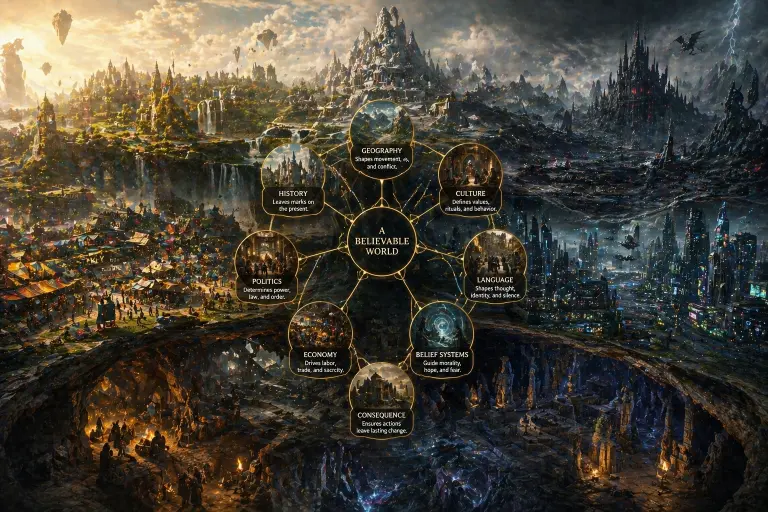
Internal Inevitability: The Hidden Architecture of Immersive Worldbuilding
A fictional world succeeds not when it appears infinitely large, but when it feels internally inevitable. Readers do not enter narrative environments because every mountain has been mapped or every dynasty fully documented; they enter because the world behaves as though it could continue existing beyond the page. Coherence creates immersion. The illusion of reality depends less on quantity of detail than on the disciplined relationship between setting, causality, memory, and consequence.
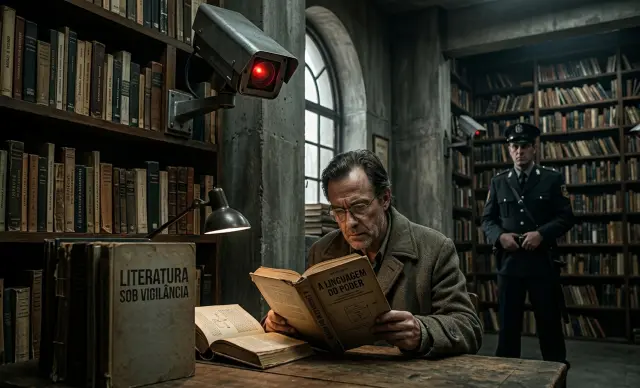
Literature Under Surveillance: Power, Language, and the Anatomy of Control in Totalitarian Societies
Literature Under Surveillance: Power, Language, and the Anatomy of Control in Totalitarian Societies. Literature becomes most urgent when freedom contracts. In moments where political systems extend their reach beyond institutions and into consciousness itself, narrative ceases to be mere representation and becomes a form of resistance—sometimes overt, often subtle, always necessary. It is within such conditions that fiction assumes a dual role: as documentation of lived realities and as critique of the mechanisms that seek to control them.