

The contemporary novel is no longer anchored to a single cultural center. Over the last decade, literary authority has shifted in ways that are both visible and structural. The global circulation of prizes, translations, and readership has made one fact increasingly unavoidable: the narratives that define our era are no longer being written exclusively from within traditional Western frameworks. Instead, they emerge from movement—migration, exile, linguistic displacement, and historical fracture.
This shift is not simply a matter of representation or diversity. It is a transformation of narrative logic itself. As writers from Africa, Asia, and diasporic communities reshape the literary landscape, they are not merely adding new voices to an existing canon. They are challenging the assumptions that sustained that canon: linear time, stable identity, coherent national belonging, and the primacy of a singular narrative perspective. The result is not expansion, but revision.

Prizes as Signals of Structural Change
Literary prizes have always shaped visibility, but in recent years they have also begun to reflect deeper transformations in narrative authority. The recognition of writers such as Abdulrazak Gurnah with the Nobel Prize in Literature or the global acclaim surrounding authors like Ocean Vuong signals more than individual success. It marks a redistribution of interpretive power.
For decades, major awards often reinforced a relatively stable idea of literary value rooted in Western narrative traditions. Today, that stability has fractured. Works shaped by migration, colonial aftermath, linguistic hybridity, and non-linear memory are not being recognized as exceptions—they are increasingly becoming central to contemporary literary evaluation.
This shift matters because prizes do not simply reward books; they influence what future literature believes it must become in order to be legible.
Abdulrazak Gurnah and the Quiet Violence of Exile
Abdulrazak Gurnah’s fiction resists spectacle. His novels, including Paradise and Afterlives, do not rely on dramatic narrative gestures to convey the impact of colonialism and displacement. Instead, they focus on the slow, often invisible processes through which identity is eroded, reshaped, and negotiated within systems of power.
What distinguishes Gurnah structurally is his refusal of narrative closure. His characters exist within histories that cannot be resolved within the limits of a single storyline. Colonial violence does not end with independence; it persists through memory, bureaucracy, language, and inherited silence.
This approach challenges a key expectation of the traditional European novel: that narrative should produce resolution. In Gurnah’s work, history remains open, unfinished, and structurally embedded in everyday life.
Ocean Vuong and the Fragmentation of Memory
Ocean Vuong’s On Earth We’re Briefly Gorgeous exemplifies a different but equally transformative approach. Structured as a letter that may never be fully received, the novel dissolves linear progression into fragments of memory, sensation, and linguistic experimentation. Time does not move forward in a stable sequence; it returns, interrupts, and reconfigures itself.
This fragmentation is not stylistic excess—it reflects the condition of diasporic identity itself. Migration disrupts continuity. Language becomes layered, unstable, and sometimes inadequate. The self is not inherited seamlessly, but assembled across cultural dislocation.
Vuong’s work resists assimilation into classical narrative expectations. It does not guide the reader through a neatly ordered progression of events. Instead, it demands a different form of attention—one that accepts discontinuity as a legitimate structure of meaning.
Rewriting the Logic of the Canon
The rise of diaspora literature is forcing a fundamental question: what counts as a “complete” narrative? Traditional Western fiction often privileges coherence, psychological continuity, and a clear relationship between cause and effect. These expectations are not universal—they are historical constructions shaped by specific cultural conditions.
Writers shaped by displacement frequently reject these assumptions, not as an act of rebellion, but as a necessity of representation. A fragmented life cannot be truthfully rendered through seamless form. A history marked by erasure cannot be told through singular perspective. A multilingual reality cannot be reduced to a single linguistic register without loss.
As these works gain recognition, the canon itself is being forced to adapt. It must expand not only its list of authors, but its definition of what constitutes narrative coherence, authority, and literary value.
Institutions such as the British Library, the Library of Congress, and scholarly archives like JSTOR play a crucial role in preserving these evolving literary traditions, documenting how global voices continue to reshape narrative form and critical interpretation.
Language, Translation, and the Politics of Voice
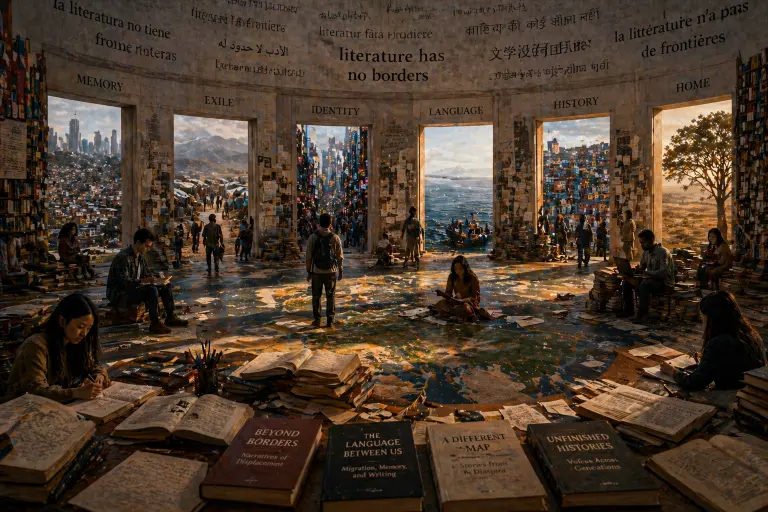
Another critical dimension of this transformation lies in language itself. Many contemporary writers operate across linguistic boundaries—writing in second languages, translating their own work, or embedding multiple linguistic systems within a single text.
This creates both opportunity and tension. Translation expands readership, but it also raises questions about what is lost, altered, or reshaped in the process. Some works deliberately resist full translation, preserving cultural specificity even at the cost of immediate accessibility.
Language becomes a site of negotiation. It is no longer a transparent medium, but a visible structure shaping meaning, identity, and power.
Beyond Representation: Structural Innovation
It would be a mistake to interpret the rise of diaspora literature solely in terms of representation. The most important contribution of these works lies in formal innovation. They introduce narrative structures that reflect lived complexity rather than inherited literary expectations.
Multiple timelines, shifting narrators, fragmented memory, hybrid genres, and unresolved endings are not experimental for their own sake. They are structural responses to histories that resist simplification. In many cases, these forms feel more accurate to contemporary experience than traditional realism.
This innovation has broader consequences. As readers become accustomed to these structures, the standards by which all fiction is judged begin to shift. What once seemed difficult becomes necessary. What once seemed unconventional becomes expected.
Why This Moment Matters
The current prominence of diaspora voices marks a turning point in literary history. It signals that narrative authority is no longer tied to geographic or cultural centrality. Instead, it emerges from the ability to represent complexity with formal precision.
This matters not only for literature, but for how societies understand history itself. When multiple perspectives become structurally embedded in narrative, singular versions of the past become harder to sustain. Literature begins to function as a corrective to historical simplification.
The contemporary novel, in this sense, becomes a space where competing histories can coexist without forced resolution.
Continue Exploring Contemporary Fiction
If you are interested in how global voices are reshaping narrative form, you may also explore our essays on autofiction, eco-horror, and the influence of digital culture on contemporary storytelling.
Readers drawn to broader literary transformations may also revisit our long-form analyses of worldbuilding, structural critique, and the evolving relationship between narrative form and cultural identity.
Frequently Asked Questions
Why are diaspora writers gaining more recognition today?
Because global literary institutions are increasingly acknowledging works that reflect migration, colonial history, and cultural hybridity as central rather than peripheral to contemporary experience.
How do these works challenge traditional narrative structures?
They often reject linear storytelling, stable identity, and singular perspective, replacing them with fragmented timelines, multiple voices, and open-ended conclusions.
Is this change permanent?
It appears structural rather than temporary. As readers and critics adapt to these forms, they become part of the evolving definition of literary value.
Does this mean the Western canon is disappearing?
No. It is being reinterpreted and expanded. The canon is not erased—it is being forced to accommodate new forms, perspectives, and narrative logics.
Reviewed for editorial quality, literary relevance, and global contextual accuracy.
Conclusion: Literature Without a Center
The contemporary novel is no longer organized around a single cultural or formal center. It moves through displacement, translation, fragmentation, and historical revision. Writers once positioned at the margins are now redefining what counts as narrative authority.
This transformation is not a trend—it is a structural shift in how literature understands itself. The canon is no longer a fixed archive, but a contested space where new forms of storytelling continuously reshape what can be recognized as meaningful.
To read contemporary fiction today is to encounter a world where history is plural, identity is unstable, and narrative itself must adapt to realities that refuse simplification. The novel has not lost coherence—it has learned to survive without it.

Bibliographic Foundation
This analysis was conducted under the Sanctum's methodological rigor, utilizing exegetical protocols grounded in universal heritage repositories and documented preservation archives.
View Authority FoundationsAnalytical Recommendations
The Architecture of Understanding: Why Rigorous Non-Fiction Reorganizes Perception
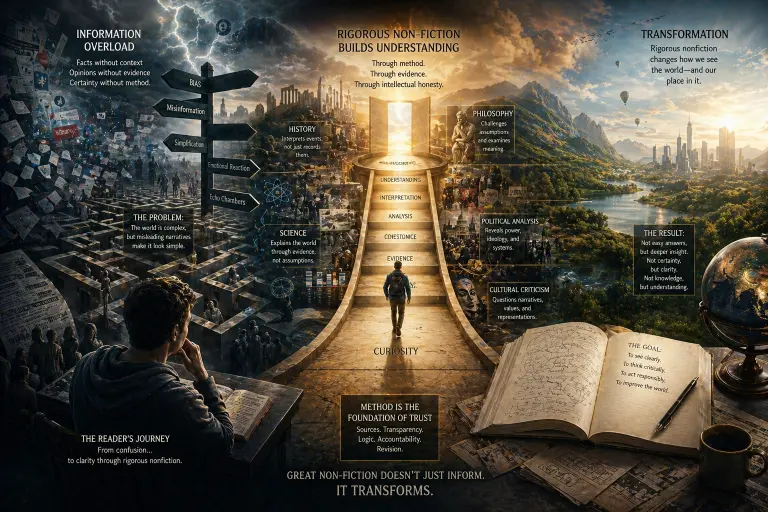
The strongest non-fiction does not merely inform—it reorganizes perception. A serious work of history, philosophy, science, political analysis, or cultural criticism changes how readers understand causality, responsibility, and evidence itself. It does not offer facts as isolated units of knowledge, but arranges them into structures of interpretation. The result is not simple agreement, but intellectual displacement: the realization that what once seemed obvious was often only familiar.
Modernism and the Wreckage of Certainty: Literature in the Age of Fractured Time
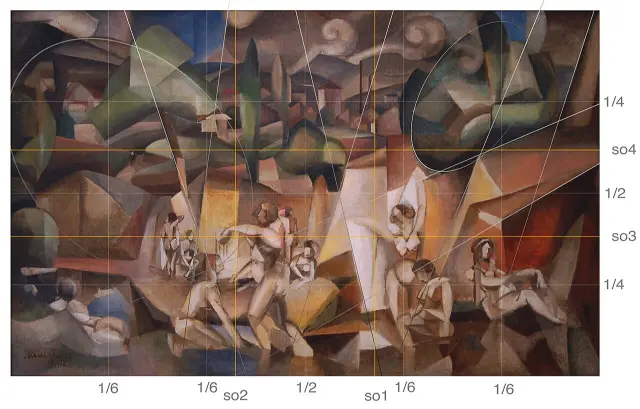
Modernism and the Wreckage of Certainty: Literature in the Age of Fractured Time. Literary modernism did not arise as a stylistic fashion. It emerged as a philosophical rupture. The early twentieth century confronted writers with a world whose inherited frameworks of meaning had begun to fail under the pressure of unprecedented historical shocks. Industrial acceleration, mechanized warfare, the collapse of empires, and the erosion of religious and social certainties produced not merely political instability, but epistemic disorientation.
The Hidden Architecture: Why Structural Critique is the Key to Narrative Mastery
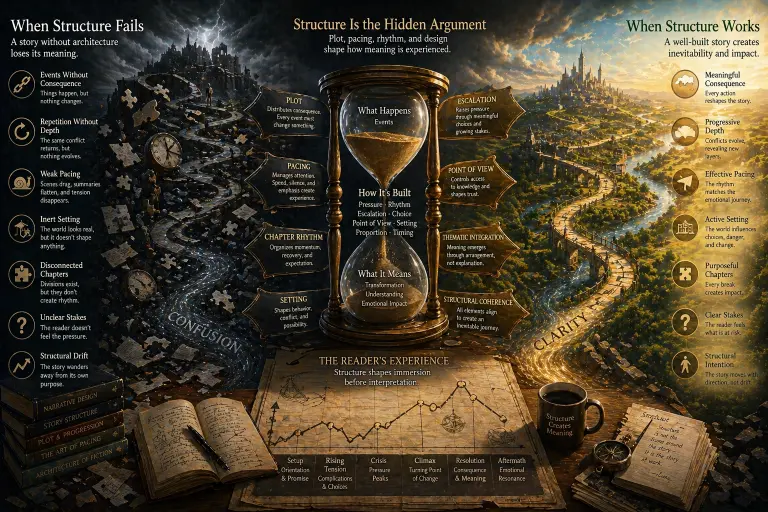
A narrative rarely fails because of its ideas alone. More often, it weakens at the level of structure—where pacing loses pressure, scenes repeat without consequence, chapters collapse into summary, or a promising setting remains dramatically inert. Readers frequently describe such problems as a book feeling “slow,” “unfinished,” or “uneven,” but these reactions are usually responses to architecture rather than theme. Structural critique begins by asking not what a story means, but how it has been built to produce meaning in the first place.