

Contemporary Fiction and the Inheritance of Fragmentation: Narrative After Modernism. If literary modernism marked the collapse of certainty, contemporary fiction inherits its aftermath. The novel of the last decade does not simply replicate modernist experimentation; it recontextualizes it within a world shaped by digital acceleration, global interdependence, and a persistent crisis of meaning. Where modernist writers confronted rupture as a shock, contemporary authors write from within it as a condition. Fragmentation is no longer an innovation. It is the ground upon which narrative now stands.
This shift has profound consequences for how stories are told. Contemporary fiction does not ask whether coherence is possible in the traditional sense. Instead, it explores how meaning can be constructed in a landscape where time, identity, and truth are continuously mediated and destabilized. The result is a body of work that is formally diverse yet philosophically aligned: a literature attentive to ambiguity, resistant to closure, and deeply invested in the textures of lived experience.

From Experiment to Condition: Living Inside Fragmentation
To understand contemporary fiction, it is necessary to recognize that many of the techniques once associated with modernist experimentation have become normalized. Non-linear timelines, shifting perspectives, and unreliable narrators are no longer disruptive in themselves. Readers have learned to navigate these forms. What was once disorienting is now expected.
However, this normalization does not mean that fragmentation has lost its significance. On the contrary, it has deepened. In contemporary novels, fragmentation often reflects not a singular historical trauma, but an ongoing state of dispersal. The experience of scrolling through multiple narratives online, the collapse of public consensus, and the constant negotiation of identity across platforms all shape how stories are constructed and perceived.
Consider how a contemporary novel might move between timelines not to mimic memory alone, but to reflect the simultaneity of digital life. A character may recall the past, respond to messages in the present, and anticipate future consequences within the same narrative breath. Time becomes layered rather than broken, and the reader is asked to inhabit that layering without the expectation of full resolution.

Concrete Voices in an Abstract Landscape
Despite its philosophical concerns, contemporary fiction remains grounded in the specificity of individual lives. One of its defining strengths is its ability to translate large-scale uncertainty into intimate, recognizable experiences. Rather than speaking in purely abstract terms, many recent novels anchor their formal experimentation in the daily realities of their characters.
For instance, a story may follow a protagonist navigating urban isolation, where the fragmentation of narrative mirrors the fragmentation of social connection. Short, disjointed scenes may reflect interrupted conversations, fleeting encounters, and the constant presence of mediated communication. In another case, a novel might employ multiple narrators to explore conflicting versions of a shared event, emphasizing how truth itself becomes contingent on perspective.
These strategies do more than illustrate literary technique. They invite the reader to recognize their own experience within the text. The difficulty of assembling meaning from partial information is no longer confined to the page; it echoes the reader’s engagement with the world beyond it.
The Return of Story—Without Illusion
One of the most interesting developments in contemporary fiction is the partial return to storytelling structures that modernism once rejected. Plot, character development, and even elements of suspense have re-emerged as central features. Yet this return is not a simple revival. It is a transformation.
Contemporary novels often employ recognizable narrative arcs while simultaneously questioning their validity. A story may appear to move toward resolution, only to undermine it at the final moment. A character’s apparent growth may be revealed as provisional or incomplete. Closure is offered, but it is rarely absolute.
This tension creates a distinctive reading experience. The reader is drawn into the familiar rhythms of storytelling while being reminded of their limitations. The novel becomes a space where narrative desire—the desire for coherence, for meaning—is both acknowledged and interrogated.
Ethics in the Age of Uncertainty
Like their modernist predecessors, contemporary writers engage with ethical questions through form as much as content. The challenge is no longer simply how to represent a fractured world, but how to do so responsibly in a context where representation itself is contested.
Issues of voice, authority, and perspective are central. Who has the right to tell a story? How can a narrative account for experiences beyond its immediate frame? These questions shape not only what is written, but how it is structured. Multiplicity of voices, shifts in point of view, and deliberate gaps in narration all function as ethical strategies.
At the same time, contemporary fiction often resists the temptation to provide definitive answers. It stages ethical dilemmas rather than resolving them. A novel may present conflicting accounts of an event without privileging one as the final truth. In doing so, it reflects a broader cultural awareness of complexity and the limits of singular narratives.
The Influence of Global and Cultural Intersections
Another defining feature of contemporary fiction is its engagement with global perspectives. The last decade has seen an increasing emphasis on stories that cross cultural, linguistic, and geographical boundaries. This expansion brings new forms of narrative experimentation, as writers draw on diverse traditions and storytelling practices.
In some cases, this results in hybrid forms that blend oral storytelling techniques with written narrative. In others, it produces novels that shift between languages or cultural frameworks, challenging the reader to navigate unfamiliar contexts. These works do not simply add diversity to the literary landscape; they reshape its formal possibilities.
The global dimension of contemporary fiction also complicates the notion of a unified literary movement. Rather than a single dominant style, there is a constellation of approaches, each responding to specific historical and cultural conditions. What unites them is not uniformity, but a shared engagement with the complexities of a connected yet fragmented world.
Reading as Participation
One of the most significant continuities between modernist and contemporary fiction is the role of the reader. In both cases, reading is not a passive act. It requires attention, interpretation, and a willingness to engage with uncertainty.
However, contemporary fiction extends this demand in new ways. The reader is often asked to navigate multiple layers of meaning simultaneously, to reconcile conflicting perspectives, and to accept that some questions may remain unresolved. This is not a failure of the text. It is a deliberate invitation to participate in the construction of meaning.
For many readers, this can be challenging. The absence of clear answers may feel unsettling. Yet it is precisely this discomfort that gives contemporary fiction its relevance. It mirrors the conditions of a world in which information is abundant, but certainty is scarce.
Balancing Accessibility and Complexity
A key tension in contemporary fiction lies in the balance between accessibility and complexity. Writers must navigate the expectations of a broad readership while maintaining the depth and rigor that define serious literary work. This tension is not easily resolved, and different authors approach it in different ways.
Some novels lean toward clarity, using straightforward language and structure to explore complex themes. Others embrace difficulty, challenging the reader with dense prose and intricate narrative designs. Neither approach is inherently superior. What matters is the alignment between form and intention.
From a broader perspective, this diversity of approaches is a strength. It allows contemporary fiction to reach a wide audience while continuing to push the boundaries of what the novel can do. The coexistence of accessibility and experimentation reflects the multiplicity of the contemporary literary landscape.
Why Contemporary Fiction Matters Now
The significance of contemporary fiction lies not only in its formal innovations, but in its capacity to engage with the realities of the present moment. In a time characterized by rapid change, social fragmentation, and competing narratives, the novel offers a space for sustained reflection.
It does not provide simple answers. Instead, it cultivates a mode of attention that is increasingly rare: the ability to dwell in complexity, to consider multiple perspectives, and to resist the pressure for immediate resolution. These are not merely literary skills. They are essential capacities for navigating contemporary life.
Moreover, contemporary fiction continues to evolve. New voices, new technologies, and new cultural contexts ensure that the novel remains a dynamic and responsive form. Its future is not fixed, but open—shaped by the ongoing interaction between writers, readers, and the world they inhabit.
Digital preservation initiatives like the Internet Archive continue to play a central role in safeguarding literary memory.
Conclusion: After Fragmentation, Toward Possibility
Contemporary fiction stands at a crossroads between inheritance and innovation. It carries forward the insights of modernism—the recognition of fragmentation, the skepticism toward coherence—while seeking new ways to engage with these conditions. It does not attempt to restore a lost sense of certainty. Instead, it explores what becomes possible in its absence.
The result is a literature that is both challenging and deeply human. It acknowledges the difficulties of making meaning in a complex world, but it also affirms the value of the attempt. Through its varied forms and voices, contemporary fiction invites readers to participate in this ongoing process—to read not for easy answers, but for a richer understanding of what it means to live, think, and imagine in the present.

Bibliographic Foundation
This analysis was conducted under the Sanctum's methodological rigor, utilizing exegetical protocols grounded in universal heritage repositories and documented preservation archives.
View Authority FoundationsAnalytical Recommendations

Literature and the Burden of Memory: Race, Identity, and the Reconstruction of Human Dignity
Literature and the Burden of Memory: Race, Identity, and the Reconstruction of Human Dignity. Literature assumes its most transformative function when it confronts histories that resist closure. There are pasts that do not remain confined to chronology—pasts that persist as structure, as inheritance, as unresolved presence within the present. In such contexts, narrative becomes more than representation; it becomes a site of reckoning. It gives form to experiences that have been suppressed, fragmented, or systematically excluded from dominant historical accounts.
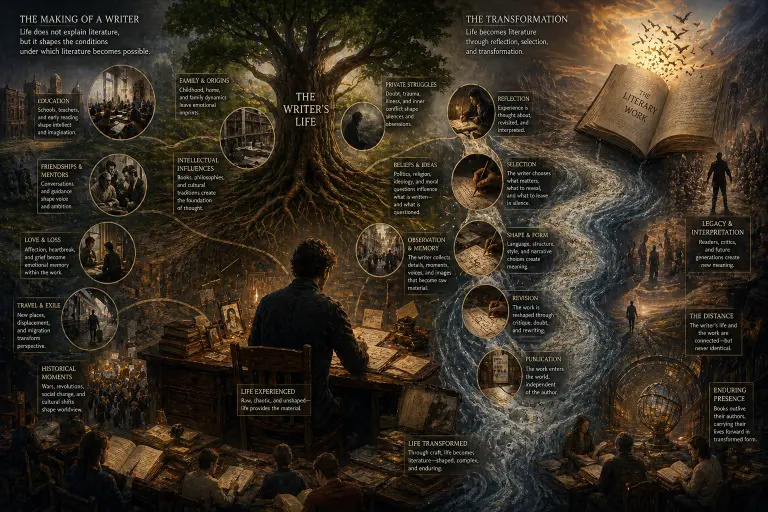
The Imprint of Experience: Why Author Biography Matters for Critical Reading
To study a writer’s life is not to search for a simple key that unlocks every page they produced. Literature does not function as disguised autobiography, nor can the complexity of a novel, a poem, or an essay be reduced to a sequence of personal events. Yet no major work emerges from abstraction alone. Writers are formed by education, exile, friendships, losses, political climates, intellectual traditions, and private contradictions. Their works carry these pressures—sometimes visibly, sometimes only as structure, silence, or recurring obsession.

The Life Behind the Page: Biography as Context, Not Explanation
To read a writer closely is, inevitably, to sense the life behind the work—not as a simple key that unlocks meaning, but as a field of pressures, experiences, and contradictions that shape what becomes possible on the page. A novel, a poem, or an essay does not emerge in isolation. It carries traces of education, exile, relationships, intellectual influences, and historical circumstance. These traces are rarely explicit, yet they persist, forming a subtle dialogue between lived experience and artistic creation.