

To revisit a classic is not to return to a fixed meaning, but to reopen a conversation. Canonical works endure not because they provide stable answers, but because they continue to generate questions—especially in moments of cultural tension. In the present, where judgment is often immediate and categorical, these texts offer something increasingly rare: a space in which ambiguity is not resolved, but sustained.
When read with attention, the classics function less as monuments and more as instruments. They allow us to examine moral complexity, systemic power, psychological distress, and historical voice through forms that resist simplification. Their value lies not in their authority, but in their capacity to complicate our assumptions about what is true, just, or human.

The “Cancellation” of Characters and the Ethics of Complexity
Contemporary reading practices often approach older texts through a framework of judgment, measuring characters and authors against present-day ethical standards. While this impulse reflects a legitimate concern with accountability, it can also obscure one of the central functions of literature: the exploration of moral ambiguity.
Writers such as Vladimir Nabokov and William Shakespeare construct protagonists who resist clear classification. They are neither wholly admirable nor entirely condemnable. Their actions may be troubling, even reprehensible, yet they are rendered with psychological depth and aesthetic precision.
This tension is not incidental—it is structural. The reader is invited into a space where ethical evaluation cannot be immediate or absolute. Instead, it unfolds gradually, shaped by context, perspective, and contradiction.
Engaging with such characters becomes a form of cognitive training. It requires the suspension of binary judgment in favor of layered interpretation. In a cultural environment that often reduces complexity to opposition—good versus bad, right versus wrong—this capacity is increasingly valuable.
To read these works attentively is not to excuse their characters, but to understand the conditions that produce them. It is to recognize that human behavior rarely conforms to simplified moral categories.
Classics as Manuals for Navigating Surveillance
Many canonical texts, particularly those associated with dystopian or bureaucratic narratives, can be reread as analyses of systems rather than as speculative fictions. George Orwell’s 1984 and Franz Kafka’s The Trial depict environments in which individuals are subject to opaque structures of control—systems that operate through observation, regulation, and procedural abstraction.
While these works emerge from specific historical contexts, their relevance extends into contemporary conditions. The mechanisms they describe—constant monitoring, algorithmic decision-making, and the erosion of privacy—find parallels in digital infrastructures that shape everyday life.
Reading these texts as system analyses reveals patterns that might otherwise remain invisible. Power is not always exercised through direct force; it often operates through processes that appear neutral but carry implicit constraints.
This awareness has practical implications. It encourages a form of intellectual vigilance, prompting readers to question how information is collected, processed, and used. The narrative becomes a model through which broader structures can be examined.
Institutions such as the British Library, the Library of Congress, and academic repositories like JSTOR preserve critical editions and scholarly analyses that continue to explore how these works engage with questions of authority, surveillance, and systemic power.
Nineteenth-Century Melancholy and Contemporary Anxiety
The emotional landscapes of nineteenth-century literature are often characterized by introspection, alienation, and a pervasive sense of dissatisfaction—phenomena sometimes described as the “mal du siècle.” Writers such as Johann Wolfgang von Goethe and Machado de Assis articulate forms of psychological unease that resonate with contemporary experiences of anxiety and burnout.
These texts do not present distress as an anomaly. Instead, they situate it within broader social and existential conditions. Characters struggle not only with personal dilemmas, but with questions of purpose, identity, and belonging.
This continuity challenges the perception that modern psychological strain is entirely unprecedented. While its forms may differ, the underlying experience of dislocation has a longer history. Literature provides a record of this continuity, offering insight into how such states have been understood and expressed across time.
Engaging with these works can have a normalizing effect. It reframes distress as part of a shared human condition rather than as an isolated failure. By encountering these representations, readers may find language for experiences that resist simple articulation.
Postcolonial Rewritings and the Right to Narrative
One of the most significant developments in modern literary discourse is the emergence of texts that respond directly to canonical works, particularly those rooted in colonial perspectives. These rewritings do not merely reinterpret earlier narratives—they reposition them, shifting the center of perspective.
The dialogue between Joseph Conrad’s Heart of Darkness and the critical responses it has generated, including those associated with Chinua Achebe, illustrates this process. What was once presented as a singular narrative is revealed to be partial, shaped by the assumptions and limitations of its context.
Postcolonial literature extends this critique by offering alternative accounts—voices that were previously marginalized or excluded. These works do not simply add new content; they alter the structure of interpretation itself.
Reading across these perspectives requires attention to what is said and what has been omitted. It involves recognizing that narratives are embedded within systems of power, and that these systems influence whose voices are heard.

Reading Between Lines: Power and Structure
The reevaluation of canonical texts reveals that literature is not only a reflection of its time, but also a participant in the construction of cultural frameworks. It shapes how histories are told, how identities are represented, and how authority is distributed.
To read critically is to engage with these structures. It is to examine not only the content of a narrative, but the conditions under which it was produced and received. This approach does not diminish the value of the classics—it expands it.
By situating these works within broader contexts, readers can move beyond passive consumption toward active interpretation. The text becomes a site of inquiry rather than a fixed object.
Why These Perspectives Matter Today
The contemporary relevance of the classics lies in their capacity to address enduring questions through complex forms. They provide frameworks for understanding moral ambiguity, systemic control, psychological distress, and historical voice.
These are not abstract concerns. They intersect with everyday experiences—how we evaluate others, how we interpret information, how we understand ourselves, and how we engage with the past.
Literature offers no definitive solutions. What it provides instead is a space in which these questions can be explored with depth and nuance.
Continue Exploring Literary History
If you are interested in how canonical works evolve over time, you may also explore our essays on critical reinterpretation, narrative theory, and postcolonial literature.
Readers seeking further depth may revisit our long-form studies on authorship, historical context, and the transformation of literary authority.
Frequently Asked Questions
Should we judge classic authors by modern standards?
It is possible to evaluate ethical dimensions while still recognizing the complexity and historical context of their work.
Why are dystopian classics still relevant?
Because they analyze systems of control and surveillance that continue to evolve in contemporary forms.
What is postcolonial rewriting?
A literary approach that reinterprets canonical texts from previously marginalized perspectives.
Can literature help with understanding mental health?
Yes, by providing language and context for experiences that persist across different historical periods.
Reviewed for editorial quality, analytical depth, and historical awareness.
Conclusion: The Living Archive of Complexity
The classics endure not because they resolve the tensions they present, but because they preserve them. They remain active sites of interpretation, capable of generating new meanings as contexts change.
To engage with these works today is to participate in an ongoing dialogue—one that extends beyond literature into questions of ethics, power, and human experience. The value of this engagement lies not in reaching final conclusions, but in developing the capacity to think with greater nuance.
In this sense, the classics are not relics of the past. They are tools for navigating the present.

Bibliographic Foundation
This analysis was conducted under the Sanctum's methodological rigor, utilizing exegetical protocols grounded in universal heritage repositories and documented preservation archives.
View Authority FoundationsAnalytical Recommendations
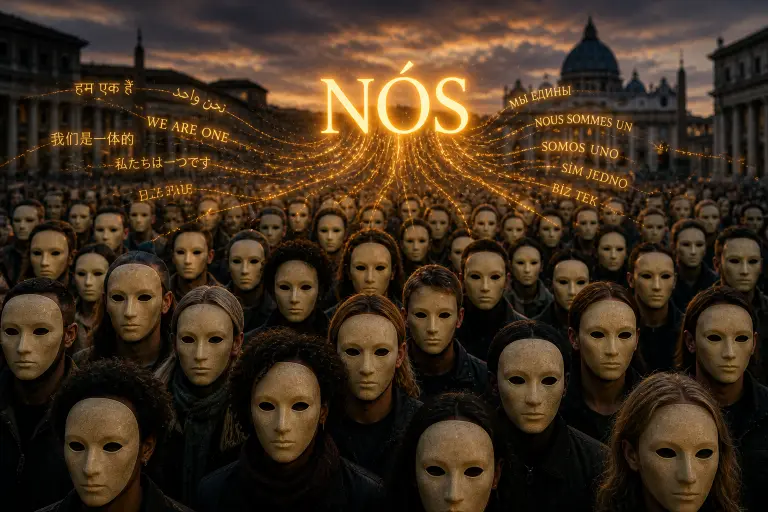
Narrative Voice as Cognitive Practice: Beyond the Aesthetic Experience
Narrative voice is often approached as a literary device—an artistic decision that shapes how a story is told. Yet its implications extend far beyond the page. The way a voice constructs reality, withholds information, or invites identification mirrors the mechanisms through which we interpret the world itself. In this sense, reading is not only an aesthetic experience; it is a cognitive exercise. It trains perception, refines judgment, and expands the boundaries of empathy.

Architectures of Mind: Perspective as Psychological Embodiment
Narrative perspective is often treated as a technical choice—a question of who speaks and from what distance. Yet in its most sophisticated forms, perspective is not simply a matter of viewpoint. It is a psychological architecture. It determines not only what the reader sees, but how reality itself is filtered, distorted, or intensified. Two of the most powerful strategies in modern fiction—the unreliable narrator and deep internal focus—demonstrate how perspective can move beyond description into embodiment.
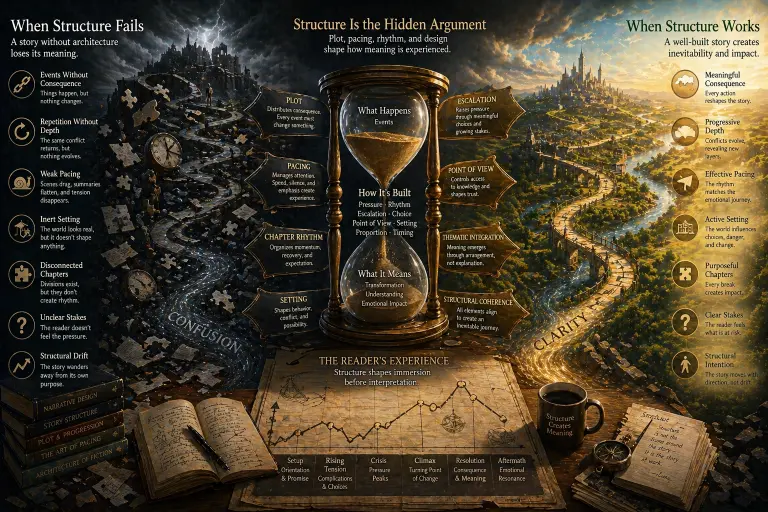
The Hidden Architecture: Why Structural Critique is the Key to Narrative Mastery
A narrative rarely fails because of its ideas alone. More often, it weakens at the level of structure—where pacing loses pressure, scenes repeat without consequence, chapters collapse into summary, or a promising setting remains dramatically inert. Readers frequently describe such problems as a book feeling “slow,” “unfinished,” or “uneven,” but these reactions are usually responses to architecture rather than theme. Structural critique begins by asking not what a story means, but how it has been built to produce meaning in the first place.