

The enduring relevance of classical literature lies not in its distance from modern life, but in its unsettling proximity to it. Beneath the differences of language, setting, and form, many canonical works operate as early models of systems that continue to structure contemporary experience. Desire, attention, persuasion, and fear—these are not new phenomena. What changes is their medium. The logic that once governed drawing rooms, public squares, and gothic castles now reappears in digital interfaces, algorithmic feeds, and technological anxieties.
To read the classics with this awareness is to recognize them not as relics, but as analytical frameworks. They reveal that what appears uniquely modern is often an evolution of older structures—refined, accelerated, and obscured by new forms.

The Economy of Desire: From Social Contracts to Algorithmic Matching
In the novels of Jane Austen and Honoré de Balzac, romantic relationships are inseparable from systems of value. Marriage is not merely an emotional union; it is an economic and social transaction shaped by class, reputation, and material stability. Desire operates within constraints, negotiated through visibility, status, and strategic positioning.
While contemporary culture often frames love as a domain of personal freedom, the underlying structures have not disappeared—they have been reformulated. Digital dating platforms transform social capital into quantifiable signals: profiles, metrics, and patterns of selection. Attraction becomes, in part, a function of visibility within a system designed to optimize engagement.
This shift introduces a form of “gamification,” where interactions are mediated by algorithms that prioritize certain behaviors and profiles. The dynamics of selection—who is seen, who is chosen, who is excluded—echo earlier systems of social stratification, albeit in a different medium.
Reading Austen or Balzac in this context reveals continuity rather than rupture. The conditions that shape desire—status, scarcity, competition—persist, even as their expressions evolve. Recognizing this can reframe contemporary frustrations not as individual failures, but as structural outcomes.
Stoicism and the Discipline of Attention
Nineteenth-century literature often demands a form of engagement that contrasts sharply with contemporary habits of consumption. Works by Marcel Proust or Victor Hugo unfold slowly, requiring sustained attention and tolerance for complexity. Their narratives are not optimized for immediacy; they are structured for depth.
This mode of reading functions as a cognitive discipline. It trains the capacity to hold extended sequences of thought, to follow intricate developments, and to remain present within a narrative that resists acceleration. In an environment shaped by rapid information exchange and fragmented attention, this capacity becomes increasingly rare.
The value of such texts lies not only in their content, but in the form of engagement they require. They cultivate a form of mental endurance—an ability to remain with complexity rather than seeking immediate resolution.
From this perspective, reading becomes less a passive activity and more a form of training. It strengthens cognitive processes that are often diminished by environments designed for speed and distraction.
Institutions such as the British Library, the Library of Congress, and academic repositories like JSTOR continue to preserve and analyze these works, offering insight into how literary form intersects with cognition and attention.
Rhetoric, Crowds, and the Architecture of Influence
The plays of William Shakespeare provide a detailed study of how language shapes collective perception. Characters such as Iago in Othello and Mark Antony in Julius Caesar demonstrate how carefully constructed speech can alter public opinion, manipulate emotion, and redirect collective action.
These rhetorical strategies remain relevant in contemporary environments, where information circulates rapidly and emotional responses are amplified through digital networks. The mechanisms of persuasion—appeals to fear, selective framing, repetition—operate with similar effectiveness, though on a different scale.
Shakespeare’s work reveals that influence is rarely exerted through direct assertion. It often functions through implication, suggestion, and the strategic arrangement of information. The audience is guided toward conclusions that appear self-generated, even when they have been carefully engineered.
Understanding these mechanisms provides a form of rhetorical awareness. It enables readers to recognize when discourse is structured to provoke reaction rather than reflection, and to identify the emotional triggers embedded within persuasive language.
Gothic Horror and the Anxiety of Creation
The gothic tradition, particularly in works such as Mary Shelley’s Frankenstein and Bram Stoker’s Dracula, articulates a persistent anxiety: the fear that human creation may exceed human control. These narratives explore the consequences of crossing boundaries—scientific, ethical, and existential.
While their imagery is often associated with the supernatural, their underlying concerns are deeply material. They question the limits of knowledge, the responsibilities of creation, and the unintended outcomes of innovation.
In contemporary contexts, these themes resonate with debates surrounding artificial intelligence, biotechnology, and other forms of advanced research. The figure of the “monster” can be reinterpreted as a projection of these anxieties—a representation of what emerges when systems operate beyond their intended scope.
Reading gothic literature through this lens transforms it from a genre of fear into a form of ethical inquiry. It provides a vocabulary for discussing the risks associated with progress, emphasizing that innovation is never neutral.

Reading Systems, Not Stories
Across these examples, a pattern emerges: classical literature encodes systems of behavior, perception, and power that remain active in contemporary life. Whether examining desire, attention, persuasion, or technological anxiety, these texts offer models that can be applied beyond their original contexts.
This approach does not diminish their aesthetic value. It expands it. The narrative becomes both an artistic construction and an analytical tool, capable of revealing structures that might otherwise remain implicit.
Why This Perspective Matters
In environments shaped by complexity and rapid change, the ability to recognize underlying patterns becomes essential. Literature provides a framework for developing this capacity, offering structured representations of systems that can be examined and interpreted.
The insights gained are not confined to literary analysis. They inform how individuals understand relationships, manage attention, interpret discourse, and engage with technological developments.
Reading, in this sense, becomes a form of preparation—a way of encountering complexity in a controlled space before facing it in less predictable contexts.
Continue Exploring Literary Structures
If you are interested in how classical works illuminate contemporary systems, you may also explore our essays on narrative theory, structural critique, and literary history.
Readers seeking further depth may revisit our long-form studies on cognition, rhetoric, and the relationship between literature and modern life.
Frequently Asked Questions
Are classical works still relevant today?
Yes, because they reveal enduring patterns in human behavior and social organization.
Can literature help improve focus?
Extended engagement with complex texts can strengthen attention and cognitive endurance.
What can Shakespeare teach about modern communication?
His works analyze how language influences perception and collective behavior.
Why revisit gothic literature in a technological age?
Because it explores ethical questions about creation and control that remain highly relevant.
Reviewed for editorial quality, analytical depth, and interdisciplinary relevance.
Conclusion: The Persistence of Structure
The distance between classical literature and contemporary life is less significant than it appears. The forms have changed, but the underlying structures persist. Desire is still shaped by systems, attention is still contested, language still persuades, and creation still carries risk.
To read the classics with this awareness is to recognize continuity within transformation. It is to see the present not as a break from the past, but as its extension—reconfigured through new mediums, yet governed by familiar dynamics.
In that recognition, literature becomes more than memory. It becomes a method of understanding the world as it is now.

Bibliographic Foundation
This analysis was conducted under the Sanctum's methodological rigor, utilizing exegetical protocols grounded in universal heritage repositories and documented preservation archives.
View Authority FoundationsAnalytical Recommendations
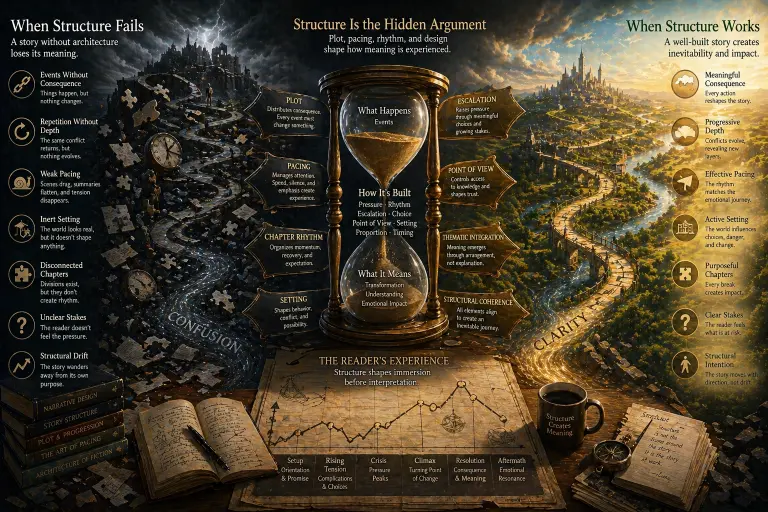
The Hidden Architecture: Why Structural Critique is the Key to Narrative Mastery
A narrative rarely fails because of its ideas alone. More often, it weakens at the level of structure—where pacing loses pressure, scenes repeat without consequence, chapters collapse into summary, or a promising setting remains dramatically inert. Readers frequently describe such problems as a book feeling “slow,” “unfinished,” or “uneven,” but these reactions are usually responses to architecture rather than theme. Structural critique begins by asking not what a story means, but how it has been built to produce meaning in the first place.

The Lord of the Rings: Mythopoesis, Power, and the Theology of Hope
ew works of modern literature have constructed a moral universe with the depth and coherence of The Lord of the Rings. Frequently remembered for its epic battles, vast geography, and mythic gravitas, the narrative resists reduction to spectacle alone. Beneath its grand scale lies a disciplined ethical inquiry into power: how it seduces, how it corrodes intention, and how resistance often emerges not from heroic exceptionalism, but from ordinary fidelity to what is small, local, and fragile.
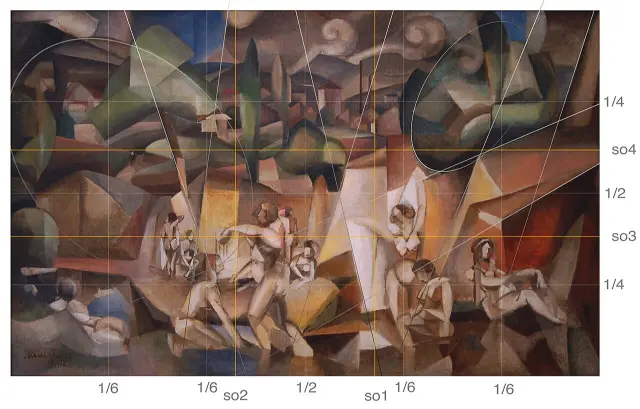
Modernism and the Wreckage of Certainty: Literature in the Age of Fractured Time
Modernism and the Wreckage of Certainty: Literature in the Age of Fractured Time. Literary modernism did not arise as a stylistic fashion. It emerged as a philosophical rupture. The early twentieth century confronted writers with a world whose inherited frameworks of meaning had begun to fail under the pressure of unprecedented historical shocks. Industrial acceleration, mechanized warfare, the collapse of empires, and the erosion of religious and social certainties produced not merely political instability, but epistemic disorientation.