Latest Posts

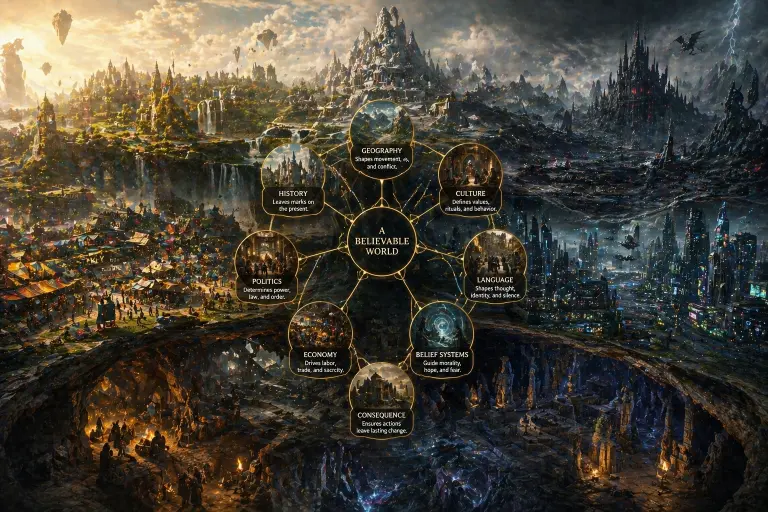
Internal Inevitability: The Hidden Architecture of Immersive Worldbuilding

Internal Inevitability: The Hidden Architecture of Immersive Worldbuilding

A fictional world succeeds not when it appears infinitely large, but when it feels internally inevitable. Readers do not enter narrative environments because every mountain has been mapped or every dynasty fully documented; they enter because the world behaves as though it could continue existing beyond the page. Coherence creates immersion. The illusion of reality depends less on quantity of detail than on the disciplined relationship between setting, causality, memory, and consequence.

Read More →


The Architecture of Authority: Evaluating Depth in Serious Non-Fiction

The Architecture of Authority: Evaluating Depth in Serious Non-Fiction

Serious non-fiction asks more of the reader than agreement. It does not simply present information, nor does it exist merely to confirm what its audience already suspects to be true. At its strongest, research-based non-fiction creates a disciplined encounter with complexity: it organizes evidence, tests assumptions, challenges inherited narratives, and demands intellectual patience. Whether the subject is history, politics, science, philosophy, economics, or cultural criticism, the work succeeds not because it is persuasive in tone, but because it earns authority through structure, method, and precision.

Read More →
Unstable Classics: Why Canonical Literature Requires Constant Reinterpretation

Unstable Classics: Why Canonical Literature Requires Constant Reinterpretation

anonical literature survives not because it remains untouched by time, but because each generation returns to it with new anxieties, new intellectual frameworks, and new moral questions. A classic does not endure through static reverence; it endures through reinterpretation. What once seemed settled becomes unstable again, and familiar texts reveal tensions that earlier readers either ignored or considered irrelevant. To revisit a classic seriously is not to dismantle its authority for the sake of novelty, but to test whether its meanings remain alive under contemporary scrutiny.

Read More →
The Life Behind the Page: Biography as Context, Not Explanation

The Life Behind the Page: Biography as Context, Not Explanation

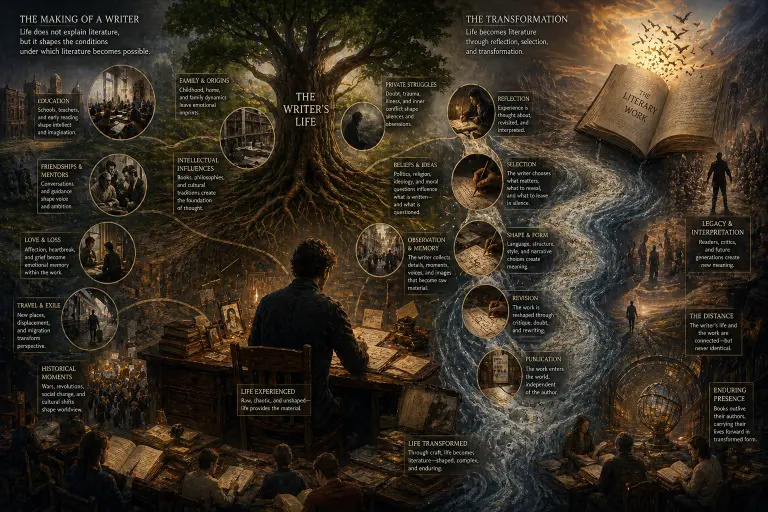
To read a writer closely is, inevitably, to sense the life behind the work—not as a simple key that unlocks meaning, but as a field of pressures, experiences, and contradictions that shape what becomes possible on the page. A novel, a poem, or an essay does not emerge in isolation. It carries traces of education, exile, relationships, intellectual influences, and historical circumstance. These traces are rarely explicit, yet they persist, forming a subtle dialogue between lived experience and artistic creation.

Read More →
The Invisible Craft: Consistency and Coherence in Narrative Environments

The Invisible Craft: Consistency and Coherence in Narrative Environments

Astory rarely announces the rules of its world outright. Instead, it teaches the reader how to see. A gesture here, a constraint there, a detail that seems incidental until it quietly proves decisive—these are the building blocks of immersion. What matters is not how much is explained, but how naturally everything holds together. When a narrative environment feels convincing, it is because its logic has been absorbed rather than declared, experienced rather than outlined.

Read More →
The Imprint of Experience: Why Author Biography Matters for Critical Reading

The Imprint of Experience: Why Author Biography Matters for Critical Reading

To study a writer’s life is not to search for a simple key that unlocks every page they produced. Literature does not function as disguised autobiography, nor can the complexity of a novel, a poem, or an essay be reduced to a sequence of personal events. Yet no major work emerges from abstraction alone. Writers are formed by education, exile, friendships, losses, political climates, intellectual traditions, and private contradictions. Their works carry these pressures—sometimes visibly, sometimes only as structure, silence, or recurring obsession.

Read More →

Most Visited Posts

The Chronicles of Narnia: A Literary Architecture of Meaning, Myth, and Moral Imagination

The Chronicles of Narnia: A Literary Architecture of Meaning, Myth, and Moral Imagination

Few works of twentieth-century literature have achieved the rare balance of popular enchantment and intellectual endurance quite like The Chronicles of Narnia.

Read More →
The Little Prince: A Philosophy of Tenderness, Responsibility, and the Tragedy of Growing Up

The Little Prince: A Philosophy of Tenderness, Responsibility, and the Tragedy of Growing Up

Few works of modern literature occupy such a paradoxical space in cultural memory as The Little Prince. It is frequently categorized as a children’s tale, gifted to young readers with the assumption of simplicity, yet it is quietly revered by adults as a meditation on loss, love, and moral perception.

Read More →
The Great Gatsby: Desire, Illusion, and the Fragile Architecture of the American Dream

The Great Gatsby: Desire, Illusion, and the Fragile Architecture of the American Dream

Few novels have captured the moral texture of an era with the quiet precision of The Great Gatsby. Often remembered for its glittering parties, tragic romance, and iconic imagery, the novel resists reduction to a story of excess alone. Beneath its surface elegance lies a rigorous examination of desire—how it is shaped by illusion, sustained by fantasy, and ultimately undone by the collision between imagined futures and stubborn realities.

Read More →
Realism and the Discipline of the Ordinary: Literature in the Age of Social Visibility

Realism and the Discipline of the Ordinary: Literature in the Age of Social Visibility

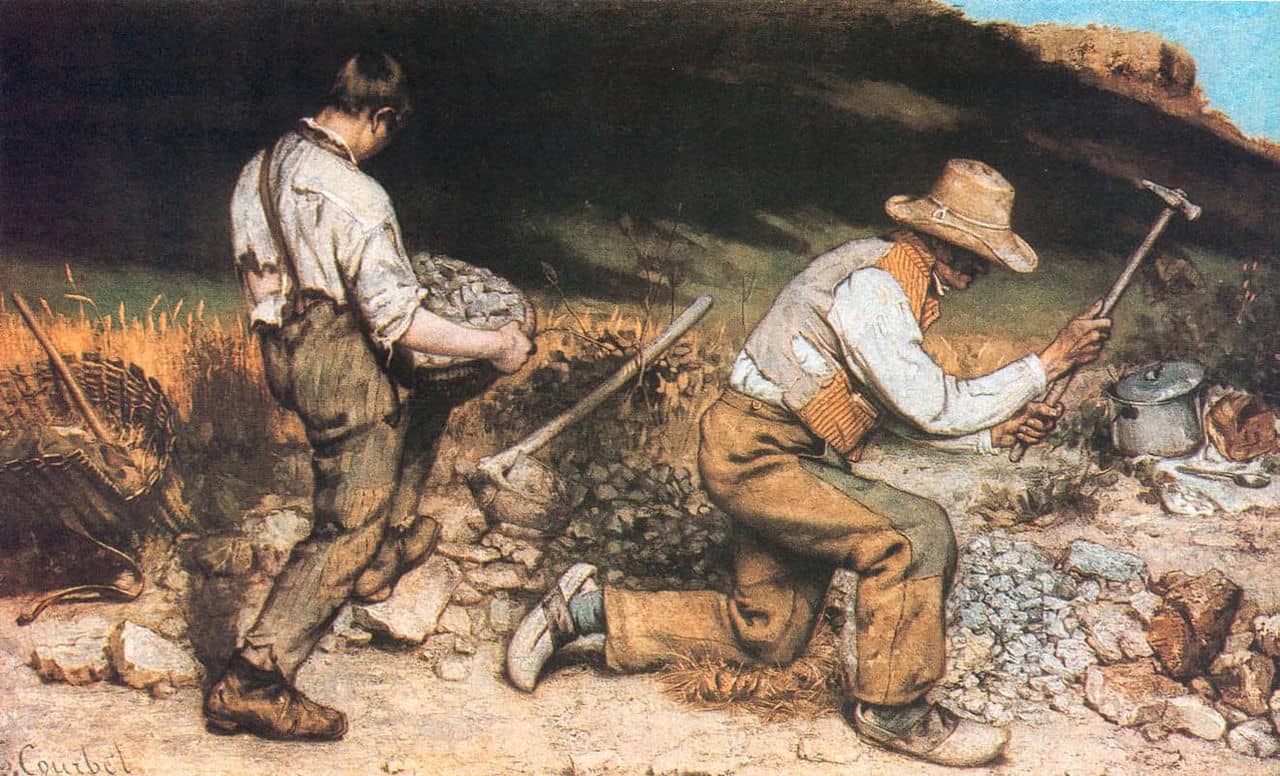
Realism and the Discipline of the Ordinary: Literature in the Age of Social Visibility. If Romanticism elevated the inner world and imagination as a response to mechanized reality, Realism emerges as a corrective movement—one that redirects attention outward, toward the material, social, and economic conditions shaping human existence. Far from a rejection of depth, Realism represents a reorientation of it. It insists that meaning is not found only in transcendence or subjective intensity, but in the structures of everyday life: work, class, institutions, and the quiet pressures of social expectation.

Read More →
Modernism and the Wreckage of Certainty: Literature in the Age of Fractured Time

Modernism and the Wreckage of Certainty: Literature in the Age of Fractured Time

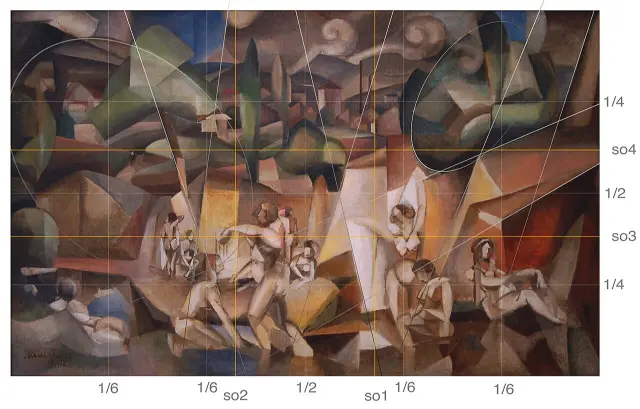
Modernism and the Wreckage of Certainty: Literature in the Age of Fractured Time. Literary modernism did not arise as a stylistic fashion. It emerged as a philosophical rupture. The early twentieth century confronted writers with a world whose inherited frameworks of meaning had begun to fail under the pressure of unprecedented historical shocks. Industrial acceleration, mechanized warfare, the collapse of empires, and the erosion of religious and social certainties produced not merely political instability, but epistemic disorientation.

Read More →
1984: Power, Language, and the Architecture of Psychological Domination

1984: Power, Language, and the Architecture of Psychological Domination

Few novels have entered the cultural bloodstream with the enduring force of Nineteen Eighty-Four. Frequently invoked in political rhetoric and popular discourse, the book is often reduced to a set of familiar images: omnipresent surveillance, totalitarian authority, the erasure of privacy.

Read More →