

Canonical literature survives not because it remains untouched by time, but because each generation returns to it with new anxieties, new intellectual frameworks, and new moral questions. A classic does not endure through static reverence; it endures through reinterpretation. What once seemed settled becomes unstable again, and familiar texts reveal tensions that earlier readers either ignored or considered irrelevant. To revisit a classic seriously is not to dismantle its authority for the sake of novelty, but to test whether its meanings remain alive under contemporary scrutiny.
For too long, the language surrounding literary masterpieces has encouraged distance rather than engagement. Certain books are treated as monuments—admired, cited, and preserved, yet rarely interrogated with urgency. This reverential approach often transforms reading into obligation rather than discovery. A work enters the canon and becomes protected by tradition, insulated from the very critical energy that once made it significant. Re-discussing classics requires resisting that passivity.
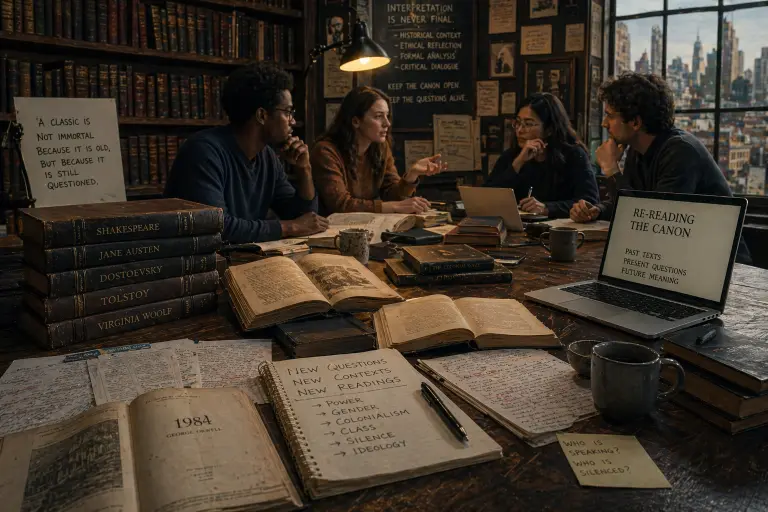
Why Classics Must Be Re-read
Every era produces its own reading habits, shaped by political realities, social expectations, and intellectual fashions. A nineteenth-century audience did not approach narrative authority, gender roles, colonial structures, or moral ambiguity in the same way a twenty-first-century reader does. To pretend otherwise is to flatten literature into historical display rather than living discourse.
Re-reading classics means recognizing that interpretation is never final. A text considered morally exemplary in one century may appear ethically unstable in another. A marginal character once dismissed may become central under new critical attention. Questions of class, race, power, gender, labor, and silence often expose dimensions of a work that traditional readings left unexamined.
This is not revisionism for its own sake. It is the natural consequence of serious reading. Literature changes because readers change, and criticism exists precisely to keep that relationship active.
The Canon Is Not Neutral
The idea of the literary canon often arrives with the illusion of inevitability, as though certain books simply rose above history through pure artistic superiority. Yet canons are constructed. They are shaped by institutions, universities, publishing traditions, cultural power, and historical exclusion. What is preserved and taught reflects decisions, not destiny.
To re-discuss classics is therefore also to question how classics became classics. Which voices were elevated? Which were ignored? Which interpretations became dominant because they aligned with cultural authority rather than textual complexity?
This does not mean rejecting canonical works outright. It means reading them with historical awareness. A masterpiece can remain formally brilliant while also participating in structures of exclusion or ideological tension. Critical maturity requires holding both truths at once.
Institutions such as the British Library, the Library of Congress, and scholarly archives like JSTOR continue to preserve the historical records that allow these re-evaluations to remain grounded in evidence rather than assumption.
When Familiar Interpretations Become Too Comfortable
One of the most revealing moments in literary criticism occurs when a familiar interpretation begins to feel suspiciously complete. A reading that explains everything often deserves renewed scrutiny. Simplified consensus can hide unresolved contradictions.
Consider how often tragedy is reduced to moral lesson, or how frequently satire is softened into polite social commentary. Canonical works are often taught through frameworks designed for clarity rather than complexity. Yet the greatest literature rarely offers comfort through certainty. It unsettles.
Re-discussion begins by asking what standard interpretations leave out. Whose perspective has been centered? What ambiguity has been ignored? Which formal choices resist the accepted conclusion?
Sometimes the most radical critical act is simply refusing the inherited summary.
Characters Once Marginal, Now Central
Modern criticism frequently shifts attention away from traditional protagonists and toward figures once treated as peripheral. Servants, women, colonized subjects, secondary narrators, and silent observers often reveal the moral architecture of a text more clearly than its celebrated heroes.
This shift is not merely ideological—it is structural. Peripheral figures frequently expose the limits of narrative authority. They reveal what the text assumes but does not fully articulate. Their absence, silence, or distortion can be as meaningful as direct representation.
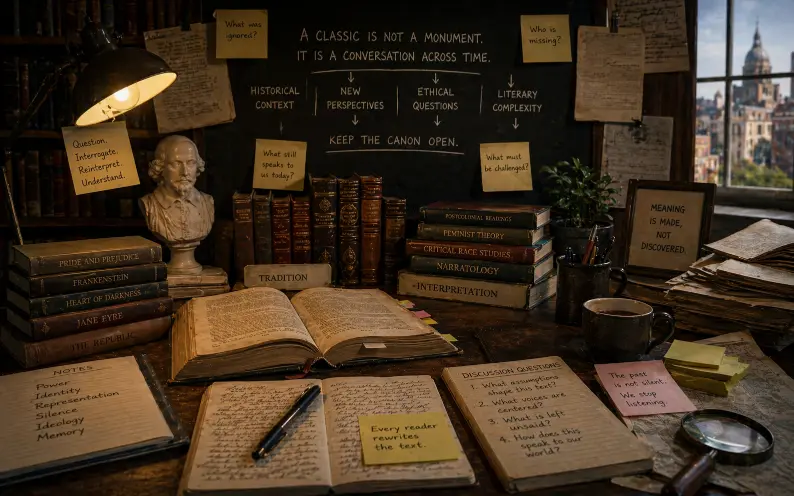
Re-reading through these margins transforms interpretation. A novel centered on individual ambition may also become a study of invisible labor. A romance may reveal itself as a system of economic negotiation. A heroic narrative may expose the cost of empire beneath its elegance.
The classic remains the same text, but not the same experience.
Historical Distance and Ethical Discomfort
Some readers approach classics defensively, afraid that criticism threatens artistic value. Yet ethical discomfort does not diminish literature—it often clarifies it. A text that reflects troubling assumptions about race, gender, or power should not be protected from examination simply because it is old.
Historical context matters, but context is not absolution. Understanding why a work emerged within certain assumptions does not require readers to suspend judgment entirely. Instead, it asks for a more layered response: historical awareness combined with ethical seriousness.
This balance prevents two opposite failures. One is presentism, where the past is condemned without complexity. The other is aesthetic immunity, where artistic prestige excuses every ideological problem. Serious criticism avoids both.
Form Matters as Much as Theme
Contemporary re-evaluation sometimes risks reducing literature to ideological diagnosis alone. While social and ethical questions matter deeply, classics also endure because of formal invention. Narrative structure, rhythm, voice, irony, silence, and symbolic architecture are not decorative—they are central to meaning.
A re-discussed classic must therefore be read both politically and aesthetically. A novel’s treatment of class is inseparable from how its narration distributes attention. A poem’s philosophy emerges through sound as much as statement. Form is argument.
Ignoring formal complexity turns criticism into sociology with quotations. Ignoring historical pressure turns criticism into aesthetic isolation. The richest readings hold both together.
Why Certain Works Refuse to Fade
Not every old book becomes a classic, and not every canonical work deserves permanent immunity. Yet some texts continue to demand attention because they generate interpretation rather than exhaust it. They remain productive.
These works resist closure. Their contradictions are not flaws to be solved but structures that continue to provoke thought. Readers return not because the answers are fixed, but because the questions remain unstable.
This is one reason re-discussion matters. A classic is not simply a book everyone agrees is important. It is a book capable of surviving disagreement.
Why This Perspective Still Matters
In an age of accelerated reading and algorithmic recommendation, classics can appear distant—assigned rather than chosen, symbolic rather than urgent. Re-evaluating them restores relevance. It asks not whether a text deserves respect, but whether it still has something difficult to say.
This matters because literary inheritance shapes cultural imagination. The stories repeatedly taught become part of how societies understand authority, morality, love, ambition, violence, and belonging. To revisit those stories critically is to examine inherited assumptions about the world itself.
Reading classics responsibly therefore becomes a civic as well as intellectual act. It trains attention, skepticism, and interpretive patience—qualities increasingly rare in environments built for speed rather than reflection.
Patterns Across Generations of Reading
Each generation leaves behind a record of how it read the past. Victorian critics, modernists, postcolonial scholars, feminist theorists, and contemporary readers all approach the same texts differently, and those differences reveal as much about the readers as about the works themselves.
Tracking these interpretive shifts is valuable because it shows criticism as history rather than personal opinion. A text does not possess a single permanent meaning waiting to be discovered. It enters a long conversation shaped by cultural change.
This continuity prevents literary study from becoming static. Re-discussion is not an attack on tradition; it is tradition functioning properly.
Continue Exploring Literary Contexts
If you are interested in how enduring works change under new interpretation, you may also explore our essays on narrative memory, symbolic architecture, and the hidden relationship between biography and literary production across modern fiction.
Readers interested in deeper thematic approaches may also revisit our analysis of internal symbolism and evolving authorial voice in long-form narrative traditions.
Frequently Asked Questions
Why should classic literature be re-evaluated?
Because social values, historical knowledge, and critical methods change over time. Re-evaluation helps readers uncover dimensions of a text that earlier interpretations may have overlooked or simplified.
Does criticizing a classic mean rejecting it?
No. Critical engagement strengthens literary understanding. A work can remain artistically significant while still being questioned ethically, politically, or historically.
Can modern readers apply contemporary values to old texts?
Yes, but responsibly. Historical context should inform interpretation, not prevent moral reflection. The goal is balance, not simplistic judgment.
What makes a literary work remain a classic?
Its ability to continue generating meaningful interpretation across generations. Endurance comes from complexity, not from universal agreement.
Reviewed for editorial quality, historical accuracy, and content integrity.
Conclusion: A Canon That Must Stay Open
To re-discuss a classic is not to diminish its stature, but to restore its vitality. Literature becomes irrelevant when it is protected from serious reading. It remains alive when readers are willing to challenge inherited certainty and ask whether the text still speaks under present conditions.
The strongest canonical works do not fear reinterpretation. They demand it. Their permanence lies not in fixed meaning, but in their capacity to produce new thought under changing historical pressure. They survive because they remain unfinished in the mind of the reader.
Classics endure when the canon remains open—when reverence gives way to inquiry, and preservation becomes conversation. In that ongoing dialogue, timeless works are not merely remembered. They are read again, and made newly necessary.

Bibliographic Foundation
This analysis was conducted under the Sanctum's methodological rigor, utilizing exegetical protocols grounded in universal heritage repositories and documented preservation archives.
View Authority FoundationsAnalytical Recommendations
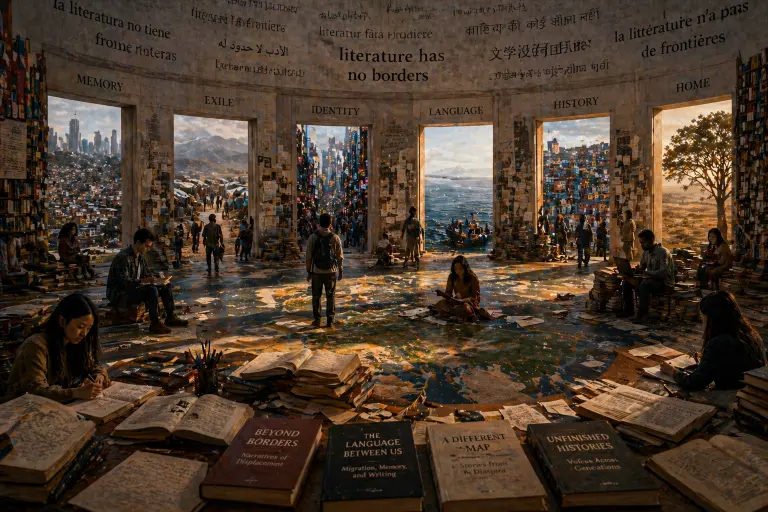
Literature Without a Center: The Structural Rise of Global Diaspora Voices
The contemporary novel is no longer anchored to a single cultural center. Over the last decade, literary authority has shifted in ways that are both visible and structural. The global circulation of prizes, translations, and readership has made one fact increasingly unavoidable: the narratives that define our era are no longer being written exclusively from within traditional Western frameworks. Instead, they emerge from movement—migration, exile, linguistic displacement, and historical fracture.

Literature and the Burden of Memory: Race, Identity, and the Reconstruction of Human Dignity
Literature and the Burden of Memory: Race, Identity, and the Reconstruction of Human Dignity. Literature assumes its most transformative function when it confronts histories that resist closure. There are pasts that do not remain confined to chronology—pasts that persist as structure, as inheritance, as unresolved presence within the present. In such contexts, narrative becomes more than representation; it becomes a site of reckoning. It gives form to experiences that have been suppressed, fragmented, or systematically excluded from dominant historical accounts.

Modernism and the Wreckage of Certainty: Literature in the Age of Fractured Time
Modernism and the Wreckage of Certainty: Literature in the Age of Fractured Time. Literary modernism did not arise as a stylistic fashion. It emerged as a philosophical rupture. The early twentieth century confronted writers with a world whose inherited frameworks of meaning had begun to fail under the pressure of unprecedented historical shocks. Industrial acceleration, mechanized warfare, the collapse of empires, and the erosion of religious and social certainties produced not merely political instability, but epistemic disorientation.