

Every fictional world makes a demand on the reader long before its story fully unfolds. That demand is not only emotional or thematic—it is cognitive. To enter a constructed reality is to accept a system of rules, visible or hidden, that governs how meaning operates inside it. Some worlds explain themselves with rigorous precision, inviting the reader to understand their mechanics in detail. Others withhold explanation, allowing mystery to function as structure. Between these approaches lies a spectrum that defines how immersion is achieved and how curiosity is sustained.
The question is not which method is superior, but how each redistributes attention. Worlds built through exhaustive explanation offer a form of intellectual mastery: the pleasure of understanding how everything works. Worlds built through omission offer a different experience: the sensation that something remains beyond reach, generating wonder rather than certainty. The balance between these modes determines not only how a narrative feels, but how deeply it remains in the reader’s imagination.
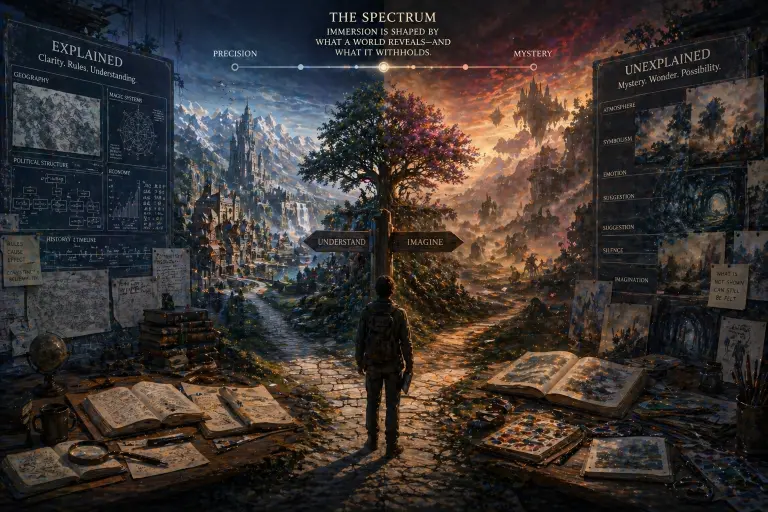
Precision and the Architecture of Understanding
Worlds built through high levels of explicit detail demand a particular form of reader engagement. They invite analysis. Geography is mapped, systems are explained, languages are structured, and causal relationships are clarified. The reader is not only following a narrative—they are learning a system.
J.R.R. Tolkien’s legendarium exemplifies this approach at its most disciplined. The geological consistency of Middle-earth, the linguistic evolution of its languages, and the historical layering of its cultures create a sense of depth that feels almost archival. Nothing appears arbitrary. The world convinces because it behaves as though it could exist independently of the narrative that reveals it.
Brandon Sanderson extends this principle through what might be called system-based imagination. Magic operates according to defined rules, limitations, and internal logic. The reader understands not only what is possible, but why it is possible. This clarity generates a form of immersion grounded in predictability: when rules are known, tension emerges from how those rules are used or broken.
This approach creates intellectual satisfaction. The reader gains control through comprehension. However, it also introduces cognitive weight. Too much explanation risks slowing narrative movement, transforming curiosity into obligation.
Omission and the Preservation of Wonder
At the opposite end of the spectrum lies a different philosophy of world construction: one that relies on strategic silence. Instead of explaining every mechanism, the narrative allows gaps to remain. These gaps are not failures of design—they are deliberate spaces where imagination becomes active.
The films of Hayao Miyazaki, particularly those produced by Studio Ghibli, operate within this logic. Worlds emerge with emotional coherence rather than systematic explanation. Creatures exist without taxonomy. Magic appears without technical framework. Landscapes feel ancient without requiring historical documentation.
This produces a distinct form of immersion. The reader or viewer is not mastering the world—they are encountering it. The experience resembles memory or dream rather than instruction. Meaning arises through association, atmosphere, and symbolic resonance rather than explicit rule.
What is not explained becomes as important as what is shown. Mystery is not a gap to be filled; it is a structural principle that sustains wonder.
The Cognitive Load of Immersion
These two approaches differ fundamentally in how they distribute cognitive effort. Highly detailed worlds require the reader to process information continuously: names, systems, hierarchies, causal chains. This can deepen engagement, but it also risks overload if not carefully balanced.
Minimalist or suggestive worlds reduce informational demand but increase interpretive openness. The reader must tolerate ambiguity, constructing coherence from partial signals. This requires a different kind of attention—less analytical, more intuitive.
Neither mode is inherently easier. Both demand participation, but in different forms. The key lies in alignment: the structure of the world must match the type of experience the narrative intends to create.
Archives and research institutions such as the British Library, the Library of Congress, and academic collections preserved through JSTOR continue to document how authors construct fictional worlds, revealing drafts, maps, and conceptual frameworks that show the balance between explanation and omission in literary creation.
When Explanation Becomes Excess
One of the central risks of highly detailed worldbuilding is overexposure. When every element is explained, the world can lose its sense of depth. Paradoxically, total clarity can flatten imagination. If nothing remains unknown, curiosity has nowhere to move.
This does not mean detail is a flaw. It means detail must be selective. Information gains power through placement. Revealing too much too early can transform discovery into passive reception. The reader stops exploring and begins absorbing.
Strong narrative design understands that explanation should follow necessity, not precede it.
When Mystery Becomes Incoherence
Strategic omission carries its own risk. If too much is withheld, the world may feel arbitrary rather than suggestive. Without sufficient internal consistency, ambiguity can collapse into confusion. Readers may disengage not because they are intrigued, but because they lack orientation.
Effective minimalism depends on invisible structure. Even when rules are not explained, they must exist. The world must behave consistently, even if its logic is never fully articulated. Coherence does not require exposition—but it requires discipline.
The difference between mystery and incoherence lies in trust. The reader must sense that the world could be understood, even if it is not fully revealed.
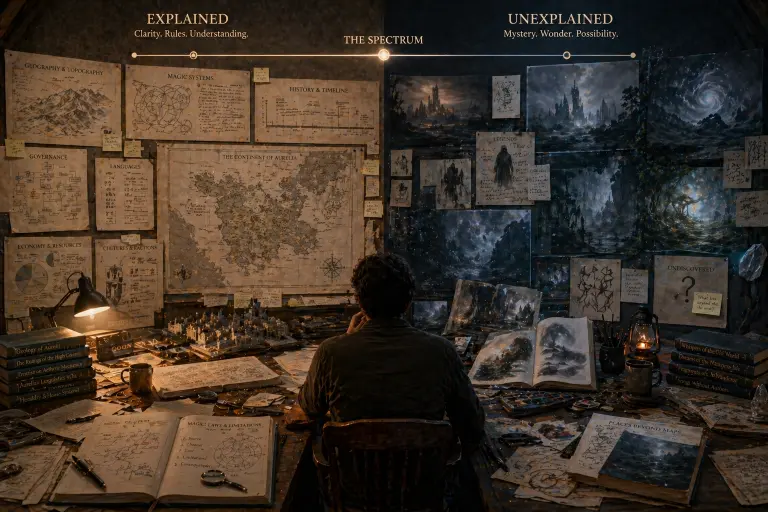
Choosing What Not to Show
The most important decision in worldbuilding is often negative: what to leave out. This choice determines pacing, tone, and the reader’s role within the narrative. Revealing less can create space for imagination; revealing more can anchor the world in tangible reality.
Experienced writers treat omission as a structural tool. They decide which elements must be explicit for coherence and which can remain implicit to sustain curiosity. This balance is dynamic, shifting across the narrative as tension evolves.
In some cases, the same world may move along the spectrum—beginning in mystery and gradually revealing structure, or starting with clarity and introducing uncertainty. The spectrum is not fixed; it is a resource.
Why This Spectrum Matters
Understanding this balance is essential because it shapes how readers inhabit fictional environments. It determines whether immersion feels like exploration, analysis, or revelation. It also influences how long a world remains present after the narrative ends.
Worlds built entirely through explanation may impress but fade once understood. Worlds built entirely through mystery may linger but resist re-entry. The most enduring works often combine both—offering enough structure to sustain engagement and enough absence to keep imagination active.
Immersion is not a function of detail alone. It is a function of controlled disclosure.
Continue Exploring Narrative Worlds
If you are interested in how fictional environments shape storytelling, you may also explore our essays on structural critique, contemporary narrative design, and the relationship between setting and thematic development.
Readers drawn to deeper formal analysis may also revisit our long-form studies of worldbuilding coherence, symbolic landscapes, and the evolving architecture of immersive fiction.
Frequently Asked Questions
What defines a highly detailed fictional world?
It relies on explicit systems, structured rules, and clear causal relationships that allow the reader to understand how the world operates internally.
Why do some stories avoid explaining everything?
Because omission can create wonder, allowing readers to engage imaginatively rather than analytically with the narrative environment.
Is one approach better than the other?
No. Each serves different narrative goals. The effectiveness depends on how well the approach aligns with the intended reader experience.
What is the biggest risk in worldbuilding?
Imbalance—either overwhelming the reader with unnecessary detail or withholding so much that the world loses coherence.
Reviewed for editorial quality, structural clarity, and narrative coherence.
Conclusion: The Art of Controlled Revelation
Every fictional world exists between knowledge and mystery. Its power depends not on how much it contains, but on how carefully it reveals itself. Explanation creates stability; omission creates depth. Together, they form the conditions under which immersion becomes possible.
The most compelling worlds are not those that answer every question, nor those that refuse all clarity. They are those that understand when to speak and when to remain silent—when to guide the reader toward understanding and when to leave space for wonder.
In that balance, worldbuilding becomes more than design. It becomes a form of narrative intelligence, shaping not only what is known, but how curiosity itself continues to move.

Bibliographic Foundation
This analysis was conducted under the Sanctum's methodological rigor, utilizing exegetical protocols grounded in universal heritage repositories and documented preservation archives.
View Authority FoundationsAnalytical Recommendations
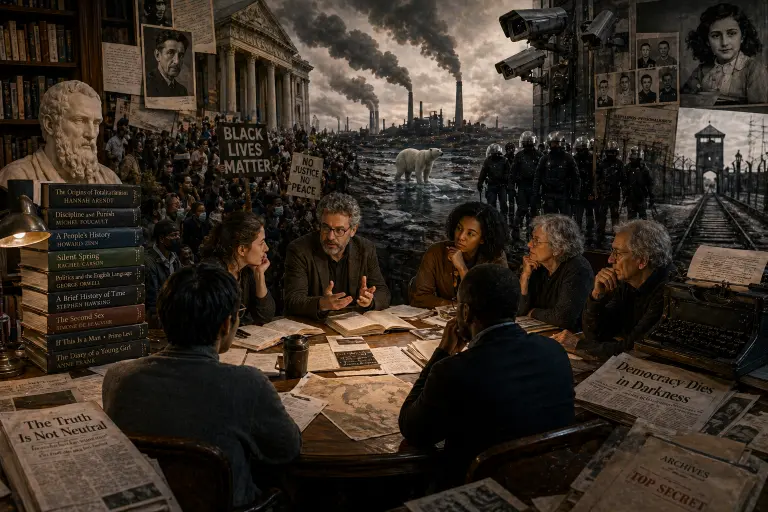
Frameworks of Influence: How Landmark Non-Fiction Reshapes Public Thought
Some books do not simply enter public conversation—they reorganize it. A serious work of non-fiction can alter how a generation understands history, power, memory, science, or moral responsibility. These books exceed bestseller lists and temporary relevance because they become reference points: texts people return to when trying to explain crises, institutions, and the invisible structures beneath ordinary life. Their influence is rarely immediate spectacle. It is slower, deeper, and often more durable than fiction’s emotional immediacy.
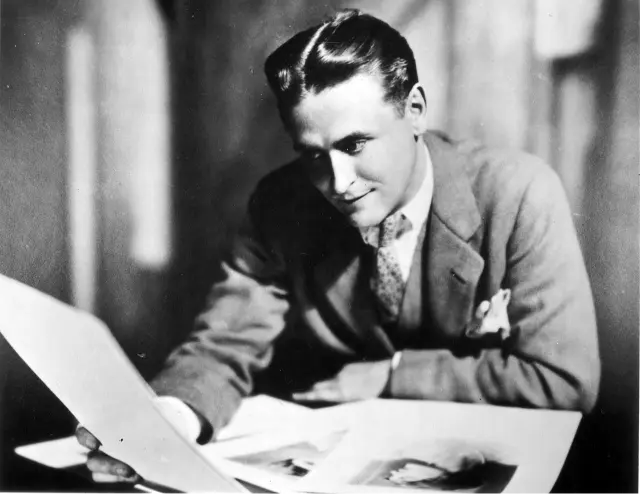
The Great Gatsby: Desire, Illusion, and the Fragile Architecture of the American Dream
Few novels have captured the moral texture of an era with the quiet precision of The Great Gatsby. Often remembered for its glittering parties, tragic romance, and iconic imagery, the novel resists reduction to a story of excess alone. Beneath its surface elegance lies a rigorous examination of desire—how it is shaped by illusion, sustained by fantasy, and ultimately undone by the collision between imagined futures and stubborn realities.
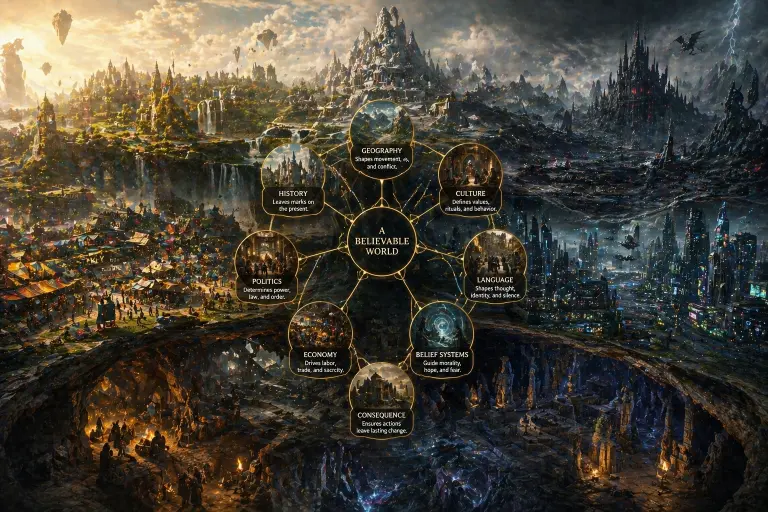
Internal Inevitability: The Hidden Architecture of Immersive Worldbuilding
A fictional world succeeds not when it appears infinitely large, but when it feels internally inevitable. Readers do not enter narrative environments because every mountain has been mapped or every dynasty fully documented; they enter because the world behaves as though it could continue existing beyond the page. Coherence creates immersion. The illusion of reality depends less on quantity of detail than on the disciplined relationship between setting, causality, memory, and consequence.