

A fictional world succeeds not when it appears infinitely large, but when it feels internally inevitable. Readers do not enter narrative environments because every mountain has been mapped or every dynasty fully documented; they enter because the world behaves as though it could continue existing beyond the page. Coherence creates immersion. The illusion of reality depends less on quantity of detail than on the disciplined relationship between setting, causality, memory, and consequence.
Worldbuilding is often misunderstood as accumulation. Writers are encouraged to construct elaborate geographies, political systems, magic rules, genealogies, and architectural histories as though density alone guarantees depth. Yet excess information can weaken rather than strengthen narrative authority. A fictional setting becomes convincing not because everything is explained, but because what is shown implies a larger structure operating consistently beneath the visible surface.

Setting Is Not Decoration
In weaker fiction, setting functions as ornament. A city exists merely to provide atmosphere, a kingdom exists to host conflict, a dystopian society exists to symbolize anxiety rather than operate as a lived structure. Such environments may be visually striking, but they remain dramatically hollow because they do not shape behavior.
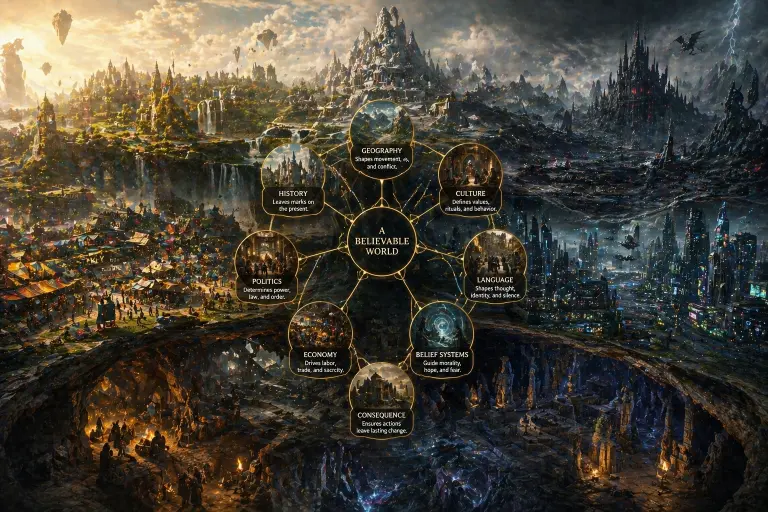
True worldbuilding begins when setting becomes causal. Geography influences economy. Economy shapes hierarchy. Hierarchy determines language, ritual, law, and violence. Climate affects labor. Memory influences architecture. Belief systems structure fear. Every convincing world emerges from relationships rather than isolated invention.
Readers recognize this instinctively. They trust environments where consequences follow logic. They disengage when settings exist only to produce spectacle without structural accountability.
The Difference Between Information and Atmosphere
Many narratives mistake explanation for immersion. Encyclopedic exposition often interrupts rather than deepens experience because it prioritizes data over perception. Readers do not inhabit a world by memorizing its facts; they inhabit it by sensing how ordinary life unfolds within it.
A market scene, a funeral ritual, the way children speak to authority, the architecture of public silence—these details often create stronger immersion than pages of institutional history. Atmosphere emerges through lived specificity.
This does not mean lore is unnecessary. It means lore must be subordinated to dramatic function. Information matters when it alters interpretation, not when it merely proves preparation.
Internal Logic and the Ethics of Consistency
Every fictional world establishes promises. Once those promises exist, consistency becomes an ethical principle of narrative design. If magic has limits, those limits matter. If political systems produce inequality, that inequality must leave visible traces. If technology changes society, social behavior must reflect it.
Incoherence breaks immersion because it reveals authorial convenience. Rules applied only when dramatically useful transform worldbuilding into manipulation. Readers may not consciously identify every inconsistency, but they feel the instability it creates.
Consistency does not require rigidity. Worlds can contain contradiction, mystery, and unpredictability. What matters is that uncertainty belongs to the world itself, not to the author’s temporary needs.
Archives and reference institutions such as the British Library, the Library of Congress, and historical databases like JSTOR remain valuable resources for writers studying how real societies produce believable structures of law, memory, ritual, and institutional continuity within fictional environments.
History Gives Weight to Space
A world without history feels like a stage built yesterday. Spaces become believable when they carry visible residue of previous lives. Ruins, inherited customs, linguistic fragments, contradictory monuments, obsolete laws, and remembered wars all create temporal depth.
History should not appear as decorative backstory. It should remain active in the present. Characters inherit institutions they did not design. Cities preserve violence beneath architecture. Political borders remember older conflicts. Even silence can be historical.
Worldbuilding becomes powerful when the past is not narrated separately from the present, but embedded within it.
Language as Architecture
Few elements shape fictional reality more powerfully than language. Not only invented languages, but registers of speech, forms of address, bureaucratic vocabulary, religious phrases, and social silence all define how a world thinks.
A society reveals itself through what can be spoken easily and what requires caution. The existence of a word suggests cultural necessity; its absence suggests structural blindness. Titles, insults, prayers, and jokes all function as architecture of social meaning.
Many writers focus on naming places while neglecting linguistic behavior. Yet speech patterns often create stronger immersion than cartography.
Power Structures Must Be Visible
Every fictional world contains power, whether acknowledged or not. Who controls movement? Who defines legitimacy? Who benefits from stability? These questions matter because narrative environments are never politically neutral.
Fantasy kingdoms often fail not because they are implausible, but because power exists only as symbolic monarchy without administrative consequence. Science fiction cities collapse when surveillance exists conceptually but not behaviorally. Dystopias weaken when oppression appears as aesthetic mood rather than institutional mechanism.
Readers believe systems when power leaves material traces: documents, checkpoints, inherited fear, inaccessible spaces, normalized obedience. Authority must be lived, not merely declared.
Character and World Cannot Be Separated
Some writers treat character and worldbuilding as separate tasks, but they are structurally inseparable. Identity is produced inside systems. Desire emerges within constraints. Even rebellion presupposes a world worth resisting.
A character’s values, vocabulary, moral imagination, and sense of possibility all reveal the environment that shaped them. If protagonists think like contemporary outsiders regardless of setting, immersion fractures. The world must exist inside consciousness, not only around it.
Strong worldbuilding therefore requires psychological architecture. It asks not only what the world looks like, but what kinds of people it produces.
Why Some Worlds Feel Empty
Many visually impressive fictional settings fail because they are designed from the outside inward. They begin with aesthetics—castles, ruins, neon cities, magical forests—rather than with systems of labor, memory, scarcity, and institutional pressure. The result is beautiful emptiness.
Readers can sense when a world has not been lived in. Shops exist without supply chains. Governments exist without bureaucracy. Religion exists without ordinary ritual. Violence exists without economic consequence. These absences create artificiality no visual detail can repair.
Depth begins where glamour ends.
Why This Perspective Still Matters
Worldbuilding matters because narrative environments shape interpretation before plot begins. Readers decide what is possible, meaningful, or morally urgent based on the logic of the world they are asked to inhabit. Setting is therefore not background—it is argument.
In contemporary storytelling, especially across fantasy, science fiction, speculative fiction, and literary hybrid forms, immersive environments determine whether narrative ambition becomes believable. Weak worlds reduce complex themes to abstraction. Coherent worlds allow ethical, political, and emotional stakes to feel earned.
To study worldbuilding is to study the invisible structure beneath narrative persuasion itself.
Continue Exploring Narrative Architecture
If you are interested in how fictional environments shape interpretation, you may also explore our essays on symbolic landscapes, narrative memory, and the relationship between space, power, and psychological realism across modern fiction.
Readers drawn to deeper structural analysis may also revisit our long-form studies of narrative voice, internal coherence, and the hidden mechanics of immersive storytelling in literary and speculative traditions.
Frequently Asked Questions
What makes worldbuilding believable?
Believability comes from internal consistency and causal relationships. Geography, politics, language, economy, and culture must influence one another rather than exist as isolated details.
Is more detail always better in worldbuilding?
No. Excess information can weaken immersion if it does not serve dramatic function. Readers trust implication and lived specificity more than encyclopedic exposition.
Why is history important in fictional settings?
History gives weight to space. Worlds feel real when institutions, architecture, rituals, and conflicts show evidence of time and inherited consequence.
How does language affect immersion?
Language shapes how a world thinks. Forms of address, silence, ritual speech, and social vocabulary often create stronger realism than maps or invented names alone.
Reviewed for editorial quality, narrative coherence, and structural integrity.
Conclusion: Worlds That Continue Beyond the Page
The strongest fictional worlds feel unfinished in the best possible sense. They suggest continuation beyond the scene, beyond the protagonist, beyond the visible plot. Their reality depends not on exhaustive explanation, but on the confidence that unseen structures remain operating when the reader looks away.
Worldbuilding succeeds when setting becomes inseparable from consequence—when geography shapes morality, when history shapes silence, and when power shapes ordinary life. In these environments, immersion is not produced by spectacle, but by inevitability.
Readers do not stay because the map is large. They stay because the world behaves as though it would still exist without them. That is the deepest form of narrative credibility, and the true architecture of immersive fiction.
Rigorous exposition remains one of literature’s most necessary forms because it refuses easy certainty. It insists that complexity deserves structure, that knowledge requires method, and that understanding is something built—carefully, slowly, and never without scrutiny.

Bibliographic Foundation
This analysis was conducted under the Sanctum's methodological rigor, utilizing exegetical protocols grounded in universal heritage repositories and documented preservation archives.
View Authority FoundationsAnalytical Recommendations

The Lord of the Rings: Mythopoesis, Power, and the Theology of Hope
ew works of modern literature have constructed a moral universe with the depth and coherence of The Lord of the Rings. Frequently remembered for its epic battles, vast geography, and mythic gravitas, the narrative resists reduction to spectacle alone. Beneath its grand scale lies a disciplined ethical inquiry into power: how it seduces, how it corrodes intention, and how resistance often emerges not from heroic exceptionalism, but from ordinary fidelity to what is small, local, and fragile.

Modernism and the Wreckage of Certainty: Literature in the Age of Fractured Time
Modernism and the Wreckage of Certainty: Literature in the Age of Fractured Time. Literary modernism did not arise as a stylistic fashion. It emerged as a philosophical rupture. The early twentieth century confronted writers with a world whose inherited frameworks of meaning had begun to fail under the pressure of unprecedented historical shocks. Industrial acceleration, mechanized warfare, the collapse of empires, and the erosion of religious and social certainties produced not merely political instability, but epistemic disorientation.

The Chronicles of Narnia: A Literary Architecture of Meaning, Myth, and Moral Imagination
Few works of twentieth-century literature have achieved the rare balance of popular enchantment and intellectual endurance quite like The Chronicles of Narnia.