

A story rarely announces the rules of its world outright. Instead, it teaches the reader how to see. A gesture here, a constraint there, a detail that seems incidental until it quietly proves decisive—these are the building blocks of immersion. What matters is not how much is explained, but how naturally everything holds together. When a narrative environment feels convincing, it is because its logic has been absorbed rather than declared, experienced rather than outlined.
At its most effective, this process remains almost invisible. The reader is not pausing to question how things work, because the story has already provided enough signals to make its world legible. Streets feel lived-in, institutions carry weight, and even the smallest interactions suggest a larger structure at play. This is not about excess detail or ornamental description. It is about coherence—the quiet assurance that everything belongs to the same underlying reality.

More Than Setting: The World as a Living Structure
It is easy to mistake environment for backdrop, as if it were something placed behind the action rather than shaping it. But a convincing narrative space behaves more like a system than a stage. Social norms influence decisions. Geography creates obstacles. Technology—or its absence—defines what is possible. Nothing exists in isolation. Each element participates in a network of cause and effect that quietly directs the flow of the story.
Think of how a simple limitation can transform an entire narrative. If communication is slow, misunderstandings linger. If movement is restricted, encounters become rare and meaningful. If resources are scarce, every choice carries weight. These are not decorative features. They are structural forces. When they align, the world feels stable. When they contradict each other without purpose, something begins to fracture.
The reader may not consciously map these relationships, but they feel them. A world either supports its story or resists it. There is little middle ground.
The Quiet Authority of Consistency
Believability does not depend on whether a world resembles our own. It depends on whether it remains faithful to itself. A narrative can introduce the impossible—unfamiliar laws, altered histories, entirely new forms of life—and still feel grounded, as long as it honors the logic it establishes.
This logic does not need to be fully explained. In fact, over-explanation often weakens its effect. What matters is that actions lead to consequences in a way that feels earned. When a boundary is set, it should matter. When an exception occurs, it should carry significance. The reader learns these patterns gradually, through repetition and variation, until the world becomes intuitive.
When that intuition is broken without reason, the illusion falters. Not because the story has become unrealistic, but because it has become inconsistent. Trust, once lost, is difficult to rebuild. A coherent world, by contrast, deepens trust with every scene.
Detail That Carries Meaning
There is a difference between a world that is dense and one that is vivid. Density accumulates information; vividness selects it. A single well-chosen detail can suggest an entire structure behind it. The worn edge of a table, the rhythm of a public space, the way a character navigates a familiar route—these moments reveal more than extended description ever could.
What gives detail its power is function. It must do something beyond filling space. It might reveal a social hierarchy, hint at a past event, or foreshadow a conflict yet to come. When details resonate in this way, they create a sense of depth without overwhelming the reader.
Equally important is what remains unsaid. Gaps invite participation. They allow the reader to complete the world in their own mind, making the experience more immediate and personal. Too much clarity can flatten a narrative, while a measured absence can give it dimension.

Seeing Through the Eyes Within
No world exists independently of those who move through it. The most effective way to reveal an environment is not through detached description, but through lived experience. A place gains meaning when it is filtered through perception—when it is shaped by familiarity, discomfort, expectation, or memory.
What one character overlooks, another may find striking. What feels ordinary in one context may feel alien in another. These shifts in perspective allow the same environment to carry multiple layers of meaning without requiring explicit explanation.
At the same time, characters are products of their surroundings. Their assumptions, habits, and desires are informed by the structures around them. When a character acts, they carry the imprint of their world with them. This alignment between person and place is what makes both feel authentic.
The Weight of What Came Before
A convincing narrative space rarely feels new, even when it is unfamiliar. It suggests a past that continues to shape the present. This sense of history does not require long exposition. It emerges through traces—customs that persist, tensions that linger, objects that carry signs of use.
These traces create continuity. They imply that the world existed before the story began and will continue after it ends. This impression of independence strengthens immersion, allowing the reader to engage with the narrative as part of a larger whole rather than a self-contained construct.
History also introduces complexity. Different perspectives on the past can coexist, sometimes in conflict. These differences add texture, turning background into an active element of the story rather than a static foundation.
From Intimate Spaces to Expansive Systems
Not every story requires a vast setting. Sometimes a single room, carefully constructed, can carry the weight of an entire world. What matters is not scale, but coherence. The smallest environment should reflect the logic of the larger structure to which it belongs.
A household can reveal social norms. A street can suggest economic conditions. A brief interaction can expose underlying tensions. When these local elements align with broader patterns, the world feels unified. When they exist in isolation, something feels incomplete.
This continuity across scale allows narratives to move fluidly between levels of focus. The personal and the systemic become interconnected, each reinforcing the other.
Responsibility in Representation
Every constructed world carries implications beyond itself. The choices made in shaping it—what is emphasized, what is omitted, how different elements are portrayed—reflect particular perspectives. These choices influence how readers interpret not only the story, but the realities it echoes.
Careful construction avoids simplification where complexity is needed. It resists reducing cultures, identities, or histories to single dimensions. Instead, it allows for variation, contradiction, and nuance. This does not require exhaustive coverage, but it does demand awareness.
Consistency, in this sense, extends beyond internal logic. It includes a sensitivity to how the world relates to broader contexts, ensuring that its coherence is not achieved at the cost of depth or integrity.
Immersion as Understanding
What draws a reader into a narrative is not only what they see, but what they grasp. Immersion depends on the ability to navigate a world—to anticipate outcomes, to interpret actions, to recognize patterns. This understanding develops gradually, as the narrative provides just enough guidance to orient without overwhelming.
When this balance is achieved, the reader becomes an active participant. They are not simply observing events, but engaging with the structure that produces them. The world becomes something to think through, not just move through.
When the balance fails—when the logic is unclear or inconsistent—the experience shifts. The reader steps back, no longer immersed, but questioning the framework itself. Clarity, therefore, is not a simplification. It is what allows complexity to function.
Why It Stays With Us
Some stories linger not because of what happens in them, but because of where they take place. The environments they create feel tangible, not in a literal sense, but in the way they continue to exist in memory. They can be revisited, reconsidered, expanded upon in thought.
This persistence comes from coherence. A world that holds together invites return. It offers more than a sequence of events; it provides a structure within which those events gain meaning. The reader does not simply recall the story—they recall the space in which it unfolded.
In this way, the construction of a narrative environment becomes inseparable from the story itself. One cannot endure without the other.
Conclusion: The Invisible Craft
The most effective narrative environments do not demand attention. They support it. Their presence is felt through stability, through the sense that everything operates according to an underlying order. This order does not need to be visible in full. It only needs to be reliable.
To create such a space requires restraint as much as invention. It involves knowing what to reveal, what to imply, and what to leave unresolved. When these choices align, the result is a world that does not merely contain a story, but sustains it—quietly, consistently, and with lasting impact.

Bibliographic Foundation
This analysis was conducted under the Sanctum's methodological rigor, utilizing exegetical protocols grounded in universal heritage repositories and documented preservation archives.
View Authority FoundationsAnalytical Recommendations

Literature and the Burden of Memory: Race, Identity, and the Reconstruction of Human Dignity
Literature and the Burden of Memory: Race, Identity, and the Reconstruction of Human Dignity. Literature assumes its most transformative function when it confronts histories that resist closure. There are pasts that do not remain confined to chronology—pasts that persist as structure, as inheritance, as unresolved presence within the present. In such contexts, narrative becomes more than representation; it becomes a site of reckoning. It gives form to experiences that have been suppressed, fragmented, or systematically excluded from dominant historical accounts.
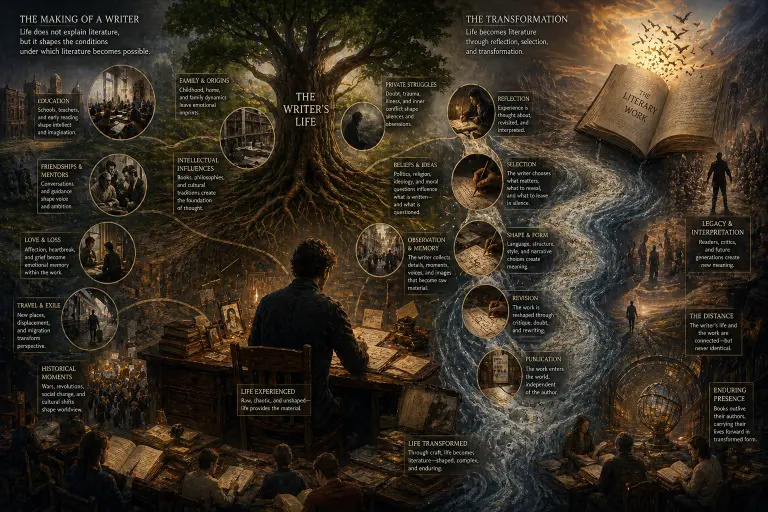
The Imprint of Experience: Why Author Biography Matters for Critical Reading
To study a writer’s life is not to search for a simple key that unlocks every page they produced. Literature does not function as disguised autobiography, nor can the complexity of a novel, a poem, or an essay be reduced to a sequence of personal events. Yet no major work emerges from abstraction alone. Writers are formed by education, exile, friendships, losses, political climates, intellectual traditions, and private contradictions. Their works carry these pressures—sometimes visibly, sometimes only as structure, silence, or recurring obsession.

Contemporary Fiction and the Inheritance of Fragmentation: Narrative After Modernism
Few works of twentieth-century literature have achieved the rare balance of popular enchantment and intellectual endurance quite like The Chronicles of Narnia.