

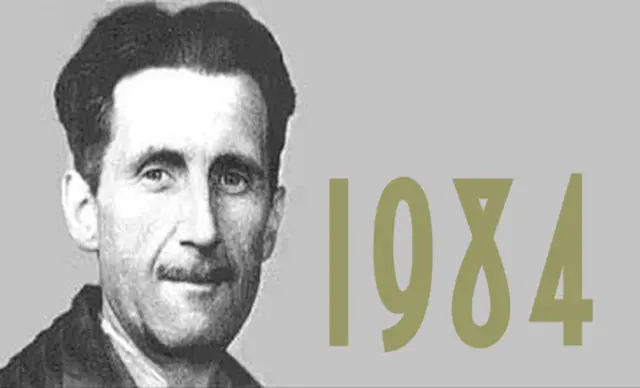
Few novels have entered the cultural bloodstream with the enduring force of Nineteen Eighty-Four. Frequently invoked in political rhetoric and popular discourse, the book is often reduced to a set of familiar images: omnipresent surveillance, totalitarian authority, the erasure of privacy. Yet such shorthand, while evocative, obscures the deeper architecture of the novel’s critique. 1984 is not merely a warning against overt political tyranny; it is a sustained meditation on how power colonizes the inner life, reshaping not only behavior but perception, memory, and the very grammar through which reality is conceived.
At its core, the novel is concerned with the conditions under which truth becomes impossible. It does not ask whether oppression can be resisted by force alone; it asks whether resistance remains intelligible once the language of resistance has been hollowed out. The terror of Orwell’s world lies not in brutality alone, but in the systematic corrosion of the faculties that make moral judgment conceivable.

Total Power and the Abolition of the Private Self
The regime depicted in 1984 seeks not merely to govern bodies, but to occupy consciousness. Surveillance is not presented as a logistical tool of control alone; it functions as a psychological environment in which privacy itself becomes unintelligible. The telescreen is less an object than a condition. Its omnipresence erodes the boundary between public performance and private reflection, rendering the inner life porous to political authority.
This dissolution of privacy has profound ethical implications. Without a protected interior space, conscience cannot develop as an autonomous faculty. Thought becomes reactive, shaped by anticipation of scrutiny. The self is no longer a site of deliberation, but a surface upon which power writes its demands. The novel thus frames totalitarianism not as an external imposition, but as an invasion of interiority.
Winston’s fragile attempts to preserve a private self—through memory, writing, and forbidden intimacy—are not acts of rebellion in the conventional sense. They are efforts to sustain the very possibility of a self capable of rebellion.
Language as a Technology of Power
One of the novel’s most enduring contributions to political thought is its portrayal of language as an instrument of domination. Newspeak is not merely propaganda; it is an epistemic project. By reducing the range of available words, the regime constricts the range of possible thoughts. Dissent is not punished alone; it is rendered linguistically unthinkable.
This manipulation of language exposes a deeper philosophical claim: that perception is shaped by the structures through which it is articulated. When vocabulary contracts, so does the horizon of moral imagination. The destruction of nuance becomes the destruction of complexity itself. In such a world, the capacity to name injustice is eroded alongside the capacity to conceive alternatives to it.
The horror of Newspeak lies not in its artificiality, but in its efficiency. It does not argue against dissent; it makes dissent inexpressible.
Memory, History, and the Manufacture of Reality
The novel’s treatment of history reveals another dimension of power’s architecture. Control over the past becomes control over the present, not because facts themselves are decisive, but because memory anchors judgment. When records are endlessly rewritten, the continuity of experience collapses. Individuals lose the ability to situate themselves within a narrative of truth.
This manipulation of memory produces a state of epistemic vertigo. If the past is infinitely malleable, then certainty becomes impossible. The individual is forced into dependence on official narratives, not because they are persuasive, but because no alternative reference points remain. Reality becomes a function of authority.
The danger articulated here is not merely political falsification, but ontological instability. When the past can be erased at will, the present becomes unmoored from meaning. The result is not ignorance alone, but a cultivated helplessness—a condition in which the self loses confidence in its own perceptions.
Love as a Threat to Total Control
In Orwell’s world, intimacy is subversive not because it produces solidarity alone, but because it generates loyalty that exceeds political allegiance. The relationship between Winston and Julia is dangerous precisely because it creates a private domain of meaning that escapes official interpretation. Their intimacy is not romanticized as heroic; it is fragile, compromised, and vulnerable. Yet its mere existence threatens the regime’s claim to total authority.
Love introduces contingency into a system built on absolute predictability. It creates obligations that cannot be fully regulated. In this sense, the regime’s hostility toward personal bonds reflects an awareness that affection resists instrumentalization. Where love persists, total domination remains incomplete.
The novel thus frames intimacy not as a sentimental refuge, but as an ethical rupture—a space in which alternative values can briefly emerge.
The Psychology of Submission and the Seduction of Certainty
Perhaps the most disturbing dimension of 1984 lies in its portrayal of submission not as the result of fear alone, but as the outcome of psychological exhaustion. The regime does not seek mere obedience; it seeks conversion. The ultimate victory of power is not compliance, but internalization.
The mechanisms of torture and indoctrination are designed to dismantle the individual’s confidence in personal perception. Pain is deployed not simply to punish, but to reorder belief. The goal is to replace the individual’s interpretive framework with the regime’s logic. In this process, truth becomes whatever alleviates suffering in the moment. Certainty is offered as relief.
This dynamic reveals a bleak insight into human vulnerability: that under sustained pressure, the desire for coherence can override the commitment to truth. The promise of certainty, however false, becomes psychologically irresistible when uncertainty is weaponized.
Why 1984 Endures
The endurance of 1984 does not stem from the literal replication of its institutions in contemporary societies, but from the persistence of the dynamics it diagnoses. The novel endures because it articulates structural vulnerabilities within human cognition and social organization. It reveals how power exploits fear, language, memory, and desire for certainty to erode autonomy from within.
Rather than offering a simple cautionary tale, the book functions as a diagnostic framework. It does not predict specific futures; it exposes recurring patterns of domination. This universality grants the novel a relevance that transcends its historical moment.
Readers return to 1984 not to confirm that tyranny exists, but to confront the unsettling possibility that the conditions for tyranny are woven into ordinary psychological tendencies.
The Fragility of Truth and the Discipline of Resistance
1984 offers no comforting resolution. Its final vision is one of tragic capitulation, not triumphant revolt. Yet within this bleakness lies the novel’s ethical demand. By refusing consolation, Orwell forces the reader to confront the cost of complacency. The absence of redemption is not nihilism; it is a provocation.
The novel insists that the preservation of truth requires more than opposition to overt tyranny. It demands vigilance toward the subtle transformations of language, memory, and desire that precede political catastrophe. Resistance, in Orwell’s vision, begins not with slogans, but with the fragile discipline of attending to reality as it is—before the words to describe it are taken away.
Conclusion: The Architecture of Psychological Domination
Nineteen Eighty-Four is not a story about political failure preserved. It is a story about the fragility of the human mind under the weight of absolute power—and about the intellectual labor required to maintain clarity without surrender. Its philosophy is neither abstract nor systematic. It is embodied in the defense of memory, the precision of speech, and the willingness to remain grounded in objective truth in a world structured around its denial.
In a cultural environment increasingly defined by misinformation, rapid slogans, and fragmented attention, the book persists as a quiet act of resistance. It asks not for agreement, but for vigilance. Not for optimism, but for lucidity. And in doing so, it continues to offer something increasingly rare in modern life: a map for identifying the shadows before they consume the light.
Analytical Recommendations

The Invisible Craft: Consistency and Coherence in Narrative Environments
Astory rarely announces the rules of its world outright. Instead, it teaches the reader how to see. A gesture here, a constraint there, a detail that seems incidental until it quietly proves decisive—these are the building blocks of immersion. What matters is not how much is explained, but how naturally everything holds together. When a narrative environment feels convincing, it is because its logic has been absorbed rather than declared, experienced rather than outlined.

The Great Gatsby: Desire, Illusion, and the Fragile Architecture of the American Dream
Few novels have captured the moral texture of an era with the quiet precision of The Great Gatsby. Often remembered for its glittering parties, tragic romance, and iconic imagery, the novel resists reduction to a story of excess alone. Beneath its surface elegance lies a rigorous examination of desire—how it is shaped by illusion, sustained by fantasy, and ultimately undone by the collision between imagined futures and stubborn realities.

The Little Prince: A Philosophy of Tenderness, Responsibility, and the Tragedy of Growing Up
Few works of modern literature occupy such a paradoxical space in cultural memory as The Little Prince. It is frequently categorized as a children’s tale, gifted to young readers with the assumption of simplicity, yet it is quietly revered by adults as a meditation on loss, love, and moral perception.