

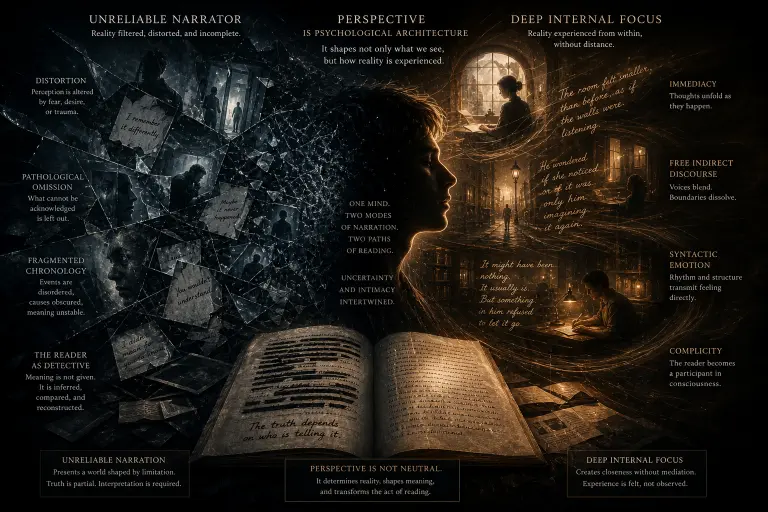
Narrative perspective is often treated as a technical choice—a question of who speaks and from what distance. Yet in its most sophisticated forms, perspective is not simply a matter of viewpoint. It is a psychological architecture. It determines not only what the reader sees, but how reality itself is filtered, distorted, or intensified. Two of the most powerful strategies in modern fiction—the unreliable narrator and deep internal focus—demonstrate how perspective can move beyond description into embodiment.
When these techniques are used with precision, the narrative ceases to function as a stable account of events. Instead, it becomes an encounter with consciousness itself—partial, unstable, and often resistant to clarity. The reader is no longer positioned outside the story, observing. They are drawn into a process of interpretation, forced to navigate uncertainty and intimacy simultaneously.
The Unreliable Narrator as Psychological Mirror
The concept of the unreliable narrator is often reduced to deception—a voice that misleads the reader. Yet this simplification misses its deeper function. In many of the most significant works of literature, unreliability is not a trick. It is a condition. The narrator does not lie to manipulate the reader; they present a reality shaped by their own limitations, distortions, or psychological fractures.
In such cases, the narrative becomes a mirror of consciousness rather than a transparent account of events. What is omitted, altered, or misunderstood reveals as much as what is stated. The reader is not simply receiving information—they are interpreting symptoms.
This shifts the act of reading into a form of investigation. The text must be decoded, not because it hides a single truth, but because it presents multiple competing versions of it.
Pathological Omission and the Limits of Perception
One of the most powerful mechanisms of unreliable narration is omission—not as a strategic withholding by the author, but as an inability within the narrator. Certain details are excluded not because they are irrelevant, but because they cannot be processed or acknowledged.
This “pathological omission” often emerges in narratives shaped by trauma, psychosis, or cognitive decline. Events are fragmented, sequences disrupted, and causal relationships obscured. The narrator may circle around certain moments without fully articulating them, leaving gaps that the reader must recognize as meaningful absences.
William Faulkner’s The Sound and the Fury exemplifies this approach. Its shifting perspectives, disordered timelines, and fractured syntax do not aim for stylistic complexity alone. They replicate the internal states of narrators who cannot organize their experiences into coherent narrative form.
The result is not confusion for its own sake. It is fidelity—to minds that cannot perceive the world in stable, linear terms.
Institutions such as the British Library, the Library of Congress, and academic archives like JSTOR preserve drafts and critical studies that reveal how authors construct these narrative voices, carefully calibrating what is said, what is distorted, and what remains unspeakable.
The Reader as Detective
When faced with an unreliable narrator, the reader is repositioned. They can no longer accept the narrative at face value. Instead, they must compare fragments, identify inconsistencies, and infer what lies beyond the narrator’s perception.
This process transforms reading into an active engagement. The reader becomes a participant in the construction of meaning, assembling a version of events that may never be fully confirmed. Certainty is replaced by probability.
Importantly, this dynamic is not adversarial. The narrator is not an opponent to be outwitted. They are a subject to be understood. Their distortions are clues to their condition, not obstacles to be eliminated.
In this way, unreliability creates both distance and intimacy: distance from the narrated events, and intimacy with the consciousness that produces them.
Internal Focus and the Dissolution of Distance
If unreliable narration introduces instability, deep internal focus introduces proximity. It reduces the distance between narrator and character, allowing the reader to experience thought as it unfolds rather than as it is reported.
This approach shifts attention from action to perception. What matters is not only what happens, but how it is experienced in the moment—how it feels, how it is processed, how it lingers.
The boundary between narration and consciousness becomes porous. The reader is no longer observing a character’s interior life from the outside. They are moving within it.
Free Indirect Discourse and the Blurring of Voices
One of the most refined techniques for achieving this effect is free indirect discourse. It allows the narrative to merge with a character’s thoughts without explicit markers such as quotation marks or direct attribution.
In the works of Virginia Woolf and James Joyce, this technique creates a fluid movement between external description and internal reflection. A sentence may begin in the voice of the narrator and end in the voice of the character, without a clear boundary between them.
This fusion produces a unique form of intimacy. The reader is not told what the character thinks—they encounter thought as part of the narrative texture itself. The distinction between “self” and “other” becomes unstable, creating a continuous flow of perception.

Syntax as Emotional Conduit
The power of internal focus lies not only in perspective, but in syntax. Sentence structure, rhythm, and linguistic choices all contribute to how emotion is conveyed. A fragmented sentence may reflect anxiety. A flowing, continuous line may suggest immersion or obsession.
Through these subtle variations, the narrative transmits feeling directly. The reader does not need to be told what a character experiences—they feel it through the form of the language itself.
This is where technique becomes sensation. Syntax ceases to be neutral and becomes expressive.
Complicity and Immediate Experience
By eliminating distance, deep internal focus creates a form of complicity. The reader is not merely observing the character’s thoughts—they are participating in them. Desires, fears, and contradictions are encountered without mediation.
This immediacy can be unsettling. It removes the safety of external perspective, forcing the reader to confront experiences that may be irrational, contradictory, or uncomfortable. Yet it also produces a level of engagement that more distant forms of narration cannot achieve.
The reader becomes, in effect, a co-inhabitant of the narrative mind.
Why These Techniques Matter
Unreliable narration and deep internal focus reveal that perspective is not a neutral lens. It is an active force that shapes how reality is constructed within the narrative. It determines not only what is known, but how knowledge itself is experienced.
These techniques challenge the assumption that stories should provide stable, objective accounts. Instead, they embrace subjectivity, ambiguity, and psychological complexity as central elements of narrative design.
In doing so, they expand the possibilities of fiction—allowing it to represent not only events, but the conditions under which those events are perceived and understood.
Continue Exploring Narrative Perspective
If you are interested in how perspective shapes storytelling, you may also explore our essays on structural critique, pacing, and non-linear narrative design.
Readers drawn to deeper formal analysis may also revisit our long-form studies of consciousness, narrative voice, and the relationship between language and perception.
Frequently Asked Questions
What makes a narrator unreliable?
Not simply deception, but a limited or distorted perception of reality that affects how events are presented.
Why do authors use unreliable narrators?
To reflect psychological complexity and to engage the reader in interpreting the narrative rather than passively receiving it.
What is free indirect discourse?
A technique that blends the narrator’s voice with a character’s thoughts, eliminating clear boundaries between them.
How does internal focus affect reading?
It reduces distance, allowing the reader to experience thoughts and emotions directly rather than through external description.
Reviewed for editorial quality, narrative precision, and analytical depth.
Conclusion: Consciousness as Narrative Form
When perspective is treated as structure, fiction moves beyond representation into embodiment. The unreliable narrator reveals the instability of perception, while deep internal focus dissolves the boundary between observer and subject.
Together, these techniques transform reading into an encounter with consciousness itself—partial, fluid, and often unresolved. The reader is no longer outside the narrative, interpreting it from a distance. They are within it, navigating its uncertainties and inhabiting its logic.
In that space, narrative becomes more than a story. It becomes an experience of mind.

Bibliographic Foundation
This analysis was conducted under the Sanctum's methodological rigor, utilizing exegetical protocols grounded in universal heritage repositories and documented preservation archives.
View Authority FoundationsAnalytical Recommendations

Postmodernism and the Collapse of Grand Narratives: Irony, Fragmentation, and the Play of Meaning
Modernism and the Wreckage of Certainty: Literature in the Age of Fractured Time. Literary modernism did not arise as a stylistic fashion. It emerged as a philosophical rupture. The early twentieth century confronted writers with a world whose inherited frameworks of meaning had begun to fail under the pressure of unprecedented historical shocks. Industrial acceleration, mechanized warfare, the collapse of empires, and the erosion of religious and social certainties produced not merely political instability, but epistemic disorientation.
Realism and the Discipline of the Ordinary: Literature in the Age of Social Visibility
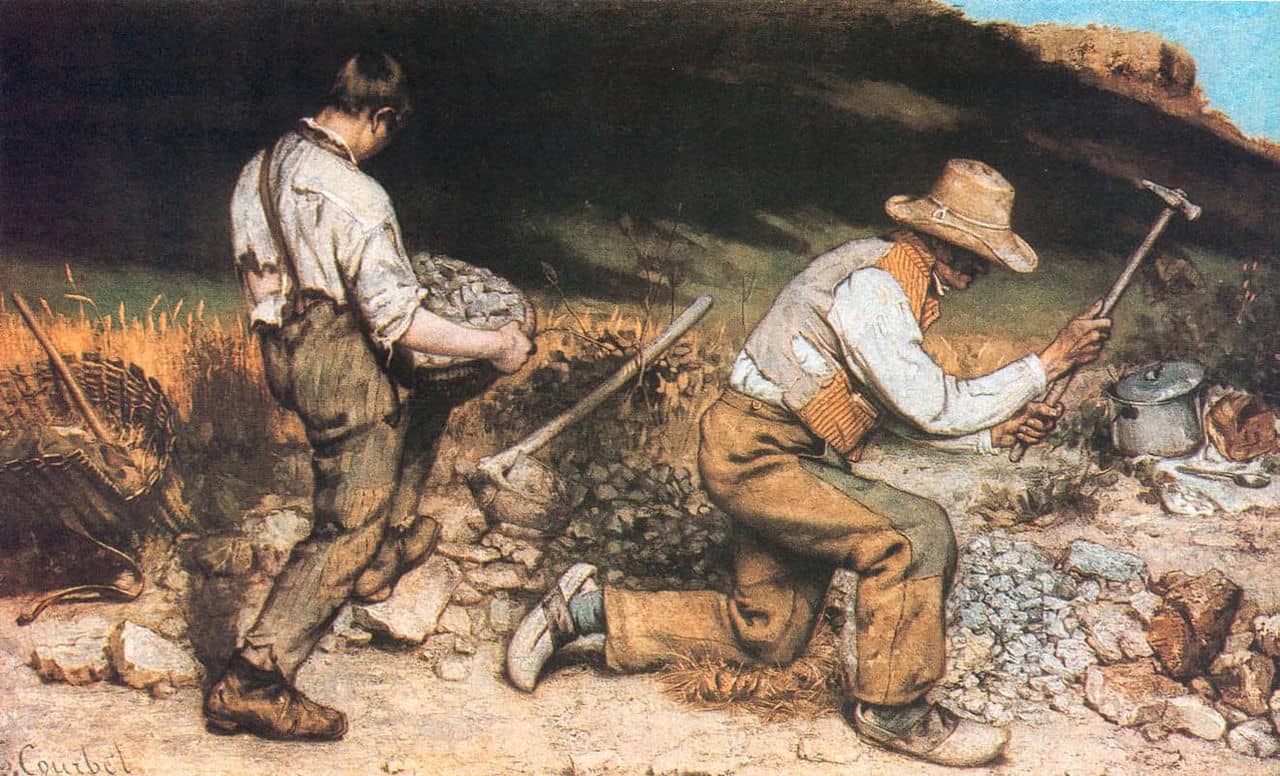
Realism and the Discipline of the Ordinary: Literature in the Age of Social Visibility. If Romanticism elevated the inner world and imagination as a response to mechanized reality, Realism emerges as a corrective movement—one that redirects attention outward, toward the material, social, and economic conditions shaping human existence. Far from a rejection of depth, Realism represents a reorientation of it. It insists that meaning is not found only in transcendence or subjective intensity, but in the structures of everyday life: work, class, institutions, and the quiet pressures of social expectation.

Literature as Cultural Mirror: Power, Class, and the Social Imagination in Industrial Society
Literature as Cultural Mirror: Power, Class, and the Social Imagination in Industrial Society. Literature does not merely tell stories; it records tensions. It registers, often with greater precision than formal historical accounts, the invisible pressures shaping a society’s moral and material life. Nowhere is this function more evident than in narratives that emerge from periods of rapid transformation—moments when economic systems shift, social hierarchies destabilize, and the language available to describe experience struggles to keep pace with lived reality.