

Literature does not rely solely on narrative events to produce meaning. Beneath plot and character, a more subtle architecture operates—one composed of recurring images, tonal dissonances, rhythmic patterns, and temporal choices. These elements function below the threshold of conscious attention, shaping how a text is felt before it is fully understood. To read at this level is to recognize that style is not decorative. It is structural, guiding perception through repetition, contrast, and modulation.
When examined closely, these techniques reveal a form of design embedded within language itself. The writer constructs not only a story, but an environment—one in which emotion, expectation, and interpretation are continuously calibrated.
Color Symbolism and Emotional Priming
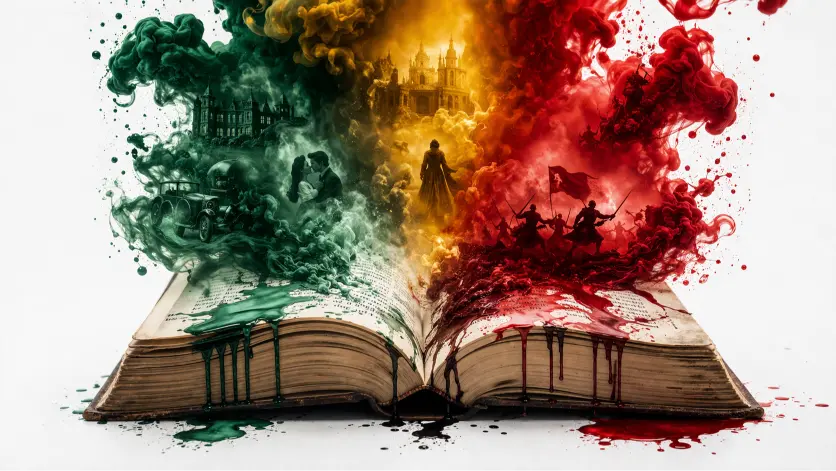
Color in literature operates as a recurring signal rather than a fixed meaning. When certain tones appear repeatedly across a narrative, they begin to accumulate associations. These associations are rarely stated directly. Instead, they emerge gradually, forming a pattern that influences how scenes are interpreted.
In the work of F. Scott Fitzgerald, for example, green becomes linked with aspiration—specifically, with forms of desire that remain just beyond reach. The repetition of this color across different contexts produces a subtle emotional continuity. The reader does not need to be told what it signifies; the pattern itself generates recognition.
Similarly, in the prose of Oscar Wilde, gold often carries a dual function. It signifies beauty and refinement, but also excess and decay. The repetition of this tone creates a layered effect, where admiration and critique coexist within the same image.
This technique functions as a form of priming. The reader’s response to a scene is shaped in advance by prior associations. The color becomes an anchor, stabilizing the emotional tone across variations in narrative content.
Beyond literature, this principle extends into design and communication. Repetition of visual or conceptual motifs can establish coherence, reinforcing a particular mood or identity without explicit explanation.
The Architecture of Irony: Style Against Substance
Irony emerges not only from contradiction, but from alignment and misalignment between form and content. When a refined, controlled style is used to describe events that are trivial, absurd, or disturbing, a tension is created. The elegance of the language does not resolve the subject—it intensifies it.
This technique can be observed in the novels of Jane Austen, where a composed narrative voice delivers observations that, upon closer inspection, carry sharp social critique. The tone remains measured, yet the implications are often destabilizing.
A similar dynamic appears in the work of Machado de Assis, where the narrator’s apparent politeness conceals a deeper skepticism. The distance between voice and content generates a form of unstable irony. The reader is required to navigate this gap, determining where sincerity ends and critique begins.
This structural use of irony transforms reading into interpretation. Meaning is not located in a single layer, but distributed across contrasts. The surface cannot be taken at face value; it must be examined for internal tension.
In broader contexts, this sensitivity becomes a form of analytical awareness. It enables the detection of indirect critique, particularly in environments where direct expression is constrained or strategically avoided.
Anaphora and Epistrophe: Rhythm as Persuasion
Repetition is one of the most fundamental mechanisms of emphasis. When words or phrases recur at the beginning (anaphora) or end (epistrophe) of successive sentences, they create a pattern that extends beyond meaning into rhythm.
This rhythm has a cumulative effect. It builds expectation, reinforces structure, and produces a sense of inevitability. The repetition does not merely restate an idea—it intensifies it through recurrence.
In literary prose, such techniques appear in the work of Charles Dickens, where repetition contributes to both momentum and tonal cohesion. In oratory, similar patterns are used to anchor key points, ensuring that they remain present in the listener’s memory.
The effectiveness of this technique lies in its predictability. The reader or listener anticipates the return of the phrase, and this anticipation generates engagement. The structure becomes participatory, drawing attention through rhythm.
Applied to communication, repetition can function as a tool of clarity and emphasis. When used with precision, it transforms isolated statements into a coherent sequence, increasing both retention and impact.
Tense Selection and the Psychology of Distance
The choice of tense is often treated as a grammatical decision. In practice, it shapes the reader’s relationship to the narrative. Present tense situates events within an ongoing frame. The action appears to unfold in real time, without the assurance of completion. This creates immediacy, but also a sense of instability. The outcome is not yet determined.
Past tense, by contrast, introduces a layer of distance. The events have already occurred. The narrative voice carries an implicit authority, suggesting that the sequence has been observed, processed, and articulated from a position of knowledge.
This distinction affects not only perception, but interpretation. Present-tense narration often aligns the reader closely with the character’s experience, limiting perspective and increasing emotional intensity. Past-tense narration allows for reflection, contextualization, and a broader view of causality.
The choice between these modes is therefore strategic. It determines whether the reader is positioned within the event or at a distance from it, whether the emphasis falls on immediacy or understanding.

Pattern as Meaning
Across these techniques—color, irony, repetition, and tense—a common principle emerges: meaning is not located in isolated elements, but in patterns. It is through recurrence, contrast, and structural alignment that a text produces its deeper effects.
This perspective shifts the act of reading. Attention moves from individual sentences to relationships between them. The text is understood as a system, where each element gains significance through its position within a larger structure.
Why These Techniques Matter
The mechanisms identified in literary analysis extend into fields beyond literature. Branding, communication, education, and leadership all rely on similar principles: consistency of tone, strategic contrast, rhythmic emphasis, and controlled perspective.
Understanding these dynamics enables more deliberate engagement with language. It allows for the construction of messages that are not only clear, but resonant—capable of sustaining attention and shaping interpretation.
Institutions such as the British Library, the Library of Congress, and academic platforms like JSTOR offer extensive resources for exploring how these techniques function across literary traditions.
Continue Exploring Narrative Design
If you are interested in how structural elements shape meaning, you may also explore our essays on narrative theory, stylistic analysis, and rhetorical design.
Readers seeking further depth may revisit our long-form studies on language, cognition, and the architecture of storytelling.
Frequently Asked Questions
Does color symbolism always have fixed meanings?
No, its significance emerges through repetition and context within a specific work.
What is the purpose of irony in literature?
It creates tension between appearance and reality, prompting deeper interpretation.
Why is repetition effective in communication?
Because it reinforces key ideas through rhythm and predictability.
How does tense affect narrative experience?
It determines the reader’s sense of immediacy and distance from the events described.
Reviewed for editorial quality, analytical depth, and stylistic precision.
Conclusion: The Hidden Design of Language
Literary technique operates beneath the surface, shaping experience through patterns that often go unnoticed. To become aware of these patterns is to engage with language as a constructed system rather than a transparent medium.
This awareness transforms both reading and writing. It reveals that meaning is not only expressed—it is engineered, through choices that guide perception with precision.
In that recognition, language becomes not only a tool of communication, but a form of design.

Bibliographic Foundation
This analysis was conducted under the Sanctum's methodological rigor, utilizing exegetical protocols grounded in universal heritage repositories and documented preservation archives.
View Authority FoundationsAnalytical Recommendations

Literature Without a Center: The Structural Rise of Global Diaspora Voices
The contemporary novel is no longer anchored to a single cultural center. Over the last decade, literary authority has shifted in ways that are both visible and structural. The global circulation of prizes, translations, and readership has made one fact increasingly unavoidable: the narratives that define our era are no longer being written exclusively from within traditional Western frameworks. Instead, they emerge from movement—migration, exile, linguistic displacement, and historical fracture.
Frameworks of Influence: How Landmark Non-Fiction Reshapes Public Thought
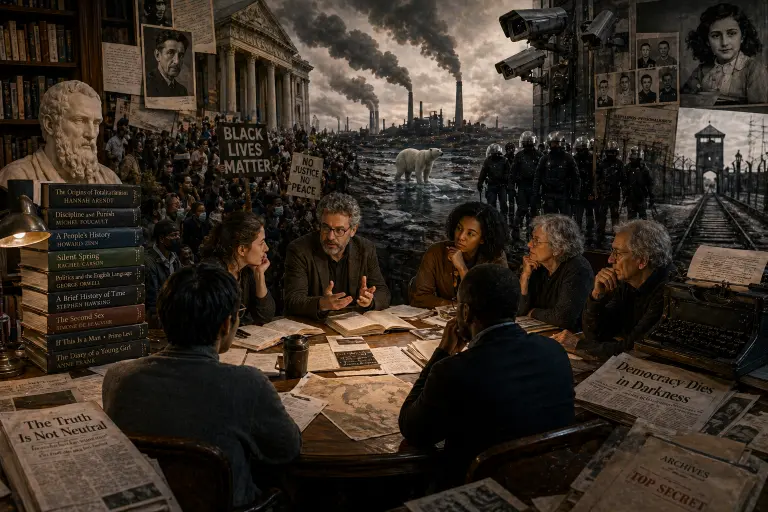
Some books do not simply enter public conversation—they reorganize it. A serious work of non-fiction can alter how a generation understands history, power, memory, science, or moral responsibility. These books exceed bestseller lists and temporary relevance because they become reference points: texts people return to when trying to explain crises, institutions, and the invisible structures beneath ordinary life. Their influence is rarely immediate spectacle. It is slower, deeper, and often more durable than fiction’s emotional immediacy.

The Architecture of Persistence: Rejection, Constraint, and the Literary Life
The mythology of literary greatness often begins at the moment of recognition: publication, acclaim, institutional validation. What it tends to obscure are the long periods of invisibility that precede that moment—the years in which manuscripts are rejected, misunderstood, or ignored. To read literary history through biography is to confront a different narrative: one in which persistence, constraint, and collaboration shape the conditions under which art becomes possible.