

Narrative structure is often treated as a neutral container—an invisible framework through which story simply passes. Yet in its most sophisticated forms, structure is not passive. It is expressive. It shapes perception, governs emotional response, and determines how time itself is experienced by the reader. In contemporary fiction, this awareness has become increasingly explicit: the architecture of a narrative does not merely organize events; it embodies states of mind.
Two of the most powerful structural strategies in modern literature—non-linear architecture and controlled pacing—demonstrate how form can move beyond technique into psychological representation. When used with precision, they do not simply tell a story about experience. They recreate the conditions under which that experience is lived, forcing the reader into forms of attention that mirror the inner logic of the narrative itself.

Non-Linear Architecture and the Logic of Traumatic Memory
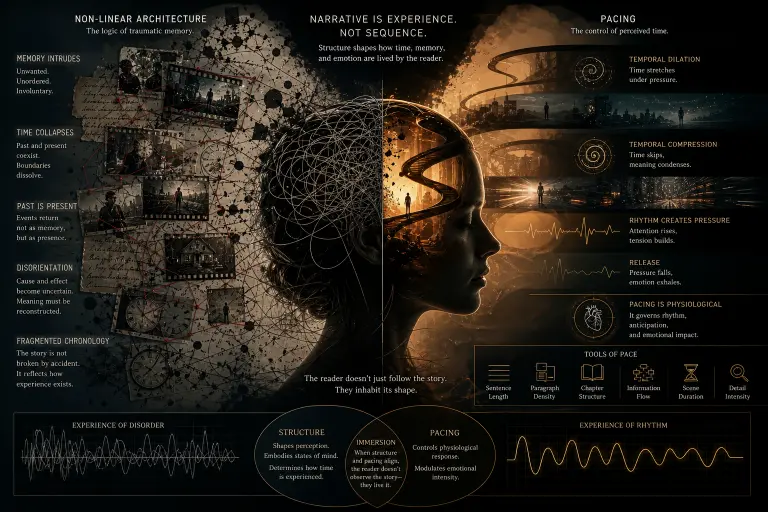
Non-linear storytelling is often described in superficial terms: flashbacks, time shifts, fragmented chronology. Yet in its most significant applications, it is not a stylistic flourish. It is a structural necessity. Certain experiences—particularly those shaped by trauma—resist linear narration because they are not lived linearly in the first place.
Toni Morrison’s Beloved stands as one of the most precise demonstrations of this principle. The novel does not move cleanly from past to present because the past itself has not been resolved. Memory intrudes without warning. Time collapses. Events reappear not as recollection, but as presence.
This fragmentation is not decorative. It reflects the psychological condition of characters for whom trauma cannot be processed into a stable narrative. Instead of remembering the past, they relive it—irregularly, involuntarily, and without chronological coherence.
By adopting this structure, the novel transfers that disorientation to the reader. The act of reading becomes experiential rather than interpretive. One does not simply understand the character’s condition; one undergoes a version of it through narrative form.
This is the crucial distinction: non-linearity is not about complexity for its own sake. It is about fidelity to the way certain experiences exist—fragmented, recursive, unresolved.
Disorientation as Narrative Strategy
When chronology breaks, the reader loses conventional orientation. Cause and effect become uncertain. Temporal markers dissolve. The narrative demands reconstruction rather than passive consumption.
This demand is not accidental. It transforms reading into participation. The reader must assemble meaning from fragments, mirroring the character’s attempt to make sense of their own experience. The result is a shift from intellectual distance to sensory proximity.
Disorientation, in this context, becomes a tool. It destabilizes the expectation that narrative should provide clarity, replacing it with a more demanding form of engagement—one that reflects the instability of the subject itself.
Archives and literary institutions such as the British Library, the Library of Congress, and scholarly databases like JSTOR preserve drafts and manuscripts that reveal how authors construct these fragmented architectures, showing that what appears disordered on the surface is often meticulously designed beneath.
Pacing as Physiological Control
If structure governs how time is arranged, pacing governs how time is felt. It is often reduced to speed—fast or slow—but this simplification misses its deeper function. Pacing operates as a form of physiological manipulation. It controls the reader’s internal rhythm: attention, tension, anticipation, release.
One way to understand pacing is to think of it as the narrative equivalent of blood pressure. It rises, stabilizes, spikes, and drops. These fluctuations determine whether a reader experiences urgency, dread, calm, or exhaustion.
Writers achieve this control through a range of techniques: sentence length, paragraph density, chapter structure, descriptive intensity, and the distribution of information. Each element contributes to how quickly or slowly the reader moves—not only through the text, but through emotional states.
Temporal Dilation: Slowing Time Under Pressure
In moments of crisis, many narratives slow down rather than accelerate. Time dilates. A single second may expand across multiple pages. Sensory detail intensifies. Internal thought becomes hyper-focused.
This technique mirrors real psychological experience. In high-stress situations, perception often sharpens. Attention narrows. Time appears to stretch. By replicating this effect, narrative pacing creates immersion at the level of perception itself.
The reader does not simply observe tension—they inhabit it. The slowed pace forces prolonged attention, making escape impossible.
Temporal Compression: The Power of Omission
At the opposite extreme lies compression. Entire periods may be condensed into a single sentence or omitted entirely through narrative ellipsis. This creates a different effect: acceleration, distance, and sometimes disorientation.
Compression can signal that certain experiences are less important, or that they resist representation. It can also create contrast. By moving rapidly through one section, the narrative prepares the reader for the intensity of what follows.
In this sense, pacing is not only about movement—it is about emphasis. What is slowed becomes significant. What is compressed becomes transitional.
The Language of Urgency
Suspense-driven narratives often rely on short sentences, rapid transitions, and brief chapters to create acceleration. These elements reduce cognitive load, allowing the reader to move quickly while maintaining high emotional intensity.
Conversely, dense descriptive passages can produce a different form of tension. By focusing intensely on seemingly minor details, the narrative delays resolution, creating anticipation that can become almost unbearable. The reader is held in place, aware that something is imminent but unable to reach it.
Both techniques manipulate expectation. Speed creates urgency; delay creates pressure. The balance between them determines how the narrative breathes.
Between Commercial and Literary Time
The distinction often drawn between “commercial” and “literary” fiction is frequently a distinction of pacing rather than content. Commercial narratives tend to prioritize forward movement, minimizing interruption in order to sustain momentum. Literary narratives often allow for interruption—reflection, digression, structural experimentation.
This does not imply hierarchy. It reflects different relationships to time. One seeks to move the reader through events efficiently; the other seeks to expand the reader’s experience of those events.
In practice, many of the most effective works combine both approaches. They accelerate when necessary and decelerate when it matters, using pacing not as a fixed style but as a dynamic instrument.
Why Structure and Rhythm Cannot Be Separated
Non-linear architecture and pacing are not independent techniques. They interact continuously. Fragmented structure can amplify the effects of pacing, while controlled rhythm can stabilize or destabilize non-linear sequences.
Together, they determine how narrative is experienced at the most immediate level. They shape not only what the reader understands, but how that understanding is reached—slowly, abruptly, painfully, or intuitively.
When used with precision, they transform narrative into an embodied experience.
Continue Exploring Narrative Form
If you are interested in how structure shapes reader experience, you may also explore our essays on worldbuilding, structural critique, and contemporary narrative experimentation.
Readers drawn to deeper formal analysis may also revisit our long-form studies of memory, temporality, and the relationship between narrative design and psychological representation.
Frequently Asked Questions
Why do some novels use non-linear storytelling?
Because certain experiences—especially those involving trauma—cannot be represented accurately through linear chronology.
Does fragmented structure make a story more complex?
Not necessarily. It changes how the story is processed, often requiring active reconstruction rather than passive reading.
What is pacing in narrative terms?
It is the control of how quickly or slowly the reader experiences events, emotions, and information within the story.
Can pacing influence emotional response?
Yes. It directly affects tension, anticipation, and immersion by shaping the reader’s internal rhythm.
Reviewed for editorial quality, structural precision, and analytical depth.
Conclusion: Reading as Experience, Not Observation
When narrative structure and pacing are treated as expressive tools, fiction moves beyond representation. It does not simply describe experience—it recreates it. Fragmented architecture mirrors fractured memory. Controlled rhythm regulates emotional intensity.
The result is a form of reading that is no longer purely intellectual. It becomes sensory, physiological, and immersive. The reader does not stand outside the narrative, observing its logic. They are drawn into its conditions, experiencing time, memory, and tension from within.
In this transformation, the novel reveals one of its most powerful capacities: not just to tell stories, but to shape how those stories are felt.

Bibliographic Foundation
This analysis was conducted under the Sanctum's methodological rigor, utilizing exegetical protocols grounded in universal heritage repositories and documented preservation archives.
View Authority FoundationsAnalytical Recommendations
The Architecture of Wonder: Balancing Logic and Mystery in Worldbuilding
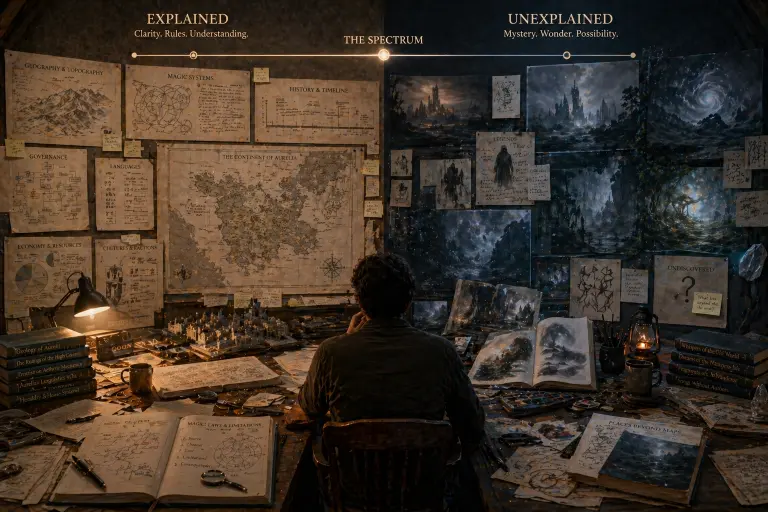
Every fictional world makes a demand on the reader long before its story fully unfolds. That demand is not only emotional or thematic—it is cognitive. To enter a constructed reality is to accept a system of rules, visible or hidden, that governs how meaning operates inside it. Some worlds explain themselves with rigorous precision, inviting the reader to understand their mechanics in detail. Others withhold explanation, allowing mystery to function as structure. Between these approaches lies a spectrum that defines how immersion is achieved and how curiosity is sustained.

The Invisible Craft: Consistency and Coherence in Narrative Environments
Astory rarely announces the rules of its world outright. Instead, it teaches the reader how to see. A gesture here, a constraint there, a detail that seems incidental until it quietly proves decisive—these are the building blocks of immersion. What matters is not how much is explained, but how naturally everything holds together. When a narrative environment feels convincing, it is because its logic has been absorbed rather than declared, experienced rather than outlined.

Literature Without a Center: The Structural Rise of Global Diaspora Voices
The contemporary novel is no longer anchored to a single cultural center. Over the last decade, literary authority has shifted in ways that are both visible and structural. The global circulation of prizes, translations, and readership has made one fact increasingly unavoidable: the narratives that define our era are no longer being written exclusively from within traditional Western frameworks. Instead, they emerge from movement—migration, exile, linguistic displacement, and historical fracture.