

Few works of modern literature occupy such a paradoxical space in cultural memory as The Little Prince. It is frequently categorized as a children’s tale, gifted to young readers with the assumption of simplicity, yet it is quietly revered by adults as a meditation on loss, love, and moral perception. This dual identity is not a contradiction but the central design of the work. The text functions simultaneously as fable and philosophical inquiry, offering surface-level enchantment while concealing profound reflections on the human condition.
What distinguishes this narrative is not its plot, which is deliberately sparse, but its emotional architecture. The story is structured around absence: the absence of understanding between adults and children, the absence of attention in a world consumed by utility, and the absence of permanence in relationships defined by impermanence. The Little Prince does not present answers; it creates silences in which readers are invited to recognize their own forgotten questions.

The Child’s Gaze as Ethical Instrument
The narrative power of The Little Prince arises from its inversion of authority. Wisdom does not belong to those who possess institutions, measurements, or titles. It belongs to the one who looks without instrumentality. The child’s gaze in the story functions as an ethical instrument, revealing the absurdity of adult preoccupations precisely because it does not share their assumptions.
Figures encountered by the Little Prince—the King, the Vain Man, the Businessman, the Geographer—are not caricatures, but distilled forms of social obsession. Each character represents a mode of living in which function replaces meaning. Authority exists without responsibility, possession without intimacy, knowledge without presence. The narrative does not condemn these figures through satire alone; it exposes their loneliness.
The child, by contrast, does not measure worth through productivity or recognition. His questions are not strategic. They are sincere. This sincerity is portrayed not as innocence, but as a form of clarity that adulthood gradually erodes.
The Desert as a Space of Inner Truth
The choice of the desert as the primary setting is central to the work’s philosophical resonance. The desert is a place of deprivation, but also of encounter. Removed from social noise and institutional structures, the narrator confronts a silence that forces attention inward. In this environment, meaning is not mediated by systems or conventions; it emerges through relationship.
The desert is not romanticized as a mystical escape. It is harsh, threatening, and isolating. Yet it is precisely this harshness that strips away distraction. The meeting between the aviator and the Little Prince unfolds in a landscape where survival depends on attentiveness. Water becomes precious. Time becomes intimate. Speech becomes careful.
This setting transforms the narrative into a meditation on presence. The desert does not offer comfort; it offers clarity. And clarity, in the world of The Little Prince, is a form of ethical awakening.
Love, Taming, and the Burden of Responsibility
The relationship between the Little Prince and the Rose constitutes the emotional core of the story. Love is not portrayed as spontaneous harmony, but as the consequence of commitment. The Rose is fragile, vain, demanding, and yet irreplaceable. The Little Prince’s journey away from her is not a rejection of love, but a misunderstanding of its weight.
The concept of “taming,” introduced through the Fox, reframes love as responsibility. To form a bond is to accept vulnerability. It is to create meaning through attention over time. This conception of love resists romantic idealization. It insists that attachment generates obligation, and that obligation, rather than diminishing freedom, gives it direction.
The tragedy of the Little Prince is not that he loves the Rose, but that he initially fails to understand what loving entails. His journey is not one of discovery alone, but of re-interpretation. He learns that uniqueness is not inherent in objects, but produced by care.
Seeing With the Heart: Epistemology and Moral Vision
The most frequently quoted line from The Little Prince—that what is essential is invisible to the eye—has often been reduced to sentimental cliché. Yet within the narrative, this statement functions as an epistemological claim. It challenges dominant modes of knowing that privilege quantification over understanding.
The book proposes a form of moral vision grounded in attention rather than analysis. To “see with the heart” is not to abandon reason, but to recognize the limits of instrumental rationality. Measurement alone cannot grasp meaning. Ownership cannot replace relationship. Classification cannot substitute for care.
This epistemology is not anti-intellectual. It is anti-reductionist. It insists that certain dimensions of reality—love, grief, loyalty—cannot be fully captured by external description. They require presence. They require time. They require vulnerability.
Narrative Simplicity as Philosophical Strategy
The stylistic simplicity of The Little Prince is often mistaken for naïveté. In truth, the prose is disciplined. Each sentence is shaped to carry emotional weight without rhetorical excess. The narrative voice avoids ornamentation, creating a surface of clarity that allows subtext to resonate.
This restraint functions as philosophical strategy. By stripping away complexity of plot and setting, the text concentrates attention on relational dynamics. The absence of elaborate world-building focuses the reader on interior movement rather than external spectacle. The story becomes a vessel for reflection rather than distraction.
In this sense, The Little Prince belongs to a tradition of philosophical fables that employ minimalism not as limitation, but as method. The emptiness of the narrative space is what allows meaning to echo.
The Tragedy of Adulthood and the Loss of Wonder
The book’s most devastating critique is reserved for adulthood itself. Adults are not portrayed as cruel, but as distracted. Their tragedy lies in forgetting how to attend to what does not yield immediate utility. They value numbers, status, and function because these offer the illusion of control.
This critique is not nostalgic romanticism. The text does not suggest that children are morally superior by nature. Rather, it argues that adulthood often involves the gradual abandonment of attentiveness. Wonder is not lost because it is childish, but because it is inconvenient. It interrupts efficiency. It resists commodification.
The Little Prince’s presence exposes this loss not through accusation, but through contrast. His questions linger because they are not framed to produce advantage. They exist simply to understand.
Why The Little Prince Endures
The endurance of The Little Prince is rooted in its refusal to resolve the tension it describes. The book does not reconcile adulthood and childhood into a harmonious synthesis. It leaves the reader suspended between worlds. The story ends not with certainty, but with an invitation to listen for a familiar laughter among the stars.
This unresolved quality is the source of the book’s lasting power. It does not close its argument. It opens a wound of remembrance. Readers return not for narrative comfort, but for ethical disturbance—for the reminder that something essential has been misplaced, and that its recovery depends on a deliberate reorientation of attention.
Conclusion: The Quiet Discipline of Caring
The Little Prince is not a story about innocence preserved. It is a story about innocence remembered—and about the moral labor required to remember it without sentimentality. Its philosophy is neither abstract nor systematic. It is embodied in gestures of care, in the slow work of forming bonds, and in the willingness to remain vulnerable in a world structured around protection.
In a cultural environment increasingly defined by speed, metrics, and surface engagement, the book persists as a quiet act of resistance. It asks not for belief, but for attention. Not for admiration, but for presence. And in doing so, it continues to offer something increasingly rare in modern life: a language for tenderness that does not apologize for its seriousness.

Bibliographic Foundation
This analysis was conducted under the Sanctum's methodological rigor, utilizing exegetical protocols grounded in universal heritage repositories and documented preservation archives.
View Authority FoundationsAnalytical Recommendations
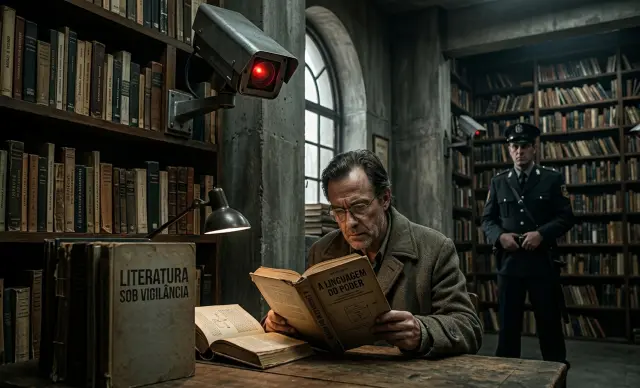
Literature Under Surveillance: Power, Language, and the Anatomy of Control in Totalitarian Societies
Literature Under Surveillance: Power, Language, and the Anatomy of Control in Totalitarian Societies. Literature becomes most urgent when freedom contracts. In moments where political systems extend their reach beyond institutions and into consciousness itself, narrative ceases to be mere representation and becomes a form of resistance—sometimes overt, often subtle, always necessary. It is within such conditions that fiction assumes a dual role: as documentation of lived realities and as critique of the mechanisms that seek to control them.
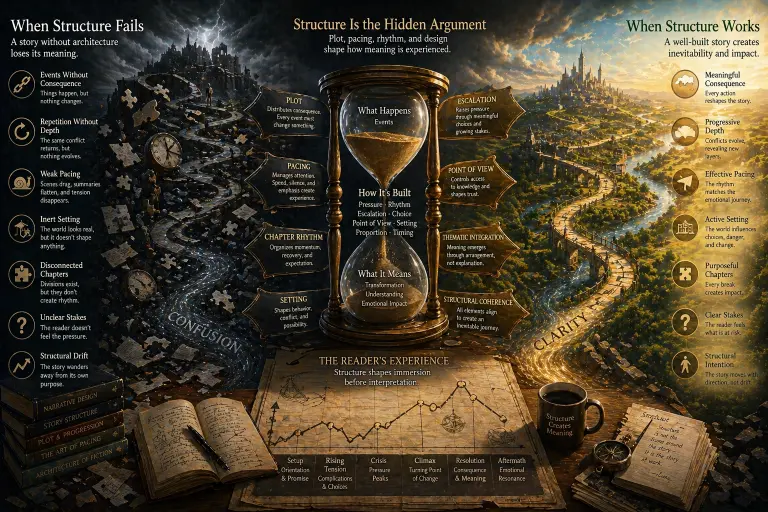
The Hidden Architecture: Why Structural Critique is the Key to Narrative Mastery
A narrative rarely fails because of its ideas alone. More often, it weakens at the level of structure—where pacing loses pressure, scenes repeat without consequence, chapters collapse into summary, or a promising setting remains dramatically inert. Readers frequently describe such problems as a book feeling “slow,” “unfinished,” or “uneven,” but these reactions are usually responses to architecture rather than theme. Structural critique begins by asking not what a story means, but how it has been built to produce meaning in the first place.
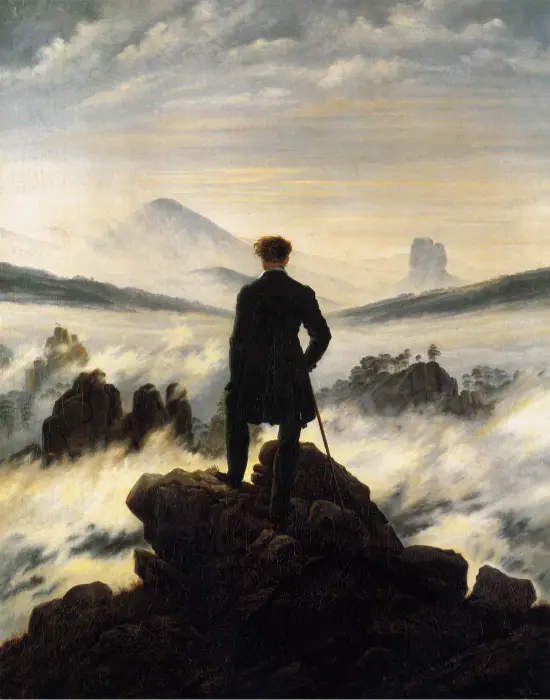
Romanticism and the Rebellion of the Inner World: Imagination, Nature, and the Refusal of Mechanized Reality
Romanticism and the Rebellion of the Inner World: Imagination, Nature, and the Refusal of Mechanized Reality. If literary modernism represents the fracture of certainty, Romanticism represents the refusal of its premature consolidation. Emerging in the late eighteenth and early nineteenth centuries, Romanticism was not merely a stylistic shift but a profound philosophical rebellion against the accelerating rationalization of human life. It arose in response to the Enlightenment’s elevation of reason as the primary arbiter of truth and the Industrial Revolution’s transformation of nature into resource, labor into mechanism, and time into measurable productivity.