

Language is often treated as a neutral vehicle for meaning—a transparent medium through which ideas pass unchanged. Yet at the level of structure, rhythm, and choice, language does not simply convey thought; it shapes perception, emotion, and even physiological response. The sentence is not only a unit of grammar. It is a unit of experience, capable of accelerating the pulse, directing attention, and altering judgment without the reader’s conscious awareness.
To examine literature at this level is to move beneath plot and theme into the mechanics of effect. It is to ask not only what a text says, but how it produces its impact—how syntax, silence, imagery, and vocabulary interact to guide the reader’s mind.
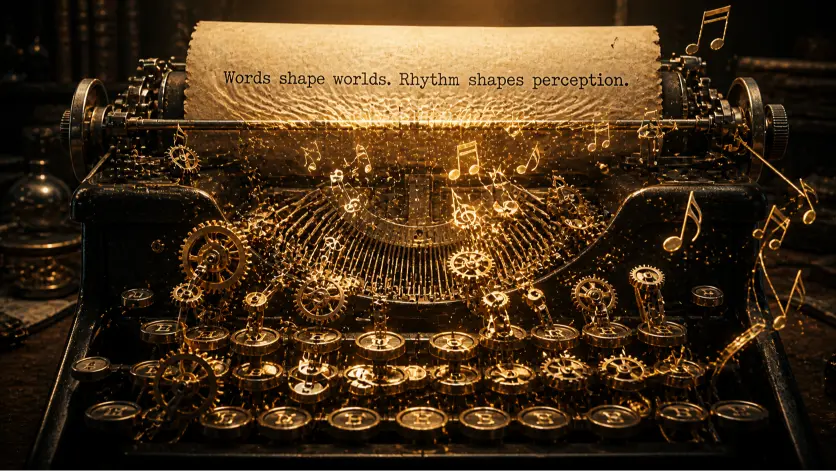
The Syntax of Anxiety: Rhythm as Physiological Control
Sentence structure operates as a form of temporal regulation. Short, abrupt phrases create a pattern of interruption. They limit processing time. They compress thought into rapid units. The effect is not merely stylistic—it is physical. The reader’s attention narrows, breathing subtly shifts, and the experience of urgency emerges.
This technique is often associated with the prose style of Ernest Hemingway, where clarity and brevity produce a controlled intensity. Each sentence arrives with minimal transition, creating a rhythm that resists pause.
In contrast, extended sentences—particularly those associated with stream-of-consciousness techniques—produce a different effect. The absence of clear punctuation or structural breaks elongates the reader’s engagement. The mind is carried forward without release, generating a sense of immersion that can approach suffocation.
This contrast reveals that syntax is not neutral. It governs the pace at which information is absorbed and the emotional state that accompanies that process. Writers do not simply choose words; they design temporal experiences.
Applied beyond literature, this insight becomes a tool of communication. The rhythm of a message—whether in writing or speech—can be calibrated to either intensify focus or create space for reflection. Control of syntax becomes, in effect, control of attention.
The Rhetoric of Silence: Meaning in Omission
Not all narrative force resides in what is expressed. A significant portion emerges from what is withheld. The concept often described as the “iceberg theory” suggests that the visible elements of a text are supported by a larger, submerged structure of implication.
Writers who employ this approach rely on restraint. Vocabulary remains simple, descriptions minimal, yet the absence of explicit explanation generates interpretive pressure. The reader is required to infer, to project, to complete the narrative space left open.
This process transforms reading into participation. Meaning is not delivered—it is constructed through interaction between text and reader. The silence within the narrative becomes active, shaping interpretation as strongly as any explicit statement.
Beyond literature, this dynamic has broader relevance. In social and professional contexts, communication often operates through implication. What is omitted can signal as much as what is stated. Authority may be reinforced not through volume, but through controlled absence.
To recognize this is to develop a sensitivity to subtext. It is to understand that meaning frequently resides in gaps, and that these gaps are rarely accidental.
Metaphor as Cognitive Activation
Metaphor is commonly understood as a decorative element of language. In practice, it functions as a cognitive mechanism. When a metaphor is effective, it does not merely describe—it activates multiple domains of perception simultaneously.
Sensory language—references to texture, sound, temperature, or movement—extends the reach of a concept beyond abstract reasoning. It engages neural pathways associated with physical experience, making the idea more immediate and more memorable.
This explains why certain metaphors persist while others dissipate. Those that connect with embodied experience create stronger cognitive associations. They are not processed solely as language; they are experienced as simulations.
For communication, this has practical implications. Abstract concepts—strategy, leadership, emotion—can be rendered more accessible through carefully chosen imagery. The goal is not ornamentation, but transformation: converting the intangible into something perceptible.
In this sense, metaphor operates as a form of translation between levels of cognition, bridging the gap between thought and sensation.
Lexical Choice and the Architecture of Judgment
Vocabulary does more than convey information. It frames interpretation. The selection of a single term can alter the perceived nature of an event or individual without changing the underlying facts.
Consider the difference between describing a figure as a “rebel” versus a “terrorist,” or a “leader” versus a “tyrant.” Each term carries implicit associations that guide moral evaluation. The reader’s response is shaped before conscious analysis occurs.
This effect is not limited to overtly charged language. Subtle variations in tone, register, and connotation can influence perception in ways that remain largely unnoticed. Language becomes a lens through which reality is filtered.
Recognizing this dynamic is essential for critical engagement. It enables readers to identify when language is directing interpretation rather than merely describing it. The text is no longer taken at face value, but examined for its underlying assumptions.
In broader contexts—media, politics, everyday communication—this awareness functions as a form of intellectual autonomy. It allows individuals to separate description from framing, reducing susceptibility to manipulation.

Language as Instrument, Not Medium
Across these dimensions—syntax, silence, metaphor, and vocabulary—a consistent principle emerges: language operates as an instrument of influence. It shapes not only what is understood, but how it is experienced.
This perspective shifts the focus of reading. The text is no longer approached solely as a source of meaning, but as a system of effects. Each structural choice contributes to the overall impact, guiding attention, emotion, and interpretation.
Why This Matters Beyond Literature
The mechanisms identified in literary analysis extend into everyday communication. Emails, presentations, negotiations, and public discourse all rely on the same underlying principles. The difference lies not in the system, but in its application.
Understanding these mechanisms provides a form of practical literacy. It enables individuals to construct messages with greater precision and to interpret received messages with greater clarity. Communication becomes a deliberate process rather than an intuitive one.
Institutions such as the British Library, the Library of Congress, and academic platforms like JSTOR offer extensive resources for exploring these dynamics across literary and rhetorical traditions.
Continue Exploring Narrative Mechanics
If you are interested in how language structures perception, you may also explore our essays on narrative theory, structural critique, and rhetorical analysis.
Readers seeking further depth may revisit our long-form studies on cognition, storytelling, and the relationship between language and thought.
Frequently Asked Questions
Can sentence structure really affect emotion?
Yes, variations in rhythm and pacing influence how information is processed and experienced.
Why is subtext important?
Because it engages the reader in constructing meaning, increasing depth and interpretive complexity.
What makes a metaphor effective?
Its ability to connect abstract ideas with sensory or embodied experience.
How does word choice influence perception?
Through connotation and framing, which shape interpretation before conscious analysis occurs.
Reviewed for editorial quality, analytical depth, and linguistic precision.
Conclusion: The Hidden Mechanics of Expression
Language operates beneath the level of conscious attention, guiding experience through structure and choice. To become aware of these mechanisms is to engage with communication at a deeper level—one in which meaning is not only received, but examined.
In this awareness, reading and writing converge. Both become practices of attention, shaped by an understanding that every word, pause, and structure contributes to the construction of experience.
What appears simple on the surface is, in reality, a complex system—one that, once understood, can be navigated with intention and precision.

Bibliographic Foundation
This analysis was conducted under the Sanctum's methodological rigor, utilizing exegetical protocols grounded in universal heritage repositories and documented preservation archives.
View Authority FoundationsAnalytical Recommendations

Contemporary Fiction and the Inheritance of Fragmentation: Narrative After Modernism
Few works of twentieth-century literature have achieved the rare balance of popular enchantment and intellectual endurance quite like The Chronicles of Narnia.

The Little Prince: A Philosophy of Tenderness, Responsibility, and the Tragedy of Growing Up
Few works of modern literature occupy such a paradoxical space in cultural memory as The Little Prince. It is frequently categorized as a children’s tale, gifted to young readers with the assumption of simplicity, yet it is quietly revered by adults as a meditation on loss, love, and moral perception.

Unstable Classics: Why Canonical Literature Requires Constant Reinterpretation
anonical literature survives not because it remains untouched by time, but because each generation returns to it with new anxieties, new intellectual frameworks, and new moral questions. A classic does not endure through static reverence; it endures through reinterpretation. What once seemed settled becomes unstable again, and familiar texts reveal tensions that earlier readers either ignored or considered irrelevant. To revisit a classic seriously is not to dismantle its authority for the sake of novelty, but to test whether its meanings remain alive under contemporary scrutiny.