

A narrative rarely fails because of its ideas alone. More often, it weakens at the level of structure—where pacing loses pressure, scenes repeat without consequence, chapters collapse into summary, or a promising setting remains dramatically inert. Readers frequently describe such problems as a book feeling “slow,” “unfinished,” or “uneven,” but these reactions are usually responses to architecture rather than theme. Structural critique begins by asking not what a story means, but how it has been built to produce meaning in the first place.
Plot, setting, chapter rhythm, narrative escalation, and formal proportion are not secondary concerns reserved for technical discussion. They are the hidden mechanics of literary persuasion. A powerful theme can be diminished by weak sequencing; a compelling character can disappear inside shapeless pacing. The reader’s emotional and intellectual experience depends on arrangement. Structure is not the frame surrounding literature—it is one of literature’s deepest arguments.
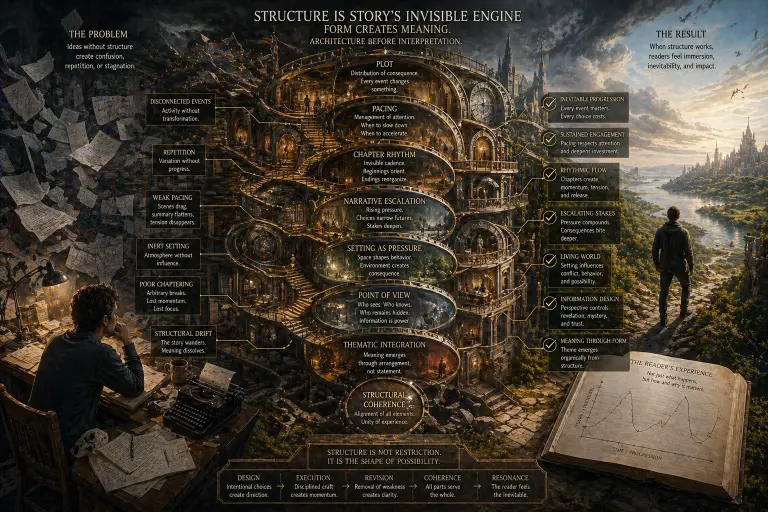
Plot Is the Distribution of Consequence
Plot is often reduced to the question of what happens next, but serious structural reading asks a more precise question: what changes because something happened? Events alone do not create narrative movement. A story becomes compelling when actions redistribute power, knowledge, vulnerability, or moral responsibility.
Many structurally weak novels contain numerous events but little transformation. Characters move, revelations occur, conflicts appear, yet nothing meaningfully alters the system of the narrative. The result is motion without progression. Readers experience this as stagnation, even when the surface remains busy.
Strong plotting depends on consequence. A revelation must destabilize relationships. A choice must close certain futures while opening others. Plot is not accumulation—it is irreversible pressure.
Pacing Is the Management of Attention
Readers often describe pacing emotionally: too slow, too rushed, strangely uneven. Yet pacing is not simply speed. It is the management of attention through emphasis, delay, silence, and narrative compression. A quiet scene can feel intense if its placement creates expectation; an action sequence can feel empty if nothing structurally depends on it.
Good pacing understands proportion. Some moments require expansion because emotional consequence demands it. Others should pass quickly because over-explanation weakens dramatic force. Excessive summary can flatten tension; excessive scene detail can create inertia.
Pacing is therefore ethical as much as technical. It reveals what the narrative believes deserves time.
Chapter Structure as Invisible Rhythm
Chapters are often treated as practical divisions, yet they are powerful structural instruments. They regulate momentum, perception, and psychological recovery. Where a chapter ends shapes suspense; where it begins shapes orientation.
A strong chapter break does not merely stop the page—it reorganizes expectation. It may withhold information, force reinterpretation, or create emotional aftershock. Weak chapters, by contrast, feel arbitrary. They divide material without altering experience.
Some novels depend heavily on short chapters to create urgency; others require longer architectural units to sustain philosophical depth. Neither is inherently superior. What matters is whether the division serves the logic of attention rather than habit.
Literary archives and institutions such as the British Library, the Library of Congress, and academic resources like JSTOR continue to preserve manuscript drafts and structural revisions that reveal how major writers reshape plot, pacing, and formal architecture long before publication.
Setting Must Produce Pressure
Setting is not background decoration. A city, a house, a school, a prison, a coastline—these spaces must shape action rather than merely host it. When setting remains atmospheric but causally inactive, narrative depth weakens.
A confined apartment changes conflict differently than an open landscape. A bureaucratic institution generates different speech, fear, and movement than a rural village. Geography influences secrecy. Architecture influences intimacy. Climate influences labor and survival.
Readers trust settings that create consequence. They distrust worlds that exist only for visual mood. Structural critique asks whether the environment changes behavior or simply provides scenery.
Repetition and the Illusion of Progress
Many novels suffer from repetition disguised as development. Characters revisit the same emotional conflict, scenes repeat the same information, and dialogue circles familiar tension without escalation. Because the language changes, the repetition is not always obvious—but the reader feels narrative fatigue.
Repetition is not inherently flawed. In fact, deliberate recurrence can create thematic power. The question is whether repetition deepens meaning or replaces movement. Returning to the same conflict should alter perspective, not merely restate it.
Structure weakens when recurrence becomes avoidance—when the story postpones transformation by performing variation without risk.
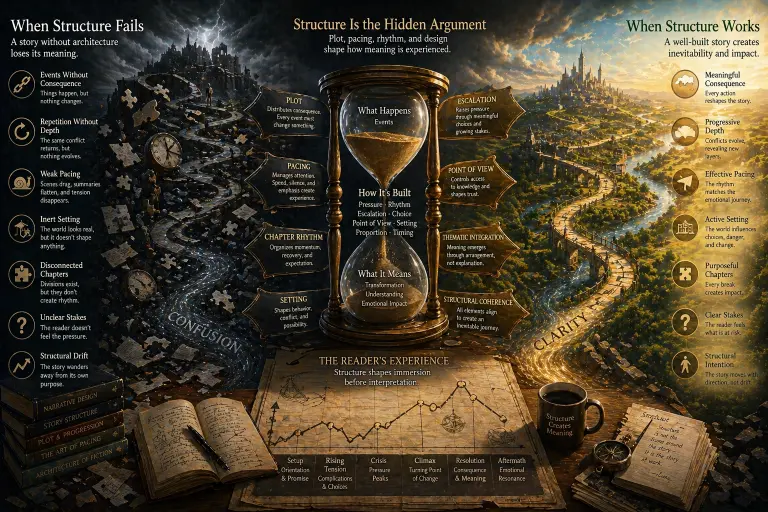
Beginnings and Endings Reveal Design
The opening of a work establishes interpretive contracts. It teaches readers what kind of attention will be required: psychological, philosophical, political, symbolic. A weak beginning confuses expectation or delays necessary stakes. A strong one creates orientation without exhausting mystery.
Endings perform the opposite task. They test whether the narrative has earned its conclusions. Closure does not require complete resolution, but it does require structural honesty. An ending should feel surprising yet inevitable—recognizable as the form the story was always moving toward.
When endings fail, it is often because earlier architecture failed first. Final chapters reveal structural truth with unusual cruelty.
Point of View Is Structural, Not Cosmetic
Perspective determines access. Who sees, who knows, and who remains unreadable are architectural decisions with ethical consequence. First-person narration creates intimacy but also limitation. Omniscient narration offers scale but risks emotional distance. Multiple perspectives can expand complexity or fragment coherence.
Structural critique asks whether the chosen point of view produces necessary tension. If a story depends on uncertainty, excessive access may weaken it. If moral ambiguity matters, restricted narration may deepen it. Perspective is not merely style—it is the distribution of knowledge.
Readers experience narrative trust through point of view long before they consciously analyze it.
Why Some Stories Feel Finished Too Early
Some novels lose energy not because they become worse, but because they resolve their deepest tension too soon. Once the central emotional or moral question has been answered, later chapters continue mechanically without genuine necessity.
This often happens when external plot survives after internal conflict has ended. The characters keep moving, but the reader has already reached interpretive closure. Structural design requires alignment between outer action and inner stakes.
A narrative should end when its deepest question has changed form—not simply when events stop happening.
Why This Perspective Still Matters
In contemporary reading culture, discussion often privileges theme over form. Readers ask what a book is about before asking how it creates meaning. Yet literature is experienced structurally. Tension, immersion, surprise, and emotional consequence are produced by architecture before interpretation becomes conscious.
Structural critique restores attention to that invisible labor. It helps readers understand why certain books remain unforgettable while others disappear despite strong premises. Often the difference is not originality of idea, but precision of arrangement.
To study structure is to study the conditions under which literature becomes persuasive at all.
Continue Exploring Literary Form
If you are interested in how narrative architecture shapes interpretation, you may also explore our essays on symbolic design, narrative voice, and the relationship between setting, rhythm, and psychological realism across modern fiction.
Readers drawn to deeper formal analysis may also revisit our long-form studies of worldbuilding, chapter mechanics, and the hidden systems of coherence that sustain immersive storytelling.
Frequently Asked Questions
What is structural critique in literature?
Structural critique examines how a narrative is built—plot progression, pacing, setting, chapter organization, and formal proportion—rather than focusing only on theme or symbolism.
Why do some books feel slow even when many things happen?
Because events without consequence create motion without progression. Readers need transformation, not just activity, for narrative momentum to feel real.
How does chapter structure affect reading?
Chapters regulate rhythm and expectation. Their beginnings and endings shape suspense, emotional recovery, and the reader’s sense of progression.
Can setting be a structural element?
Yes. Setting becomes structural when space influences behavior, conflict, secrecy, power, and consequence rather than functioning only as atmosphere.
Reviewed for editorial quality, formal precision, and narrative integrity.
Conclusion: The Hidden Architecture of Meaning
Readers often remember characters and themes, but they feel structure first. Before interpretation becomes language, architecture has already shaped attention—deciding where tension rises, where silence matters, and where consequence becomes irreversible.
Structural critique reveals that literature is not simply written but engineered. Plot distributes risk, pacing distributes attention, chapters distribute pressure, and setting distributes possibility. Meaning emerges through arrangement as much as through statement.
The strongest narratives are not those with the most dramatic ideas, but those whose form makes those ideas inevitable. When structure succeeds, readers do not notice the frame—they live inside it. That invisibility is not simplicity. It is mastery.

Bibliographic Foundation
This analysis was conducted under the Sanctum's methodological rigor, utilizing exegetical protocols grounded in universal heritage repositories and documented preservation archives.
View Authority FoundationsAnalytical Recommendations

Internal Inevitability: The Hidden Architecture of Immersive Worldbuilding
A fictional world succeeds not when it appears infinitely large, but when it feels internally inevitable. Readers do not enter narrative environments because every mountain has been mapped or every dynasty fully documented; they enter because the world behaves as though it could continue existing beyond the page. Coherence creates immersion. The illusion of reality depends less on quantity of detail than on the disciplined relationship between setting, causality, memory, and consequence.

The Architecture of Understanding: Why Rigorous Non-Fiction Reorganizes Perception
The strongest non-fiction does not merely inform—it reorganizes perception. A serious work of history, philosophy, science, political analysis, or cultural criticism changes how readers understand causality, responsibility, and evidence itself. It does not offer facts as isolated units of knowledge, but arranges them into structures of interpretation. The result is not simple agreement, but intellectual displacement: the realization that what once seemed obvious was often only familiar.

The Architecture of Wonder: Balancing Logic and Mystery in Worldbuilding
Every fictional world makes a demand on the reader long before its story fully unfolds. That demand is not only emotional or thematic—it is cognitive. To enter a constructed reality is to accept a system of rules, visible or hidden, that governs how meaning operates inside it. Some worlds explain themselves with rigorous precision, inviting the reader to understand their mechanics in detail. Others withhold explanation, allowing mystery to function as structure. Between these approaches lies a spectrum that defines how immersion is achieved and how curiosity is sustained.