

Narrative voice is often imagined as singular—a stable “I” or an observing third person guiding the reader through events. Yet some of the most revealing works of modern fiction destabilize this assumption. They redistribute voice across multiple subjects or withdraw authority from it altogether. In these cases, narration becomes less a channel of truth and more a structure through which power, identity, and perception are negotiated.
Two strategies illustrate this transformation with particular clarity: the collective voice, in which a “we” replaces the individual narrator, and the evolving role of narrative distance, where the once-dominant omniscient perspective is questioned, fragmented, or redefined. Together, they reveal that who speaks in a narrative is inseparable from how reality itself is constructed within it.
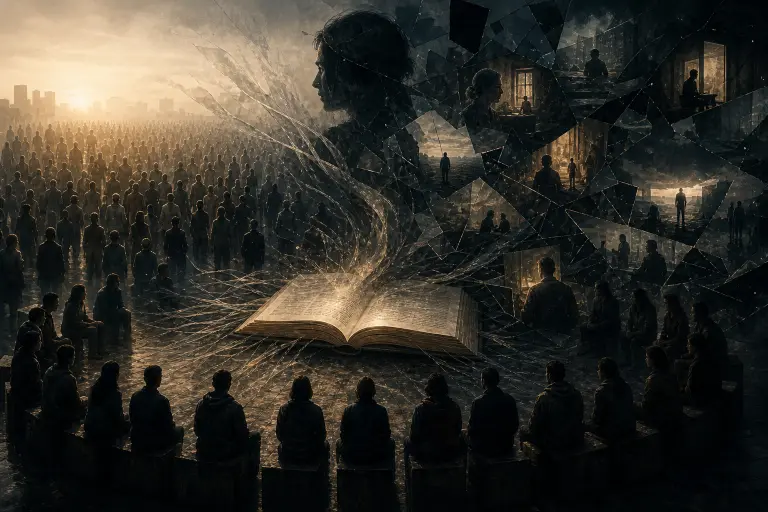
The Collective Voice as Narrative Structure
The use of the first-person plural—“we”—remains one of the least common yet most structurally significant narrative choices. It replaces the authority of an individual perspective with a shared consciousness, dissolving clear boundaries between narrator and community.
In Jeffrey Eugenides’ The Virgin Suicides, the story is told not by a single observer, but by a group. This collective voice reconstructs events from memory, speculation, and shared experience. The result is not clarity, but accumulation—multiple impressions layered into a single narrative presence.
What emerges is a voice that is both unified and unstable. It speaks as one, yet contains internal variation. Certainty is replaced by consensus, and even that consensus is fragile.
Narratives in Chorus
The collective voice functions like a chorus in classical drama. It observes, interprets, and sometimes judges, but it also reflects the limitations of group perception. Knowledge is partial, shaped by rumor, proximity, and shared assumptions.
In works associated with writers such as Aravind Adiga, the idea of collective perspective often extends beyond grammar into structure. Social systems, class dynamics, and communal identities shape how stories are told and understood. The narrative voice becomes inseparable from the environment that produces it.
This creates a layered form of narration in which individual experience is filtered through collective interpretation. Events are not simply described—they are socially processed.
Institutions such as the British Library, the Library of Congress, and scholarly archives like JSTOR document the evolution of narrative voice across literary traditions, revealing how collective narration has been used to represent social structures and shared consciousness.
The Dissolution of Individual Responsibility
One of the most striking effects of the collective voice is its ability to diffuse responsibility. When events are narrated by “we,” accountability becomes ambiguous. Actions are remembered, but their origins blur. Who saw what? Who acted? Who failed to intervene?
This ambiguity is not a limitation—it is the point. The narrative reflects the way societies often operate: responsibility is distributed, diluted, and sometimes obscured entirely. The voice that speaks is not accountable in the way an individual narrator would be.
As a result, the collective voice can produce a sense of inevitability. Events feel less like the result of individual choices and more like the outcome of shared conditions. The community becomes both witness and participant, shaping the narrative through its presence.
Social Pressure as Narrative Force
Because the collective voice emerges from a group, it carries the weight of social expectation. It reflects norms, assumptions, and unspoken rules. Characters within such narratives are not only defined by their actions, but by how those actions are perceived by the collective.
This creates a form of pressure that operates beneath the surface. The narrative does not need to state constraints explicitly; they are embedded in the voice itself. The “we” implies a standard against which deviation is measured.
In this sense, society becomes the true narrator—not as a background condition, but as an active force shaping interpretation.
Narrative Distance and the Question of Authority
If the collective voice redistributes perspective, the concept of narrative distance determines how authority is exercised. Historically, the omniscient narrator occupied a position of total knowledge. It could access every thought, interpret every action, and provide definitive judgments.
This “god-like” perspective offered stability. The reader could trust that the narrative would ultimately reveal truth, resolving ambiguity through authoritative insight.
In contemporary fiction, this model has become increasingly unstable.
The Decline of the Omniscient Voice
The traditional omniscient narrator has not disappeared, but its authority is often questioned or subverted. Readers are less inclined to accept a single, all-knowing perspective as neutral. Instead, such voices may be presented as partial, ideological, or even unreliable in their own right.
This shift reflects broader cultural changes. In a world marked by competing narratives and fragmented information, the idea of a single, authoritative truth has become difficult to sustain. Literature responds by decentralizing perspective.
The narrator no longer stands above the narrative as an unquestioned authority. It becomes one voice among many, subject to interpretation.
From Divine Observation to Human Limitation
Contemporary narratives often replace omniscience with limited observation. The narrator may have access to certain perspectives, but not all. Knowledge is constrained, incomplete, and sometimes contradictory.
This limitation produces a different kind of engagement. The reader must navigate uncertainty, recognizing that no single perspective can fully account for events. Truth becomes provisional, constructed through multiple viewpoints rather than delivered from above.
The shift from “divine” to “human” narration is not merely technical. It reflects a change in how knowledge itself is understood.

Subversion as Critique
In some works, omniscient narration is not abandoned but deliberately destabilized. The narrator may appear authoritative while subtly revealing its own biases or limitations. This creates a tension between what is said and what can be trusted.
Such strategies transform narration into critique. The voice that once guaranteed truth becomes an object of analysis, exposing the assumptions and structures that underlie its authority.
This approach aligns with a broader literary movement: the interrogation of power, not only within the story, but within the act of storytelling itself.
Why These Shifts Matter
The emergence of collective voice and the reconfiguration of narrative distance reflect a deeper transformation in literature. They signal a move away from singular authority toward distributed perspective. They recognize that experience is not uniform, and that truth cannot always be contained within a single voice.
These techniques expand the possibilities of narrative. They allow fiction to represent complexity not by simplifying it, but by structuring it into the act of narration itself.
The result is a form of storytelling that is less certain, but more responsive to the realities it seeks to engage.
Continue Exploring Narrative Voice
If you are interested in how perspective shapes storytelling, you may also explore our essays on unreliable narration, internal focus, and structural critique.
Readers drawn to deeper formal analysis may also revisit our long-form studies of narrative authority, multiplicity, and the relationship between voice and power in contemporary fiction.
Frequently Asked Questions
What is a collective narrator?
A narrative voice that speaks in the first-person plural, representing a group rather than an individual perspective.
Why use “we” instead of “I”?
To reflect shared experience, social dynamics, and the influence of collective perception on narrative events.
What is narrative distance?
The degree of separation between the narrator and the events or characters being described.
Is omniscient narration outdated?
Not entirely, but it is often reinterpreted or challenged to reflect contemporary skepticism toward absolute authority.
Reviewed for editorial quality, narrative precision, and analytical depth.
Conclusion: Voice Without Certainty
The evolution of narrative voice reveals a fundamental shift in how stories understand authority. The collective voice dissolves individuality into shared perception, while the transformation of omniscience reflects a broader uncertainty about truth itself.
Together, these strategies move fiction away from singular explanation and toward multiplicity. They acknowledge that reality is not experienced from a single vantage point, and that narrative must adapt to reflect that complexity.
In this landscape, the question is no longer who speaks with authority, but how authority is constructed, distributed, and ultimately questioned within the act of storytelling.

Bibliographic Foundation
This analysis was conducted under the Sanctum's methodological rigor, utilizing exegetical protocols grounded in universal heritage repositories and documented preservation archives.
View Authority FoundationsAnalytical Recommendations
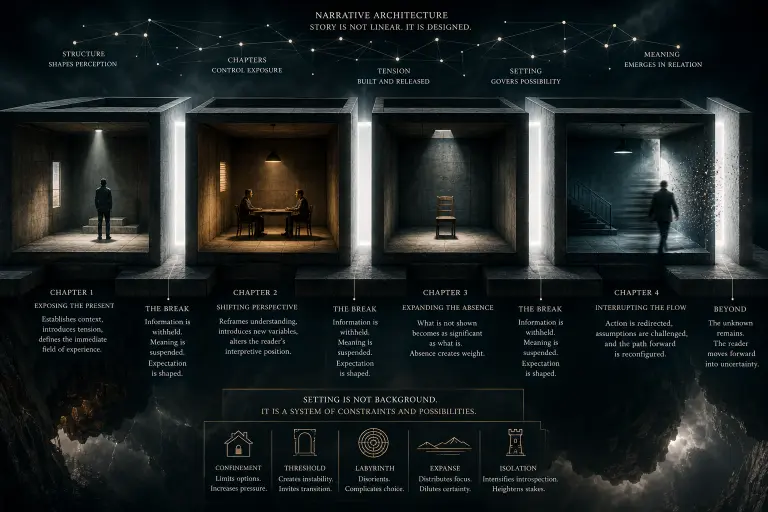
Controlled Exposures: The Active Mechanics of Chapter and Setting
Anovel is often discussed in terms of plot, character, or theme, yet two of its most decisive forces operate at a quieter structural level: the chapter and the setting. These are frequently mistaken for neutral containers—divisions of convenience or descriptive backdrops. In reality, they function as active mechanisms. They regulate the flow of information, shape perception, and determine how tension is built, released, and transformed. To read them closely is to see narrative not as a continuous stream, but as a sequence of controlled exposures.

The Lord of the Rings: Mythopoesis, Power, and the Theology of Hope
ew works of modern literature have constructed a moral universe with the depth and coherence of The Lord of the Rings. Frequently remembered for its epic battles, vast geography, and mythic gravitas, the narrative resists reduction to spectacle alone. Beneath its grand scale lies a disciplined ethical inquiry into power: how it seduces, how it corrodes intention, and how resistance often emerges not from heroic exceptionalism, but from ordinary fidelity to what is small, local, and fragile.

Contemporary Fiction and the Inheritance of Fragmentation: Narrative After Modernism
Few works of twentieth-century literature have achieved the rare balance of popular enchantment and intellectual endurance quite like The Chronicles of Narnia.