

A novel is often discussed in terms of plot, character, or theme, yet two of its most decisive forces operate at a quieter structural level: the chapter and the setting. These are frequently mistaken for neutral containers—divisions of convenience or descriptive backdrops. In reality, they function as active mechanisms. They regulate the flow of information, shape perception, and determine how tension is built, released, and transformed. To read them closely is to see narrative not as a continuous stream, but as a sequence of controlled exposures.
When understood with precision, the chapter becomes a microcosm of narrative logic, and the setting becomes an engine that governs possibility. Together, they reveal that storytelling is not only about what happens, but about how, where, and when the reader is allowed to know it.
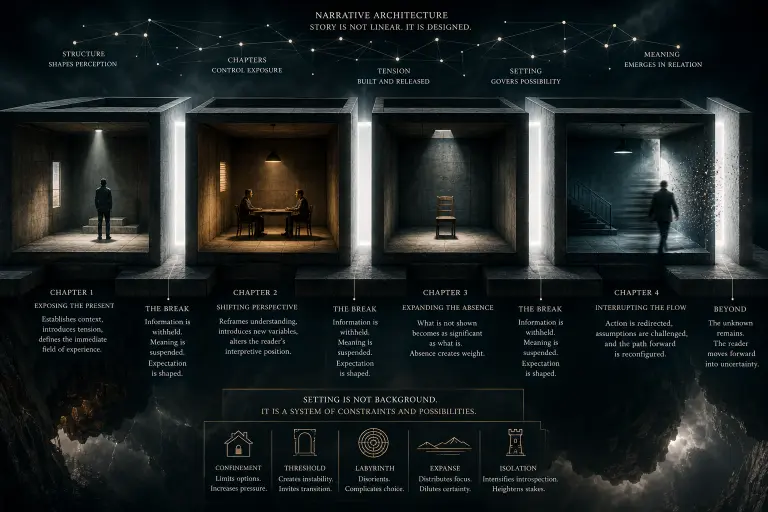
The Chapter as a Microcosm of Tension
A chapter is not merely a pause in reading. It is a unit of design—a contained arc with its own internal rhythm, escalation, and release. Within its boundaries, information is introduced, tension accumulates, and a temporary resolution or disruption occurs. The chapter ends not when pages run out, but when a specific structural function has been completed.
Seen this way, each chapter operates like a miniature narrative. It has an entry point, a transformation, and an exit that prepares the reader for what follows. This perspective shifts attention from length to function. A short chapter can carry immense structural weight if it reconfigures understanding. A long chapter can feel inert if it fails to generate movement.
The key lies in intentionality: what does this unit do to the reader’s perception?
Chapters as Cinematic Cuts
One of the most powerful uses of chapters is their ability to function as cuts—transitions that reframe what has just been read. Like cinematic editing, the shift from one chapter to the next can alter meaning without altering events. Perspective changes, temporal jumps, or withheld information can transform interpretation instantly.
A chapter may end with apparent clarity, only for the following one to reveal that clarity as partial or misleading. This is not contradiction—it is structural layering. The break between chapters becomes an active space where meaning is suspended, allowing reinterpretation to occur.
In this sense, chapters do not simply separate content. They create the conditions under which content can be re-seen.
The White Space Between Chapters
What happens between chapters is as important as what happens within them. The blank space—the pause, the transition, the moment of absence—acts as a site of controlled ignorance. The author decides what the reader does not see, and when that absence will be filled.
This is where narrative authority becomes most visible. Information can be delayed, fragmented, or redistributed. Events may occur off-page, forcing the reader to reconstruct them later. Emotional reactions may be withheld, creating distance that is only resolved retrospectively.
The chapter break, then, is not empty. It is a deliberate withholding of continuity. It shapes expectation by controlling access.
Archives and literary collections such as the British Library, the Library of Congress, and scholarly repositories like JSTOR preserve manuscript drafts that reveal how authors experiment with chapter divisions, rearranging sequences to refine the precise moment at which information is revealed or withheld.
Beyond Cliffhangers: Structural Suspension
Cliffhangers are often associated with action—moments of danger or uncertainty that compel continuation. Yet more sophisticated narratives use what might be called thematic cliffhangers. Instead of ending on physical suspense, they end on unresolved meaning.
A chapter may conclude with a statement, image, or realization that destabilizes interpretation. The tension lies not in what will happen next, but in what what has already happened now means. The reader moves forward not to resolve action, but to resolve understanding.
This form of suspension is less visible but more enduring. It engages the reader’s interpretive faculties, extending tension beyond immediate events.
Mirrored Chapters and Structural Echo
Another advanced technique involves mirrored or parallel chapters—sections that reflect each other across the narrative. These may repeat settings, motifs, or situations with variation, creating a sense of structural symmetry.
Such echoes do not simply reinforce themes. They create temporal depth. The reader perceives patterns across the narrative, linking moments that might otherwise remain isolated. Meaning emerges not from individual chapters, but from their relationship.
The chapter, in this case, becomes part of a larger architecture—one that operates across distance rather than within immediate sequence.
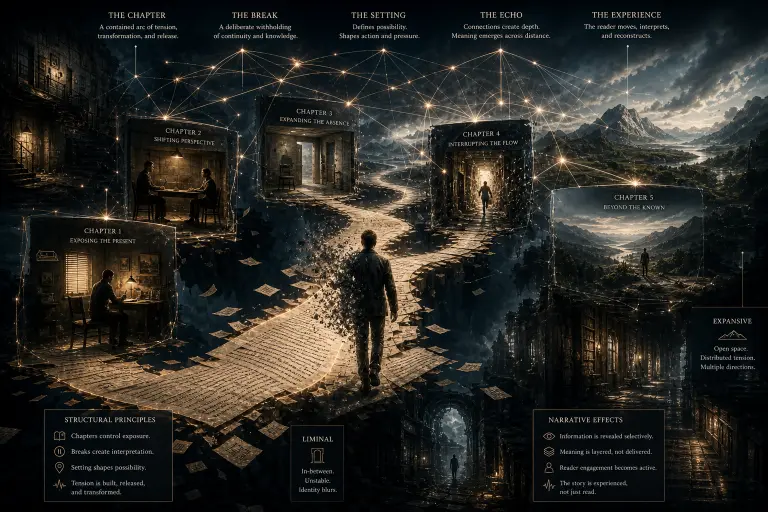
Setting as an Active Structure
If chapters regulate how information is delivered, setting regulates what is possible. It is not merely the location of events, but the system that constrains and enables them. Space defines movement, interaction, and the limits of action.
A confined setting—a single room, a house, an isolated island—compresses narrative possibilities. Characters cannot escape easily. Encounters become inevitable. Psychological depth intensifies because external distraction is minimized.
Conversely, expansive settings distribute attention. Movement becomes fluid, encounters less predictable, and narrative energy disperses across multiple locations. Each spatial configuration produces a different narrative rhythm.
Liminal Spaces and Narrative Instability
Liminal spaces—thresholds, corridors, transitional environments—introduce instability. They are neither fully one place nor another. This ambiguity allows narrative tension to emerge from uncertainty itself.
Characters in such spaces often experience disorientation. Boundaries blur. Identity becomes less fixed. The setting reflects and amplifies these conditions, turning physical environment into psychological extension.
The effect is subtle but powerful: space becomes a participant in narrative, not a passive container.
Confinement as Narrative Pressure
Some of the most intense narratives operate within highly constrained environments. A house, a train, a remote location—these settings create pressure by limiting escape. Every movement becomes significant because options are reduced.
Shirley Jackson’s The Haunting of Hill House exemplifies this principle. The house is not simply haunted—it is structured in a way that destabilizes perception. Its architecture produces disorientation, influencing how characters think and behave. The setting functions as an antagonist, not through direct action, but through spatial logic.
In such works, the environment dictates narrative progression. Events unfold not because characters choose them freely, but because the space makes certain outcomes inevitable.
When Setting and Plot Become Indivisible
In the most accomplished narratives, setting and plot cannot be separated. Change the environment, and the story collapses. This is the clearest indication that setting is functioning structurally rather than decoratively.
A narrative built around confinement cannot simply be relocated to an open landscape without losing its tension. A story dependent on social hierarchy cannot exist outside the system that produces that hierarchy. Space and structure are intertwined.
This indivisibility reveals a fundamental principle: narrative form is not abstract. It is grounded in material conditions—physical, social, and spatial.
Why These Elements Matter
Understanding chapters and setting as structural tools changes how narratives are read. It shifts attention from surface content to underlying design. The reader begins to see how meaning is constructed, not only what meaning is presented.
This awareness deepens engagement. It reveals the deliberate nature of narrative choices and the precision with which authors control perception, tension, and interpretation.
Reading becomes not only an act of following events, but of recognizing design.
Continue Exploring Narrative Structure
If you are interested in how structural elements shape storytelling, you may also explore our essays on pacing, non-linear narrative, and worldbuilding coherence.
Readers drawn to deeper formal analysis may also revisit our long-form studies of narrative architecture, spatial design, and the relationship between form and meaning in contemporary fiction.
Frequently Asked Questions
What is the function of a chapter in a novel?
It acts as a structural unit that organizes tension, controls information, and shapes how the reader interprets events.
Why are chapter transitions important?
Because they determine what is revealed or withheld, influencing how meaning evolves across the narrative.
How does setting influence plot?
By constraining or enabling actions, shaping character interaction, and determining the pace and direction of events.
Can setting act as an antagonist?
Yes. When its structure limits possibilities or creates pressure, it can function as an active force within the narrative.
Reviewed for editorial quality, structural precision, and analytical depth.
Conclusion: Structure as Invisible Control
The chapter and the setting reveal that narrative is not continuous, nor neutral. It is segmented, controlled, and shaped by decisions that often remain invisible to the reader. Chapters determine when knowledge is given or withheld. Settings determine what can or cannot occur.
Together, they form a system of constraints and releases—a dynamic architecture that governs how stories unfold. To recognize this is to move beyond surface reading and into structural awareness, where every break, every space, and every boundary carries meaning.
In that awareness, the novel becomes not just a sequence of events, but a precisely constructed experience—one in which form and content are inseparable.

Bibliographic Foundation
This analysis was conducted under the Sanctum's methodological rigor, utilizing exegetical protocols grounded in universal heritage repositories and documented preservation archives.
View Authority FoundationsAnalytical Recommendations

The Invisible Craft: Consistency and Coherence in Narrative Environments
Astory rarely announces the rules of its world outright. Instead, it teaches the reader how to see. A gesture here, a constraint there, a detail that seems incidental until it quietly proves decisive—these are the building blocks of immersion. What matters is not how much is explained, but how naturally everything holds together. When a narrative environment feels convincing, it is because its logic has been absorbed rather than declared, experienced rather than outlined.

1984: Power, Language, and the Architecture of Psychological Domination
Few novels have entered the cultural bloodstream with the enduring force of Nineteen Eighty-Four. Frequently invoked in political rhetoric and popular discourse, the book is often reduced to a set of familiar images: omnipresent surveillance, totalitarian authority, the erasure of privacy.

The Architecture of Wonder: Balancing Logic and Mystery in Worldbuilding
Every fictional world makes a demand on the reader long before its story fully unfolds. That demand is not only emotional or thematic—it is cognitive. To enter a constructed reality is to accept a system of rules, visible or hidden, that governs how meaning operates inside it. Some worlds explain themselves with rigorous precision, inviting the reader to understand their mechanics in detail. Others withhold explanation, allowing mystery to function as structure. Between these approaches lies a spectrum that defines how immersion is achieved and how curiosity is sustained.